

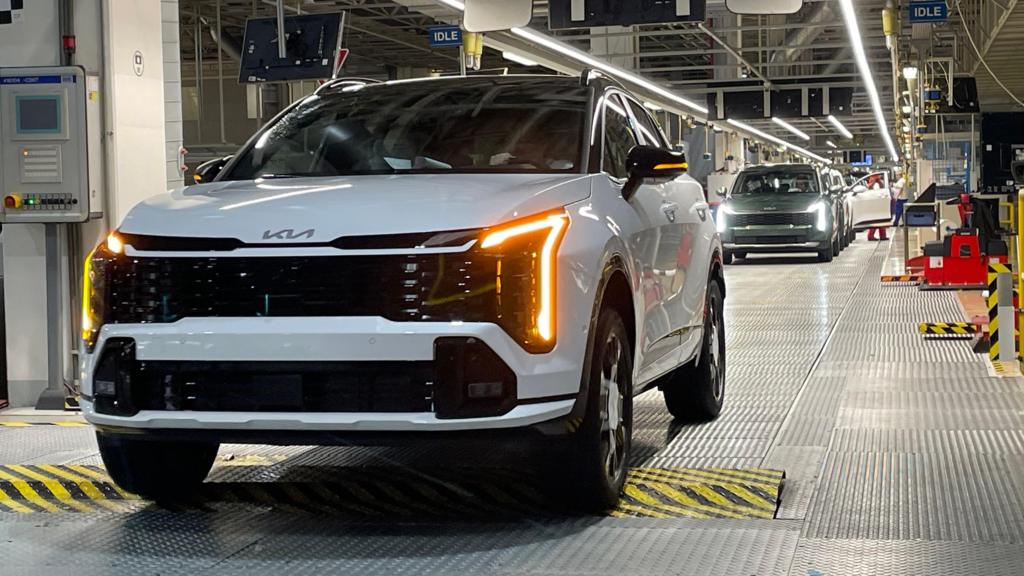
Nestled amidst snow-capped mountains, a sprawling factory witnesses the descent of steel car bodies onto its assembly line via a lift.
These frames, freshly welded by an impressive cohort of 690 robots, mark the beginning of the manufacturing process.
Subsequently, a dedicated workforce, clad in red trousers and white t-shirts, undertakes the transformation of these steel shells into fully realized vehicles.
At the culmination of this process, a completed car, its headlights signaling readiness, rolls off the assembly line every minute.
This is the European production hub of the South Korean automotive giant, Kia, strategically located just outside Žilina in northern Slovakia.
Kia reports this facility represents a substantial investment of €2.5 billion ($2.9 billion; £2.2 billion).
Slovakia’s automotive industry extends beyond Kia, with Volkswagen, Stellantis (formerly Peugeot-Citroen, Fiat and Chrysler), and Jaguar Land Rover also maintaining production facilities within the country. Furthermore, Volvo is slated to inaugurate an electric vehicle manufacturing plant in 2027.
This nation of 5.4 million inhabitants boasts an impressive output of nearly one million vehicles annually, surpassing all other countries in per capita car production.
“From a child, cars are my passion,” shares Marcel Pukhon, 48, an assembly line employee and one of the 3,700 individuals employed at the Kia plant.
“Now I am part of the team, and I can make the cars, so that’s something that’s a dream job.”
Before returning to his native Slovakia for this role, Marcel resided in Northern Ireland and England.
Further along the assembly line, within the door insulation sector, Simona Krnova, 23, shares her perspective. While acknowledging that this position doesn’t align with her initial aspirations following business studies, she recognizes its merits.
“Half of my family works here, so I wanted to try. I like the people,” she says.
Regarding compensation, her monthly earnings amount to €1,300, which she deems “Good compared to other companies,” with prospects for future increases. Kia reports an average monthly salary of €2,400 at the facility.
This figure notably exceeds the country’s average monthly salary across all sectors, which official figures indicate was €1,403 in 2023.
However, it remains significantly lower than the EU-wide average of €3,417.
Simona expresses pride in Slovakia’s robust automotive manufacturing sector, stating, “I like the fact that thanks to that, the production here supports our society.”
The Kia plant’s workforce is predominantly Slovakian, with a limited contingent of Korean senior managers residing in a purpose-built gated community on the outskirts of a nearby village.
In the era of the Czechoslovak Socialist Republic, Slovakian-produced vehicles were often characterized as substandard by Western standards, known for their noise, inefficiency, and sluggish performance.
However, following the Velvet Revolution of 1989, Volkswagen initiated investment in the Czechoslovak car manufacturer Skoda in 1991, ultimately acquiring full ownership by 2000.
Subsequently, other foreign automotive manufacturers began investing in the newly formed nations of the Czech Republic and Slovakia, established after Czechoslovakia’s separation in 1993.
Automotive industry expert Peter Prokop notes that labor costs in Slovakia at that time were just 20% of those in Germany.
Prokop, head of Give Management Consulting, a Munich-based firm specializing in automotive sector advisory services, emphasizes that Slovakia retains a substantial cost advantage.
“On one hand you still have lower wages,” he says. “I would say 60% of the Western wages. But you have also high productivity. So it’s definitely competitive.”
Further down the Kia assembly line, a machine responsible for installing air conditioning systems emits a snippet of Mozart’s music as a warning signal before moving into position. Notably, a significant proportion of the vehicles feature right-hand drive configurations, catering to the British market.
The UK indeed constitutes the largest market for vehicles produced at this facility, where Kia currently holds the position of fourth best-selling brand, trailing only VW, BMW, and Ford.
Spain, Italy, and Germany represent Kia’s next largest European markets.
Kia Europe’s chief executive, Marc Hedrich, underscores the advantageous central location of Slovakia for its car manufacturing industry. “Slovakia is really in the heart of Europe, quite well-connected to the big markets,” he asserts.
Slovakia’s substantial low-carbon energy production, encompassing hydroelectric, nuclear, and an expanding portfolio of renewable sources, further enhances the appeal of its electric vehicles, making them eligible for more substantial government incentives in markets like the UK’s Electric Car Grant.
The density of Slovakia’s automotive supply chain constitutes another crucial advantage, with approximately 360 companies supporting the industry. Mr. Hendrich emphasizes the critical nature of this “enormous” supplier base.
Kia has remained discreet regarding the specific incentives it received from the Slovak government to establish production in the country back in 2006.
However, Hedrich disclosed that the company secured a tax credit of €29 million for adapting its Slovak production lines to accommodate its new electric vehicles, representing part of a total investment of €108 million.
The Slovak government offers these incentives to automakers in recognition of the substantial benefits they bring to the country.
“There has been a huge decline in unemployment, and a significant increase in the economic strength of the Zilina region thanks to Kia,” states the city’s mayor, Peter Fiabane.
“Today, more than 20,000 people are directly employed by Kia and other companies that are linked to Kia by production.”
Hedrich also highlights the quality of the available workforce in Slovakia. At Žilina’s Technical School, 100 students participate in a Kia-sponsored “dual program,” alternating between academic studies and practical work at the factory.
Additionally, approximately 400 graduates from the University of Žilina secure employment within the automotive industry each year.
While Slovakia has emerged as a frontrunner, other former Eastern Bloc nations have also witnessed the establishment of factories by Western and Asian automakers. The Czech Republic hosts Hyundai, Toyota, and VW, while Poland is home to Toyota, Stellantis, and VW once again.
Furthermore, Audi, Mercedes-Benz, and Suzuki maintain facilities in Hungary, Ford and Renault operate in Romania, and Ford has a presence in Serbia. All are drawn to these locations by competitive wages, a strong industrial heritage, and a skilled workforce.
Hundreds of workers at the UK’s biggest EV battery plant could get a purpose-built housing campus.
Trump’s volatile trade policy has thrown the world economy into chaos, and put some US prices up.
The president wants to bring to the US tiny vehicles, like those commonly seen on the streets of Japan.
A host of technology is on offer to farmers, promising to raise farming yields and lower food prices.
The Nordic nation leads the way when it comes to both the design and construction of the vessels.