

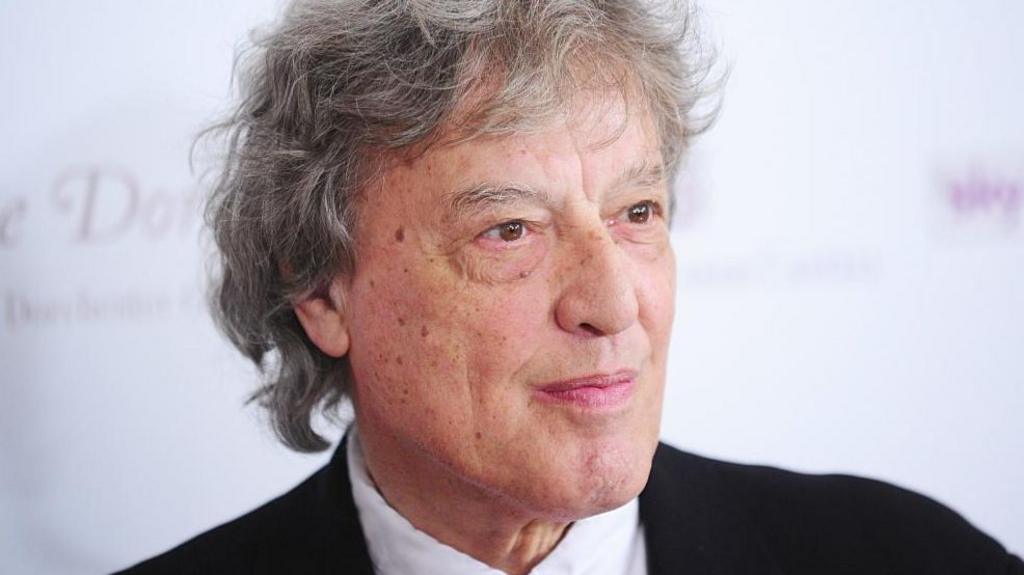
Sir Tom Stoppard, who passed away at the age of 88, stands as one of Britain’s most astute playwrights. Renowned for his witty and playful writing, he engaged with ideas earnestly and found joy in philosophical and political discourse.
Alongside his playwriting, he maintained a successful career as a sought-after script doctor in Hollywood, lending his talent to enhance numerous film scripts. He notably shared a Best Screenplay Oscar for his delightful contribution to “Shakespeare in Love.”
Stoppard distinguished himself as a writer who adeptly balanced an intellectual’s fascination with complexity and an entertainer’s knack for enjoyment.
Works like “Arcadia,” “Jumpers,” and his breakthrough piece, “Rosencrantz and Guildenstern are Dead,” occasionally faced criticism for a perceived lack of emotional depth, being deemed more style than substance.
His later works, however, showcased greater human empathy, though they were not always met with unanimous critical acclaim.
Stoppard’s distinctive qualities as a playwright perhaps stemmed from his unique background: a blend of Mitteleuropean intellectualism and self-deprecating, public-school educated English sensibilities.
Born Tomas Straussler on July 3, 1937, in Czechoslovakia, his Jewish father was a physician for the Bata shoe company. In anticipation of Nazi occupation, his parents fled to Singapore, where his father tragically died in a Japanese prison camp.
Tom, along with his mother and brother, escaped the Japanese invasion, initially finding refuge in Australia and later in India. There, his mother remarried an Englishman, Major Stoppard.
Stoppard began his career as a journalist, starting at the Western Daily Press in Bristol. His early success came in 1963 when his first stage play, “A Walk on the Water” (later renamed “Enter a Free Man”), was broadcast on ITV.
However, it was “Rosencrantz and Guildenstern are Dead” that truly catapulted him to fame, premiering at the Edinburgh Festival in 1966 and transferring to London’s National Theatre in 1967.
The play ingeniously placed two minor characters from Shakespeare’s “Hamlet” at the forefront, portraying them as baffled and bewildered by the seemingly arbitrary events unfolding around them.
It was a stroke of brilliance, reminiscent of Samuel Beckett but infused with superior wit.
He followed this success with a series of highly theatrical works, often centered on unexpected intellectual concepts or bizarre juxtapositions, characterized by brilliant dialogue, puns, repartee, double meanings, and misunderstandings.
“Jumpers” explored academic philosophy and gymnastics, while “Travesties” was set in Zurich during World War One, featuring Lenin, James Joyce, Dadaist Tristan Tzara, and alluding to Oscar Wilde’s “The Importance of Being Earnest”—plays to which Stoppard’s work was sometimes compared for their bright, brittle, and self-consciously clever style.
Later works, such as “Hapgood,” delved into espionage and quantum physics, and “Arcadia,” which explored mathematics, thermodynamics, literature, and landscape gardening, continued this trend. Stoppard often stated that he wrote plays as much to clarify his own thoughts as to explore pre-existing ideas.
His contributions extended to radio, with “If You’re Glad I’ll Be Frank” imagining the speaking clock as a real woman whose internal monologue starkly contrasted the monotonous repetition of automated time announcements. “Albert’s Bridge” told the story of a man painting a bridge, incorporating elements of philosophy and mathematics.
Over time, his writing evolved, becoming more serious, more political, and more empathetic.
“I slowly learned that plays work best if you let them have some blood heat, and not simply be exciting exchanges of witty ideas,” he shared with Joan Bakewell in a revealing 2002 interview.
“It’s the humanity of the characters that gives theatre the possibility of being great art.”
“Night and Day” addressed journalism and its purpose; “The Real Thing” explored love and infidelity, starring Felicity Kendal, for whom Stoppard left his second wife, Dr. Miriam Stoppard.
“Every Good Boy Deserves Favour” featured a symphony orchestra on stage alongside actors in a biting satire dramatizing the plight of Soviet dissidents confined to mental hospitals.
“I have no symptoms, I have opinions,” one patient declares.
“Your opinions are your symptoms. Your disease is dissent,” his doctor retorts, encapsulating the sort of paradox Stoppard relished exploring.
“The Coast of Utopia,” a sprawling trilogy about the 19th-century Russian liberal thinker Alexander Herzen, received a lukewarm reception at the National Theatre in London but achieved significant success in New York.
“Rock ‘n’ Roll” tackled the oppressive nature of the communist regime in Czechoslovakia.
His plays often displayed considerable erudition.
“I always wanted to know about a lot of things, but not particularly deeply,” he confessed to Joan Bakewell.
“I like facts, I like knowledge, I like having wide interests. There’s various ways of describing such a person, dilettante might be one way and polymath might be another.”
“To write a play at all I do have to get hold of that fix, that charge, that juice which comes from getting really, really interested in a small area – it might be a scientific thing, it might be a philosophical thing, it might be an historical thing – but a real unforced, uncontainable fascination for something, from which everything else then becomes a play.”
Sir Tom was also an accomplished screenwriter. Several of his plays, including “Professional Foul,” inspired by his involvement with the Czech dissident movement Charter 77, were initially written for television.
He adapted Jerome K. Jerome’s “Three Men in a Boat” for television, co-wrote Terry Gilliam’s dystopian fantasy “Brazil,” contributed significantly to the dialogue for “Indiana Jones and the Last Crusade” (though uncredited), and adapted works by John le Carré, Tolstoy, and Robert Harris for the screen. In 1998, he shared a Best Screenplay Oscar for his work on “Shakespeare in Love.”
He received a knighthood in 1997 and the Order of Merit in 2000. In 2014, he married his third wife, heiress and television producer Sabrina Guinness.
In his later years, he noted that the writing process did not become any easier.
“Each time I’m in this leaky boat I go through this ridiculous exercise of trying to remember how I got hold of the last play. And I never do remember,” he told one interviewer.
“I cannot remember now how I got into Rock’n’Roll, I wish I could, I’d do it again. But in the absence of anything to go on I just sort of read the papers, chat to people, hang about and worry about it before I go to sleep.”