

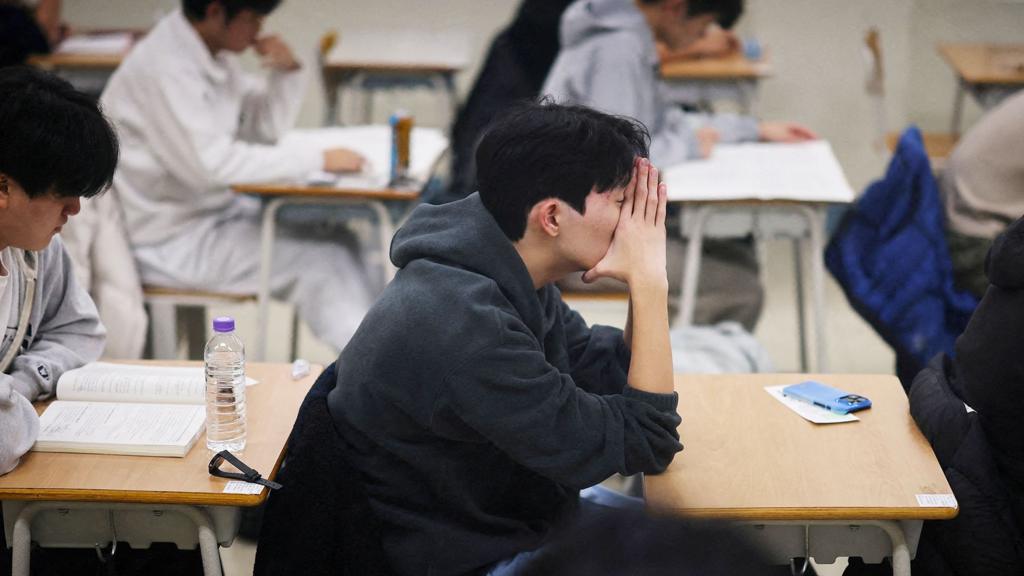
The English section of South Korea’s rigorous college entrance exam, known as the Suneung, is considered exceptionally challenging. Students have described it as akin to deciphering an ancient language, with some deeming it “insane.”
The intense criticism surrounding this year’s exam led to the resignation of the top official responsible for its administration, who took responsibility for the resulting “chaos.”
“We sincerely acknowledge the criticism that the difficulty of the questions… was inappropriate,” stated Suneung chief Oh Seung-geol. He added that the test “fell short” despite undergoing multiple rounds of review.
Among the most perplexing questions were one concerning Immanuel Kant’s philosophy of law and another that incorporated gaming terminology.
The latter, a three-point question, required students to determine the appropriate placement of a sentence within a given paragraph. The sentence is presented in bold, followed by the paragraph:
The difference is that the action in the game world can only be explored through the virtual bodily space of the avatar.
A video game has its own model of reality, internal to itself and separate from the player’s external reality, the player’s bodily space and the avatar’s bodily space. (1) The avatar’s bodily space, the potential actions of the avatar in the game world, is the only way in which the reality of the external reality of the game world can be perceived. (2) As in the real world, perception requires action. (3) Players extend their perceptual field into the game, encompassing the available actions of the avatar. (4) The feedback loop of perception and action that enables you to navigate the world around you is now one step removed: instead of perceiving primarily through interaction of your own body with the external world, you’re perceiving the game world through interaction of the avatar. (5) The entire perceptual system has been extended into the game world.
The correct placement is at position 3.
Numerous individuals have criticized the phrasing of this question and several others. One Reddit user described it as “fancy smart talking,” while another characterized it as “awful writing [that] doesn’t convey a concept or idea well.”
Students are allotted 70 minutes to complete 45 questions. Just over 3% of this year’s test-takers achieved the highest grade in the English section, a decrease from 6% in the previous year.
“It took me a long time to figure out [several questions], and understanding the texts themselves was tricky… [Some] answers looked similar to each other. So I was unsure until the last minute,” said Im Na-hye, a senior at Hanyeong High School.
However, English language professor Jung Chae-kwan argues that labeling the English test as simply “tough” is a misnomer.
“The texts aren’t necessarily impossible, but… maddeningly confusing. It’s a pain because it makes the material useless for actual education,” says Prof Jung, who previously worked at the institution that administers the Suneung and now teaches at Incheon National University.
“Teachers end up drilling test-taking hacks rather than teaching English… You don’t even really need to read the full text to get the points if you know the tricks,” he said.
Some have pointed out that several passages used in the questions are excerpts from books that have been extracted from their original context, making them difficult to comprehend. The passage above, for example, is taken from *Game Feel*, a game design guide by Steve Swink.
Others, however, believe that the test’s difficulty reflects its intended purpose.
“It measures students’ reading comprehension and whether they can handle the level of material they’ll encounter in university,” says Kim Soo-yeon, an English literature professor at Hankuk University of Foreign Studies in Seoul.
The passages chosen possess “some degree of specialization,” which allows the test to effectively assess these comprehension skills, she told The Korea Times.
South Korea’s Suneung, held annually in November, is a notorious eight-hour marathon of consecutive examinations that not only determines university admission but can also influence job prospects, income, and future relationships.
Students attempt approximately 200 questions across a range of subjects, including Korean, mathematics, English, and social and natural sciences.
Many teenagers dedicate their entire lives to preparing for these exams, with some attending private tutoring centers, often referred to as “cram schools,” from as early as age four.
The Suneung is a significant event for South Korea as a whole, bringing much of the nation to a standstill for a single day.
Construction is halted, flights are grounded, and military training is suspended to ensure an optimal testing environment.
Only four of the twelve Suneung chiefs since the exam’s inception in 1993 have completed their full three-year terms. While most resigned due to errors in test questions, Mr. Oh is the first to step down because of the perceived difficulty of the test.
Additional reporting by Hyojung Kim and Jake Kwon in Seoul
Kant was a strong defender of the rule of law as the ultimate guarantee, not only of security and peace, but also of freedom. He believed that human societies were moving towards more rational forms regulated by effective and binding legal frameworks because only such frameworks enabled people to live in harmony, to prosper and to co-operate. However, his belief in inevitable progress was not based on an optimistic or high-minded view of human nature. On the contrary, it comes close to Hobbes’s outlook: man’s violent and conflict-prone nature makes it necessary to establish and maintain an effective legal framework in order to secure peace. We cannot count on people’s benevolence or goodwill, but even ‘a nation of devils’ can live in harmony in a legal system that binds every citizen equally. Ideally, the law is the embodiment of those political principles that all rational beings would freely choose. If such laws forbid them to do something that they would not rationally choose to do anyway, then the law cannot be:
(1) regarded as reasonably confining human liberty (2) viewed as a strong defender of the justice system (3) understood as a restraint on their freedom (4) enforced effectively to suppress their evil nature (5) accepted within the assumption of ideal legal frameworks
If you’ve made it this far, the correct number is 3
In a matter of days, three big entertainers in South Korea have made headlines in separate scandals.
Seoul says it will “actively respond” to neighbouring countries’ activities in its air defence zone.
The woman claiming she was carrying the ex-Tottenham captain’s child and extorted $200,000 from him.
Critics have voiced concern over the pervasiveness of stalking and violence against women in South Korea.
The cameras were located in private homes, karaoke rooms, a Pilates studio and a gynaecologist’s clinic.