

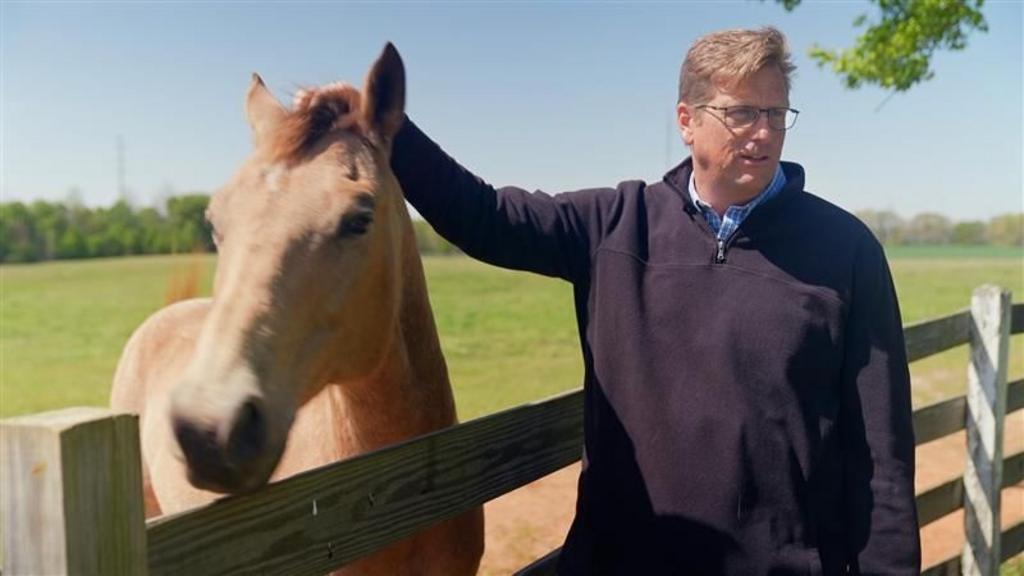
For months, Democrat Gareth Fenley and conservative John Miller, neighbors in a small Georgia town, have shared an unlikely common purpose.
Each morning, the pair drives down the rural roads, past farms, to an empty, gray warehouse spanning one million square feet.
Upon arrival, they meticulously check for any signs of construction, relieved each time the massive property appears untouched.
This sprawling industrial warehouse, acquired by the U.S. Department of Homeland Security (DHS) in February, is part of a $38.3 billion plan to establish numerous immigration detention centers across the United States.
However, these plans have encountered fierce opposition, not only in Democratic communities but also in conservative towns like Social Circle, which overwhelmingly supported Donald Trump in the last election – including his promise to deport millions of undocumented immigrants.
“People have different reasons for aligning with the exact same message,” Fenley stated. “That message is: ‘Detention center, not welcome here.'”
Many who support the former president’s immigration policies worry that the facility would deplete the small town’s critical resources by tripling its population, transforming a place once known for its quaint Blue Willow Inn buffet restaurant into a prison town.
In March, these concerns prompted City Manager Eric Taylor to shut off the water supply to the warehouse, a move that unexpectedly placed this one-stoplight town at the forefront of resistance to the administration’s plans.
“If you open up that water meter, it gives them full access to the entire supply of the whole city,” Taylor told the BBC. “I can’t let that happen without knowing what the ultimate impact is going to be.”
Now, the plans for a 10,000-person detention center appear to be on hold.
The department has also signaled a pause in plans to acquire more warehouses like the one in Social Circle – though the fate of facilities on which it has already spent millions remains unclear. DHS did not directly respond to a request for comment from the BBC regarding the Social Circle facility.
“As with any transition, we are reviewing agency policies and proposals,” a statement from the department said.
DHS canceled a scheduled meeting about the Social Circle warehouse, citing a planned “department review of processes” under new leadership, according to Taylor.
Residents are cautiously optimistic.
“We’re anxious to see what happens out of this review. They have already pulled the trigger on it. They have already bought the building, so there’s going to be some effects no matter what’s done or not done,” Miller said.
“We’re still whispering up the chain as much as we can to make sure that if they are indeed reviewing it, we can give input.”
In the center of Social Circle stands a replica of a well, a tribute to the town’s origins, dating back to 1832. A plaque recounts how a group of men, enjoying “their usual drink” around a well, invited a passing stranger to join them. “This is surely a social circle,” the stranger replied.
Nearly 200 years later, Social Circle’s wells are at the heart of residents’ fight against ICE. They contend that the town’s water system – serving 5,000 people – has faced problems for decades, and the ICE facility would demand far more than the fragile system could provide.
Taylor, the city manager, explained that the town is permitted to draw only one million gallons of water daily from the Alcovy River, south of the town, and during the summer, the town uses about 800,000 gallons at least. ICE has stated that the facility alone would require one million gallons per day.
Taylor said he informed the agency as soon as an application for water service was filed that he would not turn it on.
“I told them at that time that there was a lock on the water meter, and it was there until we had a better understanding of what the impact was going to be on our water.”
Miller, whose 50-acre horse farm sits across the road from the Social Circle warehouse, asserted that officials had not conducted due diligence on selected locations.
“It’s the same story over and over,” he said. “Communities weren’t informed. They weren’t consulted.”
“I understand the why, but I just don’t understand how they’re handling it.”
Miller said federal officials have suggested several solutions, including either digging a well on the warehouse property or trucking in a million gallons of water daily.
However, the father of seven said drilling new wells could deplete the well he uses to nourish his horses, chickens, barn cats, and dogs.
Bringing in gallons of water on Social Circle’s two-lane roads poses problems too. “That’s six or seven trucks every hour, 24 hours a day,” Miller said.
DHS did not directly respond to a list of questions from the BBC inquiring about how it would address the water supply.
Taylor also expressed concern about the town’s aging sewage systems, established in 1962 and in need of replacement for 20 years, he said.
“Where’s the sewage supposed to go?” he asked. “We don’t have the capacity to support a million gallons of sewer coming off that site.”
Residents in Social Circle have been fighting the ICE facility since discovering, through a Washington Post report last December, that the warehouse was one of 23 sites earmarked to become detention centers.
They quickly appealed to the government and their federal representatives, arguing they lacked the resources for the facility – but ICE still purchased it in February for nearly $130 million – more than four times its initial estimated worth.
Since then, Miller, Fenley, and others have led the charge to slow the project, holding protests and meetings with hundreds of concerned residents. Georgia’s Democratic Senator Raphael Warnock visited the facility, and his office participated in a briefing with ICE officials, but “many questions remain unanswered,” a spokesperson said.
Other communities tapped for similar projects have also fought back.
In Michigan last week, the state sued to block DHS from converting a warehouse into an ICE facility in Romulus, arguing it was too close to residential neighborhoods and schools and posed a flooding risk. New Jersey and Maryland have also sued to halt ICE projects, while residents in Merrimack, New Hampshire, successfully lobbied elected officials to stop a facility in town.
For some Social Circle residents, their opposition is not only a question of resources but of human rights.
Fenley said she and other Democrats in town were concerned about having people “warehoused in a place that was not built for human habitation.”
She worries about reports of people being abused in detention centers. At least 13 immigrants died in ICE custody from January 2026 through early March, according to ICE, while civil rights groups have said immigrants are being subjected to unsafe conditions such as a lack of food, overcrowding, and medical neglect.
Others raised alarms not only for those inside the facility but the community around it.
“We have one high school, one zip code, one grocery store, one stoplight. And we are going to triple the size of our town,” said Valerie Walthart, who works on a veterinary farm down the road from Miller. “We’re going to be overwhelmed.”
Walthart added that as a mother, she was concerned about safety, with a detention facility perched just a five-minute drive from the local elementary school.
“It’s unnerving,” Joy Coker, a mother of three in the area, said of the warehouse’s location.
Social Circle’s Republican Representative Mike Collins has also publicly opposed the ICE project.
“Although I am aligned with the mission of ICE to detain and deport the criminal illegal aliens who have flooded across our border due to Joe Biden’s reckless policies, I agree with the community that Social Circle does not have the sufficient resources that this facility would require,” he wrote.
Rick Cook, a resident of neighboring Monroe, said he wasn’t in favor of the facility but believed the U.S. had to clamp down on illegal immigration. He said he and others in his Social Circle church hoped to provide religious counseling to immigrants held in the facility.
“It’s going to be what it’s going to be, and we’re going to try to find the ways to make the best with whatever happens,” he said.
To Steven Williford, the owner of a cattle farm in Social Circle who voted for Trump, ICE is a “necessary evil.” But he couldn’t believe the news when he learned the detention center was coming to his hometown.
“I just thought it was crazy to put something like that in this community, with no forethought, no prior authorization, not even asking the community,” he said.
“I’m all for doing what’s best for the country, but is it best for this community?” he added. “That’s the question.”
Miller said he understood why some would be confused by the Republican town’s reaction. He said detention facilities were necessary to detain people so they could be guaranteed due process.
“You can’t say that it’s something that’s needed and then not be somewhat willing to allow a facility to be there,” he said.
But, he said, realistically, no community wants such a facility tarnishing the reputation of their town.
“I miss the days we were known for the Blue Willow Inn,” he said, referencing the famous buffet restaurant that closed during Covid, once visited by celebrities including actress Helen Mirren.
“Now,” he said, “we’re going to be known as Georgia’s greatest little detention center.”
Some residents had been hoping that a change in federal leadership would put the warehouse plans on pause. The former president fired his Homeland Security Secretary Kristi Noem at the beginning of March, after backlash for the administration’s immigration crackdown in Minneapolis earlier this year, when federal agents shot dead two U.S. citizens.
The president nominated Senator Markwayne Mullin to take her place, which was followed by DHS signaling it may be rethinking its plans.
In its statement to the BBC, DHS referenced remarks from Mullin’s confirmation hearing:
“We got to protect the homeland and we’re going to do that, but obviously we want to work with community leaders,” he said in March. “We want to be good partners.”
Social Circle’s facility was originally slated to open in April, but work appears to have stalled. The agency has yet to award a contract for the warehouse or begin the massive construction needed to convert the bare warehouse into a sprawling court facility, complete with holding areas, gyms and recreational spaces, court facilities, cafeterias and even a gun range.
Residents have been thrilled about the potential pause, including Walthart, who said the decision gives locals “a little time to breathe, since we wake up nearly every day wondering if today will be the day the trucks start rolling in.”
“We can enjoy our small town life,” she said, “for at least a little while longer, we hope.”
Two men have been arrested over the shooting of a seven-month-old baby in Williamsburg.
Iran rejected Donald Trump’s ultimatum for a deal to re-open the Strait of Hormuz whose closure has led to a spike in oil prices.
The niece and grand-niece of Qasem Soleimani are in the custody of US Immigration and Customs Enforcement, officials said.
The pilot of the downed jet has been safely rescued, but a search and rescue operation is still under way for the jet’s second crew member, US media reports.
US and Iranian forces are searching for a missing American crew member after a US warplane was shot down.