

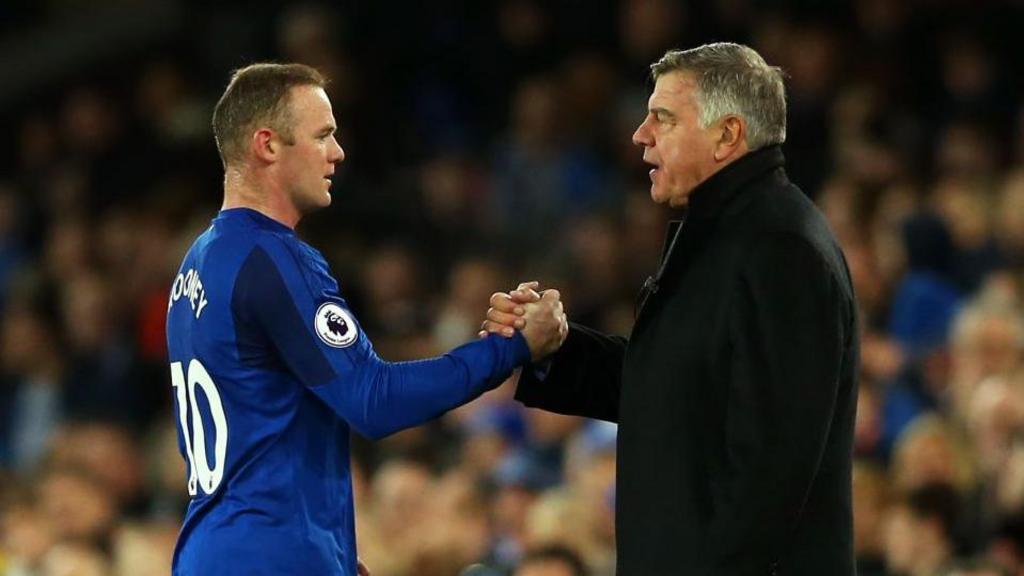
Wayne Rooney played under Sam Allardyce at Everton from 2017 to 2018.
Sam Allardyce is often characterized as an old-school coach who simplified football, but he was once regarded as an innovator, embracing novel management techniques.
Drawing inspiration from American Football and pioneering the use of sports science long before it became commonplace, his methods left a lasting impact on players who would later become managers themselves.
Wayne Rooney, the former England and Manchester United captain, is among those influenced by Allardyce. In a recent podcast episode, Rooney revealed how Allardyce’s approach shaped his own coaching philosophy during the twilight of his playing career.
“When I was with Sam [at Everton between 2017 and 2018], being older, I knew I wanted to transition into coaching,” Rooney stated on The Wayne Rooney Show.
“I was observing [Allardyce] more closely, taking in his methods and how he operated as a manager.”
The Wayne Rooney Show
Allardyce’s coaching style was significantly influenced by his time playing in America during the mid-1980s.
“A lot of my ideas came from the NFL in America when I played for the Tampa Bay Rowdies,” he explained.
“I observed the NFL players’ pre-season training and the staff’s operations, which had a profound effect on me.
“By the time I became a manager, I was experimenting with different approaches at various clubs in the lower divisions to gain experience. I would test out innovative methods.”
Allardyce’s tenure at Bolton, from 1999 to 2007, stands out as one of his most successful managerial spells.
During his early years at the club, he pioneered the introduction of sports science, data analysis, nutrition plans, and recovery methods, making him one of the first coaches to do so in English football.
“I wanted staff who could identify innovations that were currently absent in football,” he added.
“We divided the team into departments and tasked each head with developing their own strategies to achieve our goals.
“This encouraged them to explore new equipment, sports, and nutritional approaches, such as the use of electrolytes and protein, as well as recovery methods like ice baths. We even had the first cryotherapy unit in the country.”
Both Allardyce and Rooney emphasized the importance of unity and collective buy-in from players and staff for achieving success.
While players often receive the most recognition, Allardyce and Rooney stressed the importance of acknowledging the contributions of those working behind the scenes.
“When I captained England, I once sent all the England staff to Las Vegas and paid for their expenses,” Rooney recalled.
“I also arranged two pool parties for them. When players do things for the staff, it makes a significant difference.”
Allardyce added, “We called the staff the team behind the team.
“We’re all one team, but the team behind the team provides essential support.
“The players would often show their appreciation to the staff at Christmas, as they weren’t earning substantial salaries.”
Allardyce particularly valued the role of player liaison officers.
“We had two player liaison officers, one male and one female,” Allardyce noted. “They played an indispensable role.
“They arranged housing, mortgages, and bank accounts. They were the ones who received late-night calls and picked me up from the airport.
“They played a crucial part, organizing Christmas parties for the children and handling various other responsibilities.”
In addition to building relationships with staff, maintaining a good rapport with a club’s owner is essential for a manager, though Allardyce believes this has become more challenging in modern football.
“The problem now is that you rarely interact with the owners directly, instead dealing with their employees at the football club,” he observed.
“[At Crystal Palace], after losing to Sunderland in a relegation battle, [owner] Steve Parish stormed into my office, expressing his frustration, as he and I often did. I encouraged him to address the dressing room himself, as he is a true Crystal Palace fan and owner.
“It was an unforgettable 20 minutes. I wish we had recorded it.”
Rooney, who has managed clubs such as Birmingham City and Plymouth Argyle with overseas-based owners, acknowledged the difficulty of not being able to engage in face-to-face conversations.
He added, “The challenge now is that many owners reside abroad, limiting interactions to phone calls, which lacks the personal connection. Bill Kenwright, the chairman [at Everton], demonstrated his passion for the club, for better or worse, which I believe is crucial.
“I experienced this with Simon Hallett at Plymouth, who lived abroad but was deeply committed to the club’s success, and with Tom Wagner at Birmingham. However, building that relationship over the phone is challenging.”
Follow your club with BBC Sport
Listen to the latest Football Daily podcast
Get football news sent straight to your phone
Comments can not be loaded
To load Comments you need to enable JavaScript in your browser