

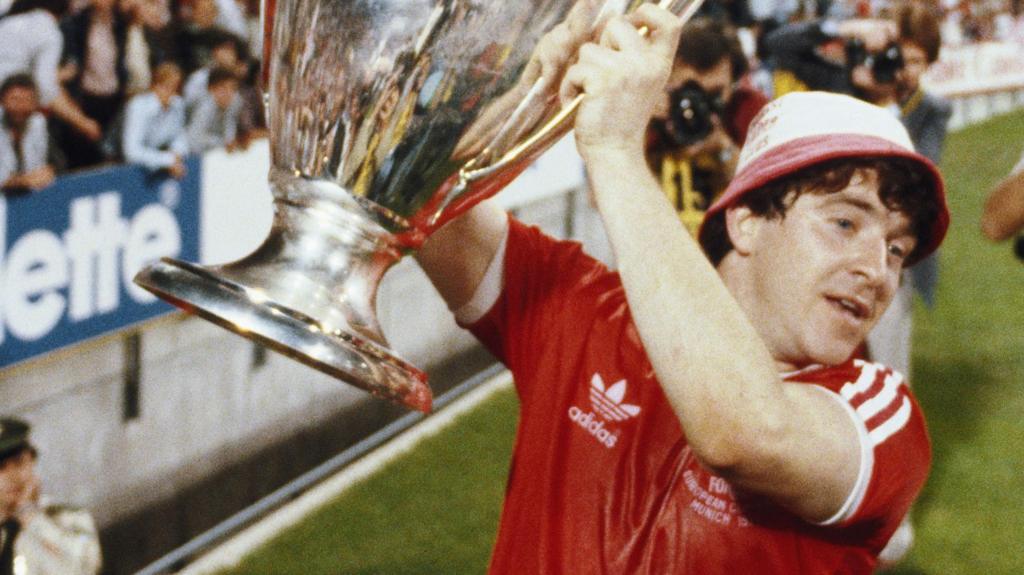
Robertson secured back-to-back European Cup titles with Nottingham Forest in 1979 and 1980.
John Robertson, who has died at the age of 72, was famously hailed as “the Picasso of our game” by legendary Nottingham Forest manager Brian Clough.
Robertson had been withering at the City Ground until Clough’s arrival in January 1975, which unlocked the intellect and skill concealed behind the Scot’s often disheveled appearance, leading to remarkable success with Forest’s celebrated team of the late 1970s and early 1980s.
The left-winger was largely considered the most vital player on a team that clinched the First Division title and the League Cup in their debut season following promotion in 1977-78.
Incredibly, this was just the beginning.
Forest followed this by achieving the even greater accomplishment of winning the European Cup in 1979 against Malmo, with Robertson delivering the precise cross for Trevor Francis’ decisive header. They then retained the title the following year, with Robertson’s goal securing victory over SV Hamburg at the Bernabeu in Madrid.
Robertson was also central to the acrimonious split between Clough and his longtime managerial partner Peter Taylor in 1983.
Clough never forgave Taylor, who was then managing Derby County, for signing Robertson on a transfer, with the fee to be determined by a tribunal, without informing him of his intentions.
To Clough’s deep regret, the rift was never resolved before Taylor’s death in 1992 at the age of 62.
Clough often jokingly remarked on Robertson’s unkempt look and was aware of his smoking habit, but he considered it a worthwhile trade-off for the magic he produced with his two-footed brilliance, precise crossing ability, and knack for scoring critical goals.
This video can not be played
‘An unbelievable feeling to play for Scotland’
Robertson represented Scotland at the schoolboy and youth levels before joining Forest as a teenager in 1970. He struggled to make an impact until Clough’s appointment, but the astute manager recognized potential worth cultivating.
In his autobiography, Clough wrote: “Rarely could there have been a more unlikely looking professional athlete… scruffy, unfit, uninterested waste of time… but something told me he was worth persevering with and he became one of the finest deliverers of a football I have ever seen.”
He also noted: “If one day, I felt a bit off colour, I would sit next to him. I was bloody Errol Flynn in comparison. But give him a ball and a yard of grass, and he was an artist, the Picasso of our game.”
Clough was idolized by Robertson, who stated: “I knew he liked me but I loved him. I wouldn’t have had a career without him.”
Robertson participated in 243 consecutive games between December 1976 and December 1980, and despite the acquisitions of prominent players like England goalkeeper Peter Shilton and Francis, Britain’s first £1 million footballer, he was the player who made Forest function seamlessly.
Despite the talent elsewhere, Robertson served as Forest’s linchpin.
During Forest’s first season back in the top flight under Clough in 1977-78, Robertson not only played a crucial role in securing the title, but he also scored the winning penalty against Liverpool in their League Cup final replay at Old Trafford.
Robertson’s importance was recognized not only by Clough, with former teammate Martin O’Neill commenting: “He was the most influential player in Europe for maybe three-and-a-half to four years.”
Additionally, Forest’s captain under Clough, John McGovern, declared: “He was like Ryan Giggs but with two good feet.”
All this occurred despite Robertson’s own admission that he lacked pace and tackling ability.
Clough, however, was unconcerned with Robertson’s shortcomings, preferring to grant him the freedom to focus on his strengths. It was the quintessential footballing synergy between manager and player: two unconventional figures operating in harmony.
In a notable interview prior to the 1980 European Cup final against Hamburg, whose squad included England captain Kevin Keegan, Clough was questioned about the possibility of their formidable German right-back Manfred Kaltz neutralizing Robertson.
“We’ve got a little fat guy who will turn him inside out,” Clough responded. “A very talented, highly skilled, unbelievable outside-left.”
Robertson became a trusted member of former Nottingham Forest team-mate Martin O’Neill’s backroom staff at several clubs
This proved to be the case, with Robertson delivering an outstanding performance, deciding the game after 20 minutes by cutting inside to exchange passes with striker Garry Birtles before beating Hamburg goalkeeper Rudi Kargus with a right-footed shot from 20 yards.
Robertson claimed the First Division title, two European Cups, and two League Cups with Forest, making 386 appearances and scoring 61 goals, before his contentious move to rivals Derby.
The transfer is remembered more for the irreparable damage it caused to the relationship between Clough and Taylor than for Robertson’s accomplishments. He was past his peak, and a return to Forest in August 1985 proved unsuccessful.
Robertson earned 28 caps for Scotland, representing his country in two World Cups in 1978 and 1982.
He scored eight goals for his nation, including what he described as his “greatest ever goal,” the winning penalty in a 1-0 victory over England at Wembley in the 1981 Home International Championship, and another in the 5-2 triumph over New Zealand at the 1982 World Cup in Spain.
In later years, Robertson was a vital member of former Forest colleague O’Neill’s backroom staff, joining him during his managerial spells at Wycombe Wanderers, Norwich City, Leicester City, Celtic, and Aston Villa.
However, it is for his brilliance under the guidance of the mercurial Clough at the City Ground that the winger, whom teammates described as “pure genius,” will be forever remembered.
John Robertson
Latest Nottingham Forest news, analysis and fan views
Ask about Nottingham Forest – what do you want to know?