

“`html
Rob Reiner, who has reportedly passed away alongside his wife, Michele, was a prominent figure in Hollywood as a celebrated filmmaker.
He initially gained recognition as an actor on the 1970s sitcom *All in the Family*, before later appearing as the father of Leonardo DiCaprio’s character in *The Wolf of Wall Street*.
However, Reiner is best remembered for his directorial work, helming a series of acclaimed films across various genres throughout the 1980s and 90s. These include the cult mockumentary *This Is Spinal Tap*, *When Harry Met Sally*, *A Few Good Men*, *The Princess Bride*, *Stand By Me*, and *Misery*.
Here’s a look back at his life and career through the lens of some of his most beloved movies.
Following his acting role on *All in the Family*, where he twice won the Emmy Award for best supporting actor for his portrayal of Michael “Meathead” Stivic, a 1960s hippie, Reiner shifted his focus to directing, starting with the 1974 TV movie *Sonny Boy*.
His breakthrough success came with the 1984 mockumentary *This Is Spinal Tap*, which chronicled the fictional exploits of a British heavy metal band.
Created in collaboration with comic actors Christopher Guest, Harry Shearer, and Michael McKean, Reiner himself played documentary filmmaker Marty DiBergi.
Much of the film’s deadpan dialogue was improvised, and it became a cult classic, popularizing phrases such as “turn it up to eleven.”
Reiner told the BFI in 2022 that DiBergi was inspired by Martin Scorsese’s work on the concert film *The Last Waltz*.
“A lot of it is,” he said. “He had put himself in *The Last Waltz*, and I thought, ‘That’ll be the way I’ll do it.’ When he first saw it, he was a little upset I was making fun of him, but now, over the years, he loves it. He’s come to love it.”
Reiner once recounted that Sting had seen *This Is Spinal Tap* 50 times, commenting, “Every time I watch it, I don’t know whether to laugh or cry.”
Just a few months ago, Reiner reprised his role as DiBergi in *Spinal Tap II: The End Continues*, which he also directed.
In 1986, he directed the coming-of-age classic *Stand by Me*.
Adapted from a Stephen King story, the film follows a group of young friends in Oregon in 1959 who embark on a two-day journey to find the body of a missing boy.
The film, which explores the bittersweet transition from childhood innocence to adulthood, helped launch the careers of actors such as River Phoenix and Kiefer Sutherland.
Reiner told the Armchair Expert with Dax Shepard podcast: “This one meant the most to me because it was the first time I ever did anything that was so far afield from anything my father [US comic actor and writer Carl Reiner] would have done.
“This was the first time that it was something really reflective of my personality – it had humour in it but it also had some melancholy and nostalgia, and so I thought, this is really the kind of thing I want to do.”
His next hit was the 1987 fantasy fairy tale *The Princess Bride*, based on a novel by William Goldman.
It featured actors Robin Wright, Cary Elwes, and Billy Crystal, as well as André the Giant, in a world of adventure, romance, and satire.
Reiner once recounted a story of a woman who claimed the film saved her life. She and several other skiers were trapped by an avalanche, and she recited every line from the movie to keep herself and everyone else awake.
Lines such as: “As you wish“, “Inconceivable” and “Life is pain, Highness. Anyone who says differently is selling something“.
“That was the best line I ever got – ‘The Princess Bride saved my life’,” Reiner told Variety.
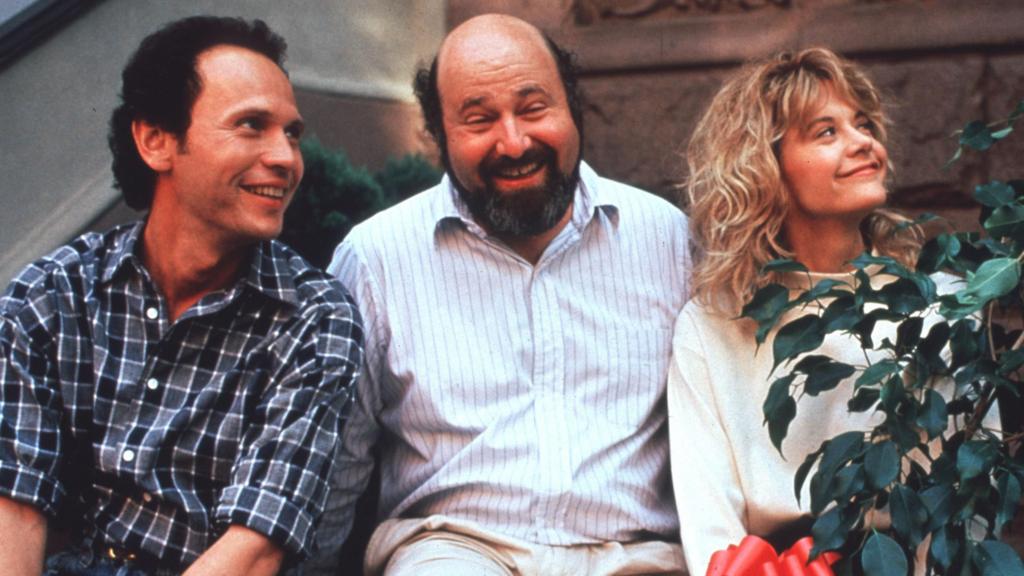
In 1989, Reiner established a benchmark for the romantic comedy genre with *When Harry Met Sally*.
The film paired Billy Crystal with Meg Ryan as two friends who fall in love, culminating in one of Hollywood’s most iconic restaurant scenes.
After Ryan’s Sally fakes an orgasm to prove a point, it prompts another customer, played by Reiner’s mother Estelle, to declare: “I’ll have what she’s having!“
Sydney Sweeney recently delivered the line in a Hellmann’s Super Bowl commercial, which served as a nostalgic parody of the film.
While directing the film, Reiner met photographer Michele Singer, with their encounter influencing his decision to change the film’s ending.
He told Ted Danson’s Where Everybody Knows Your Name podcast: “We started seeing each other during [the making of] this film, and one thing led to another and, you know, I changed the ending of the movie.
“I didn’t figure I was ever going to be with anybody, I couldn’t figure out how to be with anybody, and I had it where Harry and Sally don’t get together. They run into each other in New York, they talk a little bit and then they walk in opposite directions.
“But I meet Michele and I said, ‘Well, I see how this works’, and I changed it. I reshot the ending where you see Billy running and seeing Meg at the New Year’s Eve party.”
Reiner and Singer soon married, and they had three children together.
He was previously married to actress and director Penny Marshall in 1971, adopting her daughter, actress Tracy.
The director’s work took a darker turn in 1990 with *Misery*, another adaptation of a King novel.
It starred Kathy Bates as Annie Wilkes, a crazed woman who imprisons her favorite writer, played by James Caan.
Bates won the best actress Oscar for her chillingly humane performance.
During an appearance at San Diego Comic-Con earlier this year, Reiner recalled having a feeling that *Misery* might be the only thriller he would ever direct.
“But I studied Hitchcock,” he said. “I studied every thriller I could to see what is the grammar for film thrillers. ‘Cut to the insert of the key.’ ‘The foot hits the ground.'”
Bates, who was primarily a theatre actor at the time, feared she had ruined her big screen audition. However, her director did not share her concerns.
“She read, like, two lines, I think, two or three lines, and I said, ‘That’s enough, you can do this,'” Reiner said, according to Entertainment Weekly. “She was like, ‘What do you mean?’ I’m cutting her off. I’m like, ‘No, no, you can do this, I know you can do it.’
“And she went, ‘Really?'” he continued. “And as she walked out of the room, she said, ‘Can I call my mother?'”
The 1992 courtroom drama *A Few Good Men* concerned the court martial of two marines for the death of a fellow soldier.
It featured Reiner directing Hollywood stars Tom Cruise, Demi Moore, and Kevin Bacon, as well as Jack Nicholson.
Nicholson played a colonel who, while testifying, delivered the iconic line: “You can’t handle the truth!”
The actor enjoyed delivering the line so much that he continued to do so with enthusiasm even during every off-camera take when Reiner was filming Cruise’s character’s reaction.
“Every time we did the scene, Jack did it perfectly,” Reiner laughed. “After a couple of takes, I said, ‘Jack, maybe you want to save a little bit for when we’ve got the camera on you.’ And he replied, ‘Rob, you don’t understand – I love to act.'”
The film received an Oscar nomination for best picture.
Beyond his film work, Reiner was also known for his political and social activism, frequently speaking out on issues ranging from climate change to gun control.
Speaking to BBC Radio 5 live on Monday, LA-based entertainment journalist K.J. Matthews described him as “a big-hearted genius behind so many of the classic stories we love.”
“So many people have been touched by him and his generosity,” she noted.
“He was really known for speaking up for members of the LGBTQ community, [and] trying to help lower income people in various neighborhoods in Los Angeles.
“So he wasn’t just a figure in front of the camera and producing and known for giving us great films throughout the years… He really was a humanitarian.”
Reiner actively campaigned for early childhood education and healthcare, as well as LGBTQ+ rights.
His filmography also includes *North* (1994), starring Elijah Wood, *The American President* (1995), starring Michael Douglas and Annette Bening, and *Ghosts of Mississippi* (1996), a film about the trial of Byron De La Beckwith, who murdered civil rights activist Medgar Evers.
Following several commercial failures, the filmmaker returned to form with *The Bucket List* (2007), starring Nicholson alongside Morgan Freeman as two terminally ill men who set out to fulfill their life ambitions before they die. It helped popularize the now-common phrase “bucket list.”
In 2015, the semi-autobiographical *Being Charlie*, co-written by Reiner’s son Nick, explored the complex relationship between a young man struggling with addiction and his father.
Two years later, Reiner directed and appeared in the 2017 film *Shock and Awe*, which followed a group of reporters covering the US invasion of Iraq in 2003.
He also portrayed the father of Zooey Deschanel’s character in *New Girl* and versions of himself on TV shows like *Hannah Montana*, *Wizards of Waverly Place*, *30 Rock*, and *Happyish*.
Reiner, who also appeared as a movie studio executive in the 2020 miniseries *Hollywood*, once said: “If you are a creative person, you try to create things that are an extension of yourself.”
“`