

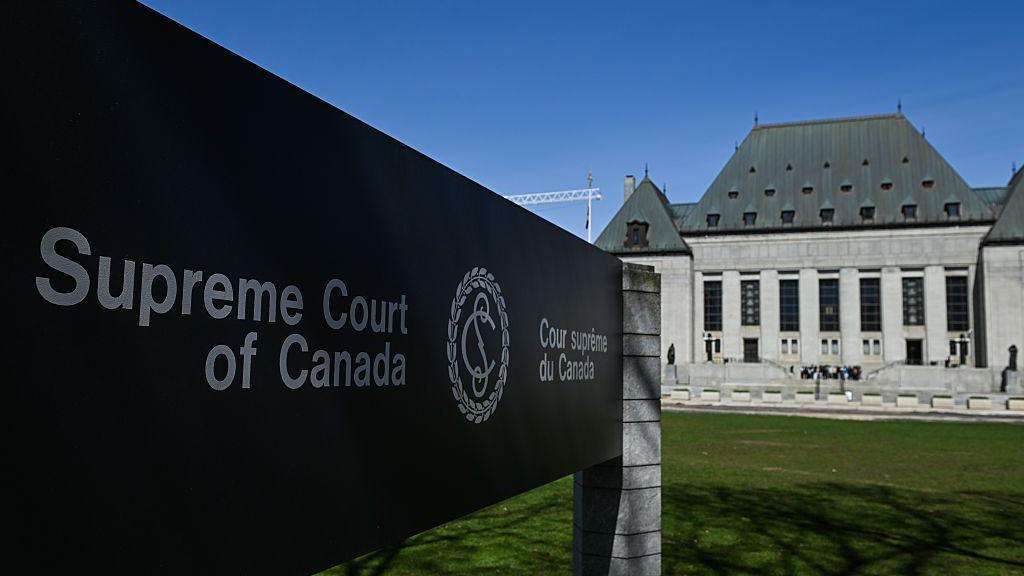
A contentious secularism law in Quebec is set to be reviewed by Canada’s Supreme Court, in a case legal experts say could have far-reaching implications beyond religious expression.
The outcome of the case could test national unity and the balance of power between the courts and elected officials.
“This case is probably going to be the most important constitutional case in a generation,” said Christine Van Geyn, executive director at the Canadian Constitution Foundation.
At the center of the debate is Bill 21, enacted in 2019 by the Coalition Avenir Quebec (CAQ), which prohibits civil servants, including judges, police officers, and teachers, from wearing religious symbols at work.
To preempt legal challenges, the legislators invoked the “notwithstanding clause,” a unique Canadian legal provision that allows governments to override certain constitutional rights, such as freedom of religion and equality rights.
The Canadian Civil Liberties Association (CCLA) has described Quebec’s arguments in court as “spine-chilling”.
“Could a government invoke [the clause] to ban abortion? To criminalise political speech critical of the government? To legalise torture?” the CCLA questioned in a recent op-ed published in Le Devoir.
“According to the Quebec government’s logic, even in such cases, the courts would not only be powerless but also bound to silence.”
The Supreme Court is scheduled to begin four days of hearings on Monday to address the constitutional challenge to Bill 21, with over 50 interveners, including the federal government.
Quebec’s state secularism, or laïcité, similar to France, is integral to its cultural identity.
Aligned with the concept of “separation of church and state”, proponents of laïcité advocate for religious neutrality within state institutions.
However, the practical application of this principle has sparked considerable debate.
Supporters of Bill 21 view it as a reasonable measure to solidify the separation of church and state in Quebec, while critics argue that it is discriminatory, hinders the integration of religious minorities, and unfairly targets Muslim women, despite the legislation not explicitly naming any specific religion.
To shield the legislation from legal challenges, the CAQ preemptively included the “notwithstanding clause” in the bill.
This clause, found in section 33 of the Canadian constitution, enables a provincial or federal government to override certain fundamental freedoms, including religion, expression, and association, as well as legal and equality rights.
The clause is effective for a five-year period, allowing voters time to respond with political consequences if they disagree with the law.
It is renewable and, in theory, can be extended indefinitely.
In the early 1980s, Canada sought to repatriate its constitution from the United Kingdom and incorporate a Charter of Rights and Freedoms, akin to the US Bill of Rights.
The clause served as a “grand bargain” to secure the support of all provinces, some of which feared that a rights charter would grant excessive power to the courts over democratically elected legislators.
It applies to some but not all charter rights; democratic and language rights are excluded, for instance.
The notwithstanding clause was introduced as a safety valve. While Quebec has used it several times in recent decades, other provinces have increasingly employed it to enact controversial legislation.
Besides Bill 21, Ontario recently invoked the clause to reduce the size of Toronto’s city council, Alberta to order striking teachers back to work, and Saskatchewan to mandate parental consent for students under 16 to change their names or pronouns at school.
This has led some to contend that it is being used beyond its intended purpose as a measure of last resort.
Errol Mendes, a law professor at the University of Ottawa and an intervener in the case for the International Commission of Jurists Canada, stated that he and others cautioned that the clause was overly broad and susceptible to misuse.
“And our predictions were coming true now, because there slowly started to be more and more use of the clause.”
This week’s hearing will mark the first time the Supreme Court has addressed a challenge to the provision since 1988.
The Canadian Civil Liberties Association and Ichrak Nourel Hak, a Muslim teacher in Quebec who wears a hijab, are among those who sought leave to appeal.
In a statement, they assert that in Quebec, “Bill 21 has been infringing on the dignity, rights and freedoms of individuals who work in or aspire to work in the public service” and “has a disproportionate impact on specific religious minority groups, such as Muslim, Sikh and Jewish communities”.
Quebec argues that whether or not the bill restricts freedoms is irrelevant, as it is protected by the notwithstanding clause.
“Section 33 constitutes, in a way, one of the cornerstones of the Canadian Charter,” Quebec argues in legal briefings.
They assert that the bill’s purpose is to safeguard the religious neutrality of the state and foster a sense of shared civic identity.
The province maintains that nothing in the clause prevents its preemptive use, and its application aligns with Supreme Court precedent.
Many, including the federal government, are advocating for limits on its use.
In September, federal Justice Minister Sean Fraser stated that the court’s decision “will shape how both federal and provincial governments may use the notwithstanding clause for years to come”.
He described Canada’s rights charter as a “pillar of our democracy and a reflection of our shared values”.
In court documents, Ottawa does not comment on the merits of Bill 21 but argues that the clause cannot be used as a blank check.
It urges the court to establish limits on its invocation, asserting that it was not intended to “be used to distort or annihilate the rights and freedoms guaranteed by the Charter” or to reduce them to “des peaux de chagrin,” rendering them unrecognizable.
This argument elicited swift opposition from the provinces, many of which are also interveners in the case.
Quebec accused Ottawa of staging an “attack on the parliamentary sovereignty of the legislative assemblies of all of Canada”.
Five premiers called on Ottawa to withdraw its legal arguments, which they claimed “threaten national unity by seeking to undermine the sovereignty of provincial legislatures”.
“Indeed, the federal government’s position amounts to a direct attack on the foundational constitutional principles of federalism and democracy,” stated the leaders of Saskatchewan, Alberta, Ontario, Quebec, and Nova Scotia in a joint statement.
In its own filings, Alberta contends that the clause is a “hard-fought and hard-won compromise” introduced with the intention to “preserve parliamentary sovereignty”.
The 57-year-old had been attempting to cycle 300 miles in three days in Canada’s Northwestern Territories.
Mike Scott is trying to contact the sender after Maggie the labrador found the bottle at St Cyrus.
Head coach Danny Rohl casts doubt on Derek Cornelius’ future with Rangers after admitting that the on-loan Marseille centre-half has been training alone and has been released early to join up with Canada’s national squad.
Pierre Poilievre said he wanted to make the case for removing US tariffs on Canada directly to Americans “on the biggest podcast in the world”.
Plymouth Argyle striker Bim Pepple is called up to the Canada national team for the first time.