

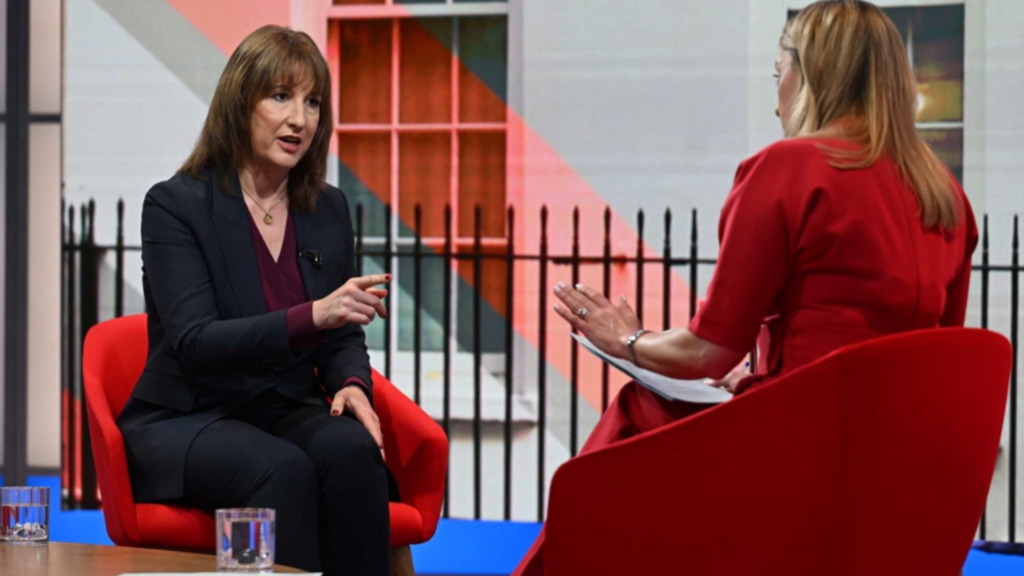
Chancellor Rachel Reeves has refuted allegations that she misled the public regarding the nation’s financial standing leading up to her recent Budget announcement.
During a BBC interview, Reeves was pressed to explain why she had repeatedly issued warnings about a potential downgrade to the UK’s economic productivity forecasts – including in a speech delivered on November 4th – in the period preceding Wednesday’s Budget.
It has since come to light that the Office for Budget Responsibility (OBR) informed her in mid-September that the public finances were in a more favorable position than generally perceived. Critics point to Reeves omitting a forecast of higher wages during her public statements.
Reeves maintained that the OBR figures clearly indicated “less fiscal space than there was” and asserted that she had been “upfront” about her decision-making process. However, Conservative leader Kemi Badenoch has renewed her call for the chancellor’s resignation.
When questioned about the matter on BBC One’s Sunday with Laura Kuenssberg, Reeves stated that she did not “accept” the accusation of misleading the public.
Appearing on the same program, Badenoch expressed her dissatisfaction with the chancellor’s denial.
The Conservative party has accused the chancellor of presenting an excessively pessimistic view of public finances as a “smokescreen” to justify tax increases, with Badenoch alleging that Reeves had “lied to the public.”
Downing Street has dismissed these accusations. Prime Minister Sir Keir Starmer is expected to voice his support for Reeves’ budget decisions in a forthcoming speech on Monday, arguing that the chancellor’s measures will assist in alleviating cost of living pressures and reducing inflation.
When Kuenssberg asked Reeves if she could be trusted, the chancellor affirmed that she could.
Kuenssberg then referenced Reeves’ November 4th speech, during which the chancellor suggested that reduced productivity forecasts indicated less available funding than previously anticipated, potentially necessitating tax increases.
Reeves clarified that, contrary to criticisms, “I didn’t have an extra £4bn to play with.” She explained that the OBR had downgraded its headroom figure, from £9.9bn in the spring to £4.2bn in the autumn.
Headroom refers to the financial buffer remaining after the government covers its projected budget expenses under its fiscal regulations, providing flexibility for unforeseen costs.
“I clearly could not deliver a budget with just £4.2bn of headroom,” she stated, emphasizing that it would have constituted “the lowest surplus any chancellor ever delivered,” and she would have “rightly” faced criticism for the minimal headroom.
She added: “I was clear that I wanted to build up that resilience and that is why I took those decisions to get that headroom up to £21.7bn.”
Pressed on whether she had exaggerated the situation to pave the way for a £16bn increase in welfare, Reeves stated that she had to consider policy decisions made during the preceding six months on welfare and the Winter Fuel Allowance.
She said: “I did say when those policies changed just before the summer that we would have to find that money in the Budget, so I was very upfront about that.
“Yes, I did make the decision in the Budget to scrap the two-child [benefit] limit – that was funded by increases on online gambling taxes and also by cracking down on tax avoidance and tax evasion, fully costed and fully funded, and lifting half a million children out of poverty.”
When asked if she had violated the spirit, if not the letter, of her manifesto commitment on taxation by freezing income tax thresholds, Reeves replied: “I recognise I did not say that in the manifesto, but since then we’ve had both a significant downgrade in the productivity forecast but also huge global turbulence.”
She added: “I have to respond to all those things because, if I were to lose control of the public finances, we would be punished.
“Punished by financial markets that hold £2.6tn of public debt, and punished with higher interest rates, which wouldn’t affect just the country but would also affect every single business that borrows, and every single family that has a mortgage.”
Badenoch stated she was “absolutely not” satisfied with Reeves’ explanation and advocated instead for cuts to welfare spending.
She said: “The chancellor called an emergency press conference telling everyone about how terrible the state of the finances were and now we have seen that the OBR was telling her the complete opposite.”
“She was raising taxes to pay for welfare – the only thing that was unfunded was the welfare payments that she has made, and she’s doing it on the backs of a lot of people out there who are working very hard and getting poorer – and because of that I believe she should resign.”
She accused the chancellor of attempting to “pitch-roll her budget – tell everyone how awful it would be and then they wouldn’t be as upset when she finally announced it”, which could constitute “market manipulation.”
Tory shadow chancellor Mel Stride has written to the Financial Conduct Authority requesting an investigation into “possible market abuse” by individuals within the Treasury and Downing Street in the lead-up to the Budget. The SNP has similarly contacted the regulatory body.
Reform UK Leader Nigel Farage has reported Reeves to the the independent adviser on ministerial ethics to investigate whether she broke the ministerial code over her pre-Budget interventions.
Liberal Democrat deputy leader Daisy Cooper also stated that there were “very serious questions to answer” and is understood to have submitted an urgent question in Parliament regarding the matter.
Sign up for our Politics Essential newsletter to read top political analysis, gain insight from across the UK and stay up to speed with the big moments. It’ll be delivered straight to your inbox every weekday.
Shadow chancellor Mel Stride calls for the financial regulator to investigate “possible market abuse” over briefings in the run-up to the Budget.
Essex businesses and workers give their views on what they think the Chancellor’s Budget will mean for them.
The prime minister will commit the government to going “further and faster” on growth as his chancellor faces questions.
Three days in, after a tax U-turn and partial climbdown on workers’ rights, Laura Kuenssberg looks at what impact Budget week might have.
The Conservatives say she was overly gloomy about the public finances as a “smokescreen” to raise tax.