

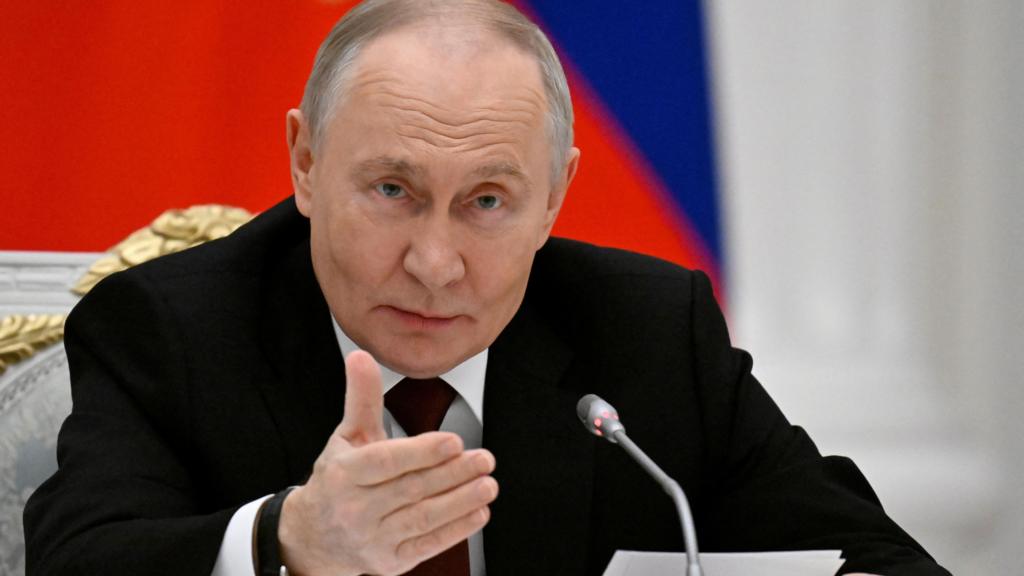
Russian President Vladimir Putin has reiterated that Ukrainian forces must withdraw from the Donbas region of eastern Ukraine, or Russia will proceed with its seizure, dismissing any potential compromises to resolve the ongoing conflict.
In an interview with India Today, Putin stated, “Either we liberate these territories by force, or Ukrainian troops will leave these territories.” Currently, Moscow controls approximately 85% of the Donbas region.
Ukrainian President Volodymyr Zelensky has consistently rejected the prospect of ceding any territory.
Putin’s remarks follow statements from former U.S. President Donald Trump, who indicated that his negotiators, engaged in discussions regarding a U.S. peace plan, believed Putin “would like to end the war” following discussions held in Moscow on Tuesday.
Steve Witkoff, Trump’s envoy present in Moscow, is scheduled to meet with the Ukrainian team in Florida.
Trump characterized the Tuesday talks in the Kremlin as “reasonably good,” while cautioning that it was premature to assess the outcome, emphasizing that “it does take two to tango.”
The original draft of the U.S. peace plan reportedly proposed transferring areas of the Donbas still under Ukrainian control to de facto Russian administration; however, the Witkoff team presented a revised version in Moscow.
In his India Today interview, conducted prior to a state visit to Delhi, Putin asserted that he had not reviewed the new version prior to his discussions with Witkoff and Jared Kushner, Trump’s son-in-law.
“That’s why we had to go over every point, that’s why it took so long,” the Kremlin leader explained.
He also noted that Moscow disagreed with elements of the U.S. plan.
“At times we said that yes, we can discuss this, but to that we can’t agree,” Putin stated.
Specific points of contention were not disclosed. Key unresolved issues reportedly include the fate of Ukrainian territory seized by Russian forces and security guarantees for Ukraine.
Yuri Ushakov, Putin’s senior foreign policy advisor and a lead negotiator, stated immediately after the talks that they yielded “no compromise” regarding the resolution of the war.
Ushakov also suggested that Russia’s negotiating position had been strengthened by what Moscow characterized as its recent battlefield successes.
Ukraine has repeatedly accused Russia of obstructing ceasefire agreements, alleging that Moscow seeks to seize additional Ukrainian territory.
Commenting on the Kremlin talks, Ukrainian Foreign Minister Andrii Sybhia stated that Putin was “wasting the world’s time.”
Ukraine has consistently demanded firm security guarantees in any potential settlement.
On Wednesday, Zelensky stated that “the world clearly feels that there is a real opportunity to end the war,” but stressed that negotiations must be “backed by pressure on Russia,” which Kyiv and its European allies accuse of deliberately stalling any ceasefire agreements.
The Ukrainian president indicated last week that his top negotiators had secured key revisions to the original U.S. peace plan—widely perceived as favoring Moscow—during talks with an American delegation in Geneva on November 23.
In a joint statement, U.S. and Ukrainian negotiators announced the development of an “updated and refined peace framework,” without providing further details.
Senior European negotiators, who had previously expressed concerns regarding the initial U.S. plan, were also present in Geneva last week, holding separate meetings with the Ukrainian and U.S. teams.
Separately, Germany’s Der Spiegel news website reported on Thursday that it had obtained a confidential transcript of a conference call in which European leaders voiced concerns about the U.S. negotiations.
“There is a possibility that the US will betray Ukraine on the issue of territory without clarity on security guarantees,” French President Emmanuel Macron reportedly said, according to an English transcript of Monday’s conference call.
German Chancellor Friedrich Merz was quoted as warning that Zelensky had to be “extremely careful in the coming days.”
“They are playing games, both with you and with us,” Merz reportedly stated.
Finnish President Alexander Stubb was also quoted as saying: “We mustn’t leave Ukraine and Volodymyr alone with these guys.”
The BBC has not independently verified the reported transcript.
In response to an inquiry from Der Spiegel, France’s Élysée Palace stated that “the president did not express himself in those terms,” declining to provide specific details on Macron’s remarks, citing confidentiality.
Stubb declined to comment to Der Spiegel, and Merz has not addressed the matter.
In a statement to the BBC, the White House affirmed, “Secretary [Marco] Rubio, Special Envoy Witkoff, Mr Kushner, and the President’s entire national security team are working tirelessly to stop the killing between Russia and Ukraine.”
“They have held productive meetings to gather feedback from both sides on a plan that can foster a durable, enforceable peace,” the statement concluded.
Russia launched a full-scale invasion of Ukraine in February 2022, and currently controls approximately 20% of Ukrainian territory.
In recent weeks, Russian troops have been slowly advancing in south-east Ukraine, despite reports of heavy combat casualties.
The Irish Defence Forces says it had no comment on “any alleged incidents” during the visit.
Rusia’s ability to target a defector with nerve agent is almost certainly diminished but it may pose other threats, the BBC’s security correspondent writes.
Dawn Sturgess, 44, died in 2018 after coming into contact with the nerve agent Novichok.
The partnership aims to protect undersea cables, which Western officials say face increased threat from Moscow.
An official report has concluded that Russian president Vladimir Putin was “morally responsible” for her death.