

“`html
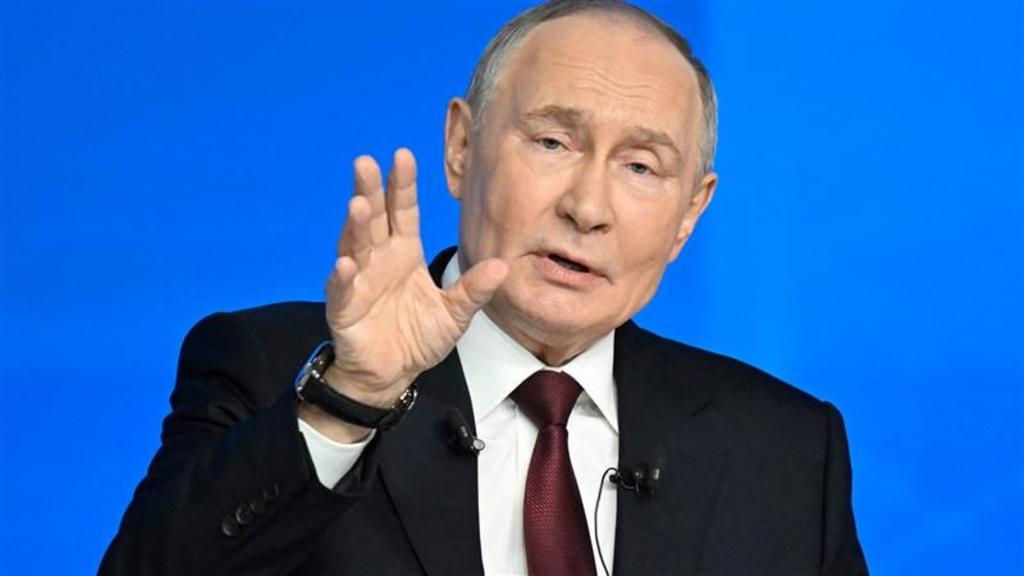
Russian President Vladimir Putin has stated that further military conflicts beyond Ukraine would be averted if Russia receives due respect. He dismissed allegations of Moscow planning to attack European nations as “nonsense.”
During a televised question-and-answer session spanning nearly four and a half hours, Putin was asked by the BBC’s Steve Rosenberg whether additional “special military operations” – the Kremlin’s term for the full-scale invasion of Ukraine – were planned.
“There won’t be any operations if you treat us with respect, if you respect our interests just as we’ve always tried to respect yours,” Putin asserted, addressing the inquiry.
Earlier in the month, Putin maintained that Russia had no intention of engaging in war with Europe, but affirmed the nation’s readiness to respond “right now” if Europeans desired such a conflict.
Answering a question from the BBC Russia editor on Friday, Putin further stipulated that no further Russian invasions would occur “if you don’t cheat us like you cheated us with Nato’s eastward expansion.”
Putin has long alleged that NATO reneged on a purported 1990 Western assurance to then-Soviet leader Mikhail Gorbachev before the dissolution of the Soviet Union, a claim Gorbachev subsequently denied.
The “Direct Line” event combined questions from the general public and journalists from across Russia in a Moscow hall. Putin was positioned beneath a large map of Russia encompassing occupied regions of Ukraine, including Crimea, which Russia annexed in 2014.
Russian state media reported that over three million questions were submitted.
Shortly after the televised marathon, Ukrainian officials reported that seven individuals were killed and 15 were injured in a Russian missile strike on Ukraine’s southern Odesa region. Russia’s invasion of Ukraine commenced in February 2022.
While the “Direct Line” event was largely orchestrated, some critical comments from the public surfaced on a large screen, including one labeling the event a “circus,” another decrying internet outages, and one highlighting poor-quality tap water. Authorities have attributed mobile internet outages to Ukrainian drone attacks.
Putin also addressed Russia’s economic challenges, including rising prices, declining growth, and a planned VAT increase from 20% to 22% on January 1. One message directed to the president urged: “Stop the crazy rise in prices on everything!”
The Kremlin typically uses the year-end event to emphasize the resilience of the Russian economy. Coinciding with Putin’s address, Russia’s central bank announced a reduction in interest rates to 16%.
Foreign policy matters were interwoven with reflections on the homeland, commendations for local businesses, discussions on fish prices, and the importance of supporting veterans.
The ongoing conflict in Ukraine, now in its fourth year, remained a central theme, often serving as the backdrop for many questions.
Putin reiterated his claim of being “ready and willing” to end the war in Ukraine “peacefully” but offered little indication of compromise.
He restated his adherence to principles outlined in a June 2024 speech, demanding that Ukrainian forces withdraw from four partially occupied regions and that Kyiv abandon its aspirations to join NATO.
A primary demand from Russia is full control of Ukraine’s eastern Donbas region, including approximately 23% of the Donetsk region that Russia has not yet managed to occupy.
Putin contended that Russian forces were advancing along the front lines in Ukraine and derided Volodymyr Zelensky’s recent visit to the front line at Kupiansk, where the Ukrainian leader refuted Russian claims of capturing the town.
Putin has also called for new elections in Ukraine to be included in peace proposals that US President Donald Trump has submitted as part of his efforts to resolve the conflict. During his news conference, Putin offered to halt bombings in Ukraine during voting.
Ukraine’s SBU security service reported on Friday that it had, for the first time, struck an oil tanker operating as part of Russia’s “shadow fleet” in the Mediterranean. Putin stated that this action would not achieve Kyiv’s desired outcome and would not disrupt Russian exports.
While most questions from Russian media and the public did not directly challenge Putin, inquiries were permitted from Western correspondents, including Keir Simmons of US network NBC and the BBC’s Steve Rosenberg.
When Simmons asked if Putin would feel responsible for the deaths of Ukrainians and Russians if he rejected the Trump peace plan, Putin commended the US president’s “sincere” efforts to end the war but stated that the West, not Russia, was obstructing a deal.
“The ball is in the hands of our Western opponents,” he said, “primarily the leaders of the Kyiv regime, and in this case, first and foremost, their European sponsors.”
Trump has suggested a peace deal is imminent, and despite Putin’s apparent reluctance to compromise, the US president has expressed hope that “Ukraine moves quickly because Russia is there.”
A Ukrainian delegation is reportedly engaged in discussions in Miami with Trump envoy Steve Witkoff and Trump’s son-in-law Jared Kushner. German, French, and British officials are also present, following their meeting with US officials in Berlin.
Kremlin envoy Kirill Dmitriev is also expected in Miami over the weekend, according to reports.
Putin told the BBC’s Russia Editor: “We are ready to work with you – with the UK and with Europe in general and with the United States, but as equals, with mutual respect to each other.
“We are ready to cease these hostilities immediately, provided that Russia’s medium- and long-term security is ensured, and we are ready to cooperate with you.”
He accused the West of creating an enemy out of Russia. Skating over his decision to mount a full-scale invasion in February 2022, he said: “You are waging a war against us with the hands of Ukrainian neo-Nazis,” before repeating his regular diatribe against Ukraine’s democratically elected leaders.
European intelligence agencies have warned that Russia is only a few years away from attacking Nato. The Western defensive alliance’s chief Mark Rutte said this month that Russia was already escalating a covert campaign and the West had to be prepared for war.
While many of the questions were benign, including several from children, from a one reporter from Yakutia in north-eastern Siberia highlighted a tenfold increase in energy prices in the past four years. Putin told her that his team would look into alternative sources of energy and “keep Yakutia in mind”.
Towards the end of the TV marathon, Putin was asked a series of quickfire questions, touching on his views on friendship, religion, the motherland and love at first sight. He said he believed in love at first sight – then added that he himself was in love, without divulging any more details.
EU leaders agreed to loan Ukraine €90bn to stay financially afloat for the next two years.
There are no official statistics surrounding suicide among Ukrainian soldiers, but they are thought to count in the hundreds.
The EU is deciding whether to loan tens of billions of euros of Russian money to fund Ukraine’s military and economic needs.
Former British soldier Hayden Davies, labelled a mercenary by Russia, will be sent to a maximum-security prison.
The BBC goes to a secret Ukrainian factory, where they are manufacturing new long-range missiles.
“`