

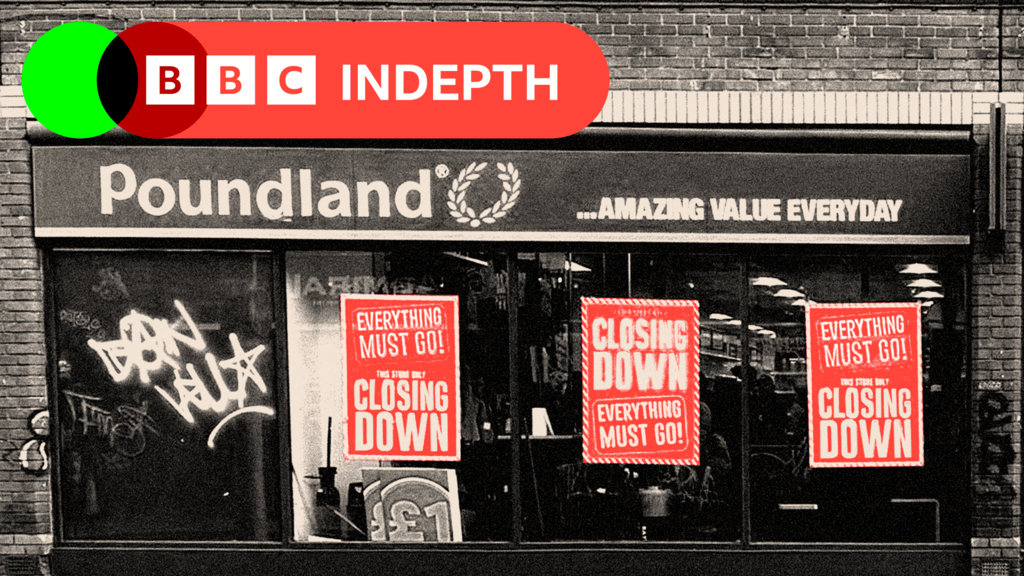
Residents of Peckham, South London, are now without their local Poundland store, which shuttered this week after more than a decade in operation.
“Everyone comes in here; it’s very affordable. I buy things for my children, snacks, toiletries,” remarked Becky Cullen, a local shopper, as she gazed at the vacant storefront. “It was always busy… Where are we going to shop now?”
The store’s location on Rye Lane, a vibrant thoroughfare dotted with Caribbean grocers, beauty salons, phone repair shops, bars, cafes, and vintage boutiques, made it a central hub for the community. Given Peckham’s ongoing economic challenges, the closure of a budget-friendly retailer seems particularly inopportune during a period of heightened cost of living concerns.
Poundland has initiated a store closure program as part of its efforts to solidify its position in the retail landscape.
Since the summer, over 100 Poundland locations have been closed or slated for closure. This decision follows the company’s sale in June for a nominal £1, amidst what executives characterized as “challenging trading conditions.”
While a turnaround strategy is in motion, Poundland anticipates operating between 650 and 700 stores by the plan’s completion, a reduction from the approximately 800 locations it maintained at the beginning of the year.
Other retailers are facing headwinds as well. The Original Factory Shop is facing financial difficulties and has closed at least 22 shops. The discount chain Maxideal has ceased operations altogether. B&M Bargains, a UK discount retail giant, has launched a turnaround plan, citing weak sales performance.
Theoretically, these establishments should be the primary destinations for consumers looking to economize or seeking alternatives to more expensive stores.
What accounts for the difficulties faced by some of these well-known budget retailers at a time when many consumers are grappling with financial strain?
It is clear that bargain shopping remains popular. However, patterns in how consumers approach budget shopping have undergone shifts.
“Shoppers are outmaneuvering budget shops,” observes retail expert Catherine Shuttleworth of Savvy, a consumer behavior analytics firm. “[They’re doing this] by saying, ‘These are things I’m going to buy from you.'”
“They know their prices inside out.”
Shoppers are now adept at leveraging technology to share real-time deals with their networks, ensuring widespread awareness of pricing trends, according to Shuttleworth.
Budget chains are simultaneously battling rising costs and increased competition.
The recent Budget led to increased employer costs for all major retailers. It can be more difficult when a retailer sells low price point products. In these cases, retailers have less ability to absorb the extra costs or pass them on to customers.
The traditional “pound shop” model faces unique challenges. The purchasing power of £1 has diminished.
When Poundland was founded in 1990, selling goods for £1 was equivalent to selling them for 40p today, accounting for inflation.
Chris Edwards, a veteran Yorkshire businessman with over five decades of experience in the discount retail sector, co-founded Poundworld with his son. The duo successfully sold the chain for £150 million a decade ago.
In 2019, the Edwardses launched a new venture, OneBelow, offering all items for £1 or less. However, the company pivoted within three years to OneBeyond, with most of its products priced above £1.
“We realized the pound game wasn’t going to work anymore,” Edwards stated. “What tipped us over the edge was the [post-pandemic] shipping crisis, when we couldn’t get containers through and the cost of freight was ridiculous.”
Edwards asserts that his refined business model remains viable. He says it hinges on experience, negotiation skills, and expertise in product selection.
During a weekend visit to his Croydon store, which features a festive Christmas aisle, shoppers were observed stocking up on mouthwash, dish soap, candy, and batteries, with long lines at the checkout.
“We know what the customer is going to buy before the customer knows they’re going to buy it,” he declared.
Regarding maintaining profitability, Edwards explains that he sometimes secures favorable prices on UK stock from prominent brands. However, when this is unattainable, he is willing to sacrifice profits to attract customers.
“We’ve got a constant flow of containers from China and we can negotiate very keen prices,” he says.
By luring consumers into his stores with UK stock such as Coca-Cola, Edwards can also feature a product imported directly from China, where he can make “extra margin.”
The intricacies of the budget retail model mean that profitability can be elusive.
The Edwardses transformed Poundworld into a chain of over 300 stores prior to selling it to an American investor in 2015. The business later went into administration, disappearing from the high street three years later.
“They just didn’t understand the discount business,” Edwards argues. “They tried to sell other things but not in a controlled way like we do it.”
Wilko also struggled, entering administration in 2023, resulting in significant job losses.
Poundland narrowly avoided administration this year following a period of poor performance, with much of that performance due to self inflicted issues.
The business had strayed from its core premise of offering numerous items for £1, with a broader range of prices.
Pepco clothing was also added to Poundland stores by its owners, the Warsaw-listed Pepco Group. Shoppers did not like this.
“Poundland forgot what they were. The key to budget shops is keeping them simple,” says Catherine Shuttleworth.
She believes Poundland is capable of rebounding if it returns to its foundations. The company has started to simplify pricing and reports progress with its turnaround strategy.
The simplification has included closing 57 unprofitable stores and negotiating rent reductions with landlords. Another 48 shops are being shut as landlords have decided to take back the leases and find new occupants instead.
According to data analytics firm Geolytix, there are approximately 3,400 budget chain stores in the UK. The number of them more than doubled between 2009 and 2015 – but numbers have risen only slightly since then.
The UK was in a recession and faced the global financial crisis in 2009. Following the departure of Woolworths, rivals like Poundland had a chance to fill the void and profit from low rents.
Everywhere, shoppers sought deals.
Discount supermarkets Aldi and Lidl grew as well. With cheaper prices, the stores attracted customers from existing grocers. Frugality gained traction, even as consumers earned higher incomes.
By 2019, more budget stores were located out-of-town and in retail parks. The pandemic further accelerated the budget store trend. B&M, Home Bargain and The Range shops host larger garden centers and tend to sell larger items, which are easier to bring when traveling by car.
Budget shops are facing challenges during the cost-of-living crisis.
In order to keep customers, supermarkets have sharpened pricing and launched loyalty cards. The sector is dealing with the rise of “extreme discounting” online.
Chinese players such as Shein and Temu are taking market share by selling very affordable products directly to consumers. AliExpress, another Chinese-based retailer, connects consumers to sellers on a global scale.
“AliExpress had a huge boost in usership last year, from sponsoring the Euros, and it’s growing,” says Nick Carroll, director of retail insight from Mintel.
Sales numbers are hard to come by, but Mintel data suggest 30% of online shoppers in the UK shopped with Temu in the year to September 2025, while 14% shopped with AliExpress and 3% with DHGate, another Chinese marketplace, in the same period.
Amazon has entered the sphere by launching its own ultra-low-cost shopping section, Amazon Haul.
“If you look at those products, they look very similar to what you’d find on Temu etc, so if Amazon’s doing a reaction to something in the market, you know it’s notable,” says Mr Carroll.
“There’s a lot more coming into that space. So this sort of wave of low-cost influence from outside of the UK isn’t slowing down, and I think there’s much more to come.”
Catherine Shuttleworth notes new selling platforms such as TikTok Shop, where merchants advertise a variety of goods from candy to toilet paper. A seller on TikTok may sell products more affordably than the local shop owner since they have no overhead, no staff, and very little stock.
“As long as they [shoppers] can get it at the right price, the right place and at the right time, they will go anywhere to do that,” she says.
“It’s not just the standard retailer they used to go to – it could be anybody.”
The risk for traditional budget stores is that they will no longer be seen as the market’s most affordable store.
Shuttleworth posits that, in conjunction with a “cost-of-business crisis” triggered by increases in the minimum wage and employers’ National Insurance contributions, there could be a shake out with weaker players being forced to consolidate.
“You’ve got to be the best of the best in whichever segment, whether you’re at the top, the middle or the bottom, and it’s super-super-competitive and one of the problems here, is there’s so many people in that market.
“But I think what will happen in this sector is that there has to be some consolidation, and the stronger players will win out.”
Of course, not all news is negative. Some chains have seen improved performance recently.
After acquiring the DIY chain Homebase from administration, The Range has opened 60 standalone stores this year. Home Bargains continues to grow and open new stores.
Savers, which sells mostly toiletries and cosmetics, but some other goods too, has also expanded in recent years. The BBC has been told it is moving into Poundland’s Peckham store space.
OneBeyond has grown to 132 stores, but expansion has slowed. Chris Edwards attributes the government for making issues harder by layering on more costs.
“Every period has its own challenges… and we just have to do our own thing.”
As for current business, he is getting by. “We’re not saying we’re earning fortunes of money. We’re not – but we’re paying our way, and we’re just waiting for better times.”
His focus is now, along with nearly every other retailer, is Christmas trading.
“It means everything… we can break even all year if we have a good Halloween and a good Christmas,” he says.
Catherine Shuttleworth thinks competent budget retailers shine especially during the holidays as shoppers head to them for big events. “They’re a great place to go and deck your house out.”
For many, these stores may be the only shopping choice. Not everyone likes shopping online or wants a trip to the retail park.
“For some people, budget shopping is a hobby,” she adds, “but for others it’s an absolute necessity.”
BBC InDepth is the home on the website and app for the best analysis, with fresh perspectives that challenge assumptions and deep reporting on the biggest issues of the day. You can now sign up for notifications that will alert you whenever an InDepth story is published – click here to find out how.
Discounts often aren’t the cheapest prices, but here’s how to make sure you’re getting a good deal.
Hammerson, which owns The Oracle, also runs Birmingham’s Bullring and Cabot Circus in Bristol.
Town centres across the country are facing challenges with their high streets, so what’s the answer?
Coffees made with extra ingredients like mushrooms, protein and collagen are known as “functional coffees”.
East Riding of Yorkshire Council says it is taking steps to tackle long-term vacancies.