

“`html
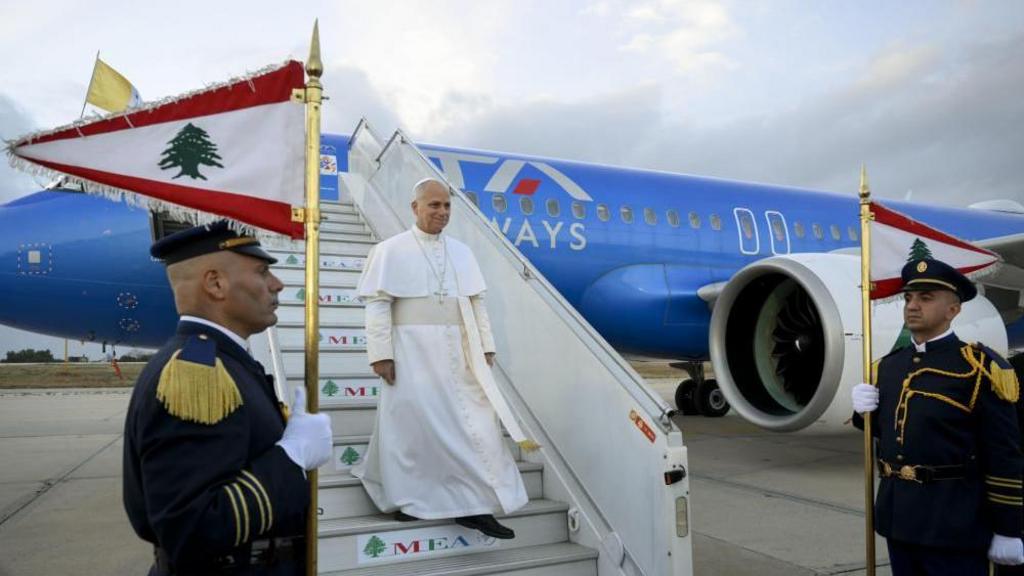
Pope Leo XIV has arrived in Beirut, the Lebanese capital, one week after Israeli airstrikes impacted the city.
Known for his measured and deliberate approach, the Pope’s decision to visit a nation recently affected by conflict marks a significant statement early in his first foreign trip.
Following three days in Turkey, observing his diplomatic interactions offers insights into how he intends to balance his roles as both spiritual leader and head of state for Vatican City.
Pope Leo’s interactions with journalists are characterized by a gentle demeanor and carefully considered words.
In contrast, his predecessor, Pope Francis, often engaged in lengthy and passionate exchanges with reporters, speaking directly from the heart.
This approach occasionally necessitated intervention from his aides to manage potential risks or clarify statements that seemed to deviate from established positions or diplomatic norms.
Pope Francis noted in his autobiography that he anticipated a relatively short papacy upon assuming the role in 2013, acting with a sense of urgency to implement his vision for the Church.
Six months into his papacy, Pope Leo appears to be deliberately absorbing the gravity of his position and carefully weighing his options, occasionally displaying moments of emotional reflection.
At the Cathedral of the Holy Spirit in Istanbul, as he addressed the small Christian minority, he seemed to be holding back tears, moved by their warm welcome and shared worship.
This moment echoed his appearance on the balcony of St. Peter’s Basilica in May, when he accepted the daunting responsibility of guiding over a billion people in matters of faith.
As a statesman leading the Vatican, he often seems to prioritize listening, but his current trip demonstrates his capacity to deliver strong messages.
Standing alongside Turkish President Recep Tayyip Erdogan, he criticized powerful nations for using economic and military dominance, blaming it for escalating global conflict and declaring that “the future of humanity is at stake.”
At an event commemorating 1,700 years since a pivotal Christian council in Iznik, Turkey, he stated: “We must strongly reject the use of religion for justifying war, violence, or any form of fundamentalism or fanaticism.”
On the flight from Istanbul to Beirut, he addressed the long-standing conflict between Israel and the Palestinians, emphasizing that a solution must include a Palestinian state.
“We all know that at this time Israel still does not accept that solution,” he noted, while affirming the Vatican’s continued “friendship with Israel” and its desire to mediate.
Upon arrival in Lebanon, a country facing significant governance challenges, Pope Leo met with leading politicians to remind them of their duty to serve the people.
The Pope has described his visit to Turkey and Lebanon as an effort to be “a messenger of peace,” a sentiment that has generated considerable anticipation, particularly in Lebanon.
“It means a lot to me. He could have visited other countries, but he gave priority to Lebanon while it is still at war,” Patriarch Bechara al-Rahi, leader of the Maronite Catholic Church, told the BBC.
“He brings hope when the Lebanese feel abandoned and we feel uplifted,” he added.
While the visit provides a boost to Lebanon’s Christian population, estimated to be one-third of the country, all Lebanese citizens have been granted a two-day national holiday, and individuals from various faiths have welcomed him.
Even Hezbollah, the Shia Muslim political party and militia considered a terrorist organization by the UK and US, extended its greetings.
In an open letter, the group expressed a “full welcome” and “deep appreciation” for the Pope’s “honourable presence.” Alongside Lebanese and Vatican flags, Hezbollah flags were also visible as his motorcade traveled from Beirut’s airport.
During his time in Lebanon, Pope Leo will meet with Patriarch Bechara al-Rahi, as well as other local Christian, Muslim, and Druze leaders.
He has positioned himself as a bridge-builder between peoples, faiths, Christian denominations, and even within the Catholic Church, where divisions between progressive and traditionalist factions have appeared to widen.
However, the pursuit of togetherness is not without its limitations.
In Turkey, when the Pope sought to unite different Christian traditions in a celebration of past unity, the Russian Orthodox Church declined to send a representative.
Criticism is inevitable. Some expressed disappointment that the Pope did not use his visit to Turkey to address the suppression of opposition or the jailing of journalists with President Erdogan.
In Lebanon, some are angered that Pope Leo is not visiting those most directly affected by the war.
“No one has even asked about us,” said Geryes Jabbour, from the Christian village of Sarda, near the Israeli border.
“We are worn out, we have been set back decades, but we are not even on the Pope’s mind,” he said, reflecting similar sentiments among others in southern Lebanon.
While that day in May marked his unexpected acquisition of a powerful moral platform, he remains a man from South Side Chicago, evolving into a role where missteps could have significant repercussions.
Unlike Pope Francis, he does not appear to be seeking rapid upheaval, but Pope Leo’s first foreign trip suggests that he is finding his voice on the world stage.
Pope Leo XIV praised the “spiritual gifts” of Nicholas Hudson in a Bull of Appointment.
The three nuns say they were taken out of the convent against their will and placed in a care home.
The Pope makes his first foreign trip to Turkey and says a third world war is being “fought piecemeal”.
A year on from a ceasefire in Lebanon, Israel is continuing attacks on what it says are Hezbollah’s efforts to recover from their war.
The vehicle had transported the late Pope Francis on a visit to Bethlehem in 2014.
“`