

“`html
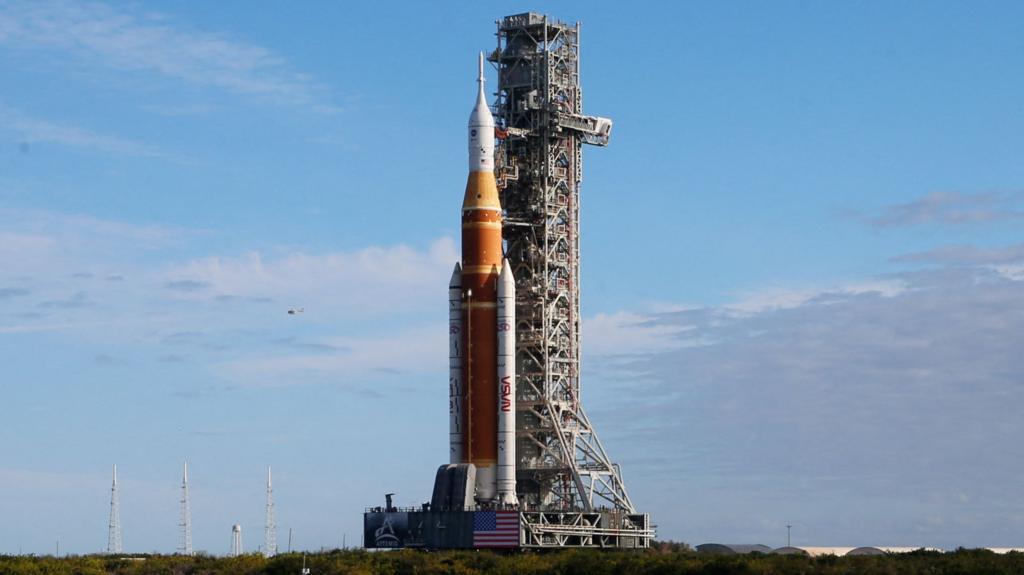
NASA’s Space Launch System (SLS) mega-rocket has been transported to the launch pad at Cape Canaveral, Florida, marking a crucial step in preparations for the first crewed lunar mission in over half a century.
The 98-meter-tall SLS completed its 6.5-kilometer journey from the Vehicle Assembly Building to the launch pad over a period of nearly 12 hours, carried vertically by a specialized transport system.
With the rocket now in position, a series of final tests and checks, including a “wet dress rehearsal,” will be conducted before the green light is given for the Artemis II mission. This ambitious 10-day endeavor will send four astronauts on a journey around the Moon.
NASA has indicated that the earliest potential launch date is February 6th, with additional launch windows available later in February, as well as in March and April.
The rocket’s movement commenced at 07:04 local time (12:04 GMT) and concluded upon arrival at Launch Pad 39B at the Kennedy Space Center at 18:41 local time (23:42 GMT).
The crawler-transporter, a massive machine responsible for carrying the rocket, moved at a peak speed of 1.3 km/h (0.82 mph) during the journey. The slow-moving spectacle was captured in live coverage.
NASA has stated that the rocket will undergo preparations in the coming days for a “wet dress rehearsal,” which is a comprehensive test of fuel operations and countdown procedures.
The Artemis II crew – comprised of NASA astronauts Reid Wiseman, Victor Glover, and Christina Koch, along with Canadian astronaut Jeremy Hansen – were present at the Kennedy Space Center to observe the rocket’s movement.
In the weeks ahead, the four astronauts will be secured within a spacecraft atop the rocket, ready for the launch to the Moon.
This mission marks the first crewed lunar endeavor since Apollo 17 landed on the Moon’s surface in December 1972.
NASA has stated that Artemis II has the potential to carry its astronauts further into space than any human has ventured before.
While Artemis II is not slated for a lunar landing, it will pave the way for a future landing led by the Artemis III mission.
NASA has indicated that the launch of Artemis III will occur “no earlier than” 2027, though experts suggest 2028 as a more realistic timeframe.
Koch described witnessing the rocket’s movement as an incredible experience.
“Astronauts tend to be the calmest individuals on launch day. I believe this stems from our readiness to execute the mission we’ve come here to accomplish and for which we’ve trained,” she stated.
Hansen expressed his hope that the mission will serve as an inspiration to the world.
“I’ve often taken the Moon for granted, glancing at it without truly appreciating it,” he said.
“However, I’ve been focusing on it more intently lately, and I anticipate that others will join us in observing the Moon more closely as humans fly around its far side, which is beneficial for humanity.”
Before venturing to the Moon, the Artemis II crew will spend the initial two days of their mission in Earth’s orbit.
“We will almost immediately enter an orbit approximately 64,000 kilometers out – about a fifth of the distance to the Moon,” Koch told BBC News.
“From that vantage point, we will observe Earth as a single sphere, a perspective none of us have experienced before.
“Subsequently, we will travel a quarter of a million miles… conducting extensive science and operations along the way.”
During their circumlunar flight, the crew will dedicate three hours to lunar observation – studying its geology, capturing images, and gathering data to inform future landing site selection at the Moon’s south pole.
A key component of the Orion spacecraft, which will transport the astronauts, was manufactured in Bremen, Germany.
The European Service Module, positioned behind the crew capsule, represents the European Space Agency’s contribution to the mission and was built by Airbus.
“The European Service Module is crucial; we essentially cannot reach the Moon without it,” stated Sian Cleaver, a spacecraft engineer at Airbus.
“It provides the necessary propulsion for Orion to reach the Moon.”
Its large solar arrays will generate all the electrical power for the spacecraft, she added.
“We also have large tanks filled with oxygen and nitrogen, which are mixed to create air, as well as water, providing everything the astronauts need in the crew module to sustain them throughout their journey.”
Inside their cleanroom, the team is actively constructing additional modules for future Artemis missions. Each module requires approximately 18 months to assemble, representing thousands of engineering hours dedicated to its design. Every onboard system must function flawlessly.
“We must ensure the astronauts’ safe journey to the Moon and their return,” emphasized Cleaver.
With the rocket now situated on launchpad 39B, the Artemis team is working diligently to prepare it for launch.
The mission has already experienced years of delays, and NASA faces pressure to launch the astronauts as soon as possible. However, the US space agency has affirmed its commitment to prioritizing safety.
John Honeycutt, chair of the Artemis mission management team, stated: “My sole responsibility is the safe return of Reid, Victor, Christina, and Jeremy.”
“We will launch when we are prepared… crew safety will remain our utmost priority.”
The four members of Crew-11 beamed as they stepped out of their spacecraft after a safe landing.
The project hopes to end ‘moon wars’ between mosques across the UK.
The government says it has listened to farmers and increased the proposed inheritance tax threshold.
The New Year has a bright start as a supermoon lights up winter skies in the region.
Your photos of the Wolf Moon as it lights up the sky across the South and South East.
“`