

“`html
NASA could launch the first crewed Moon mission in over half a century as early as the first week of February.
The Artemis II mission, slated to last approximately 10 days, aims to propel its astronauts further into space than any human has previously ventured.
This mission is designed to pave the way for the first human landing on the lunar surface since the Apollo missions of the 1960s and 70s.
NASA’s planned launch window commences on February 6th and extends into the spring, with the agency targeting a launch before the end of April.
A definitive launch date will be established upon the completion of final checks on the Space Launch System (SLS) rocket, the Orion capsule carrying the crew, and associated ground systems.
The mission is scheduled to launch from the Kennedy Space Center in Florida.
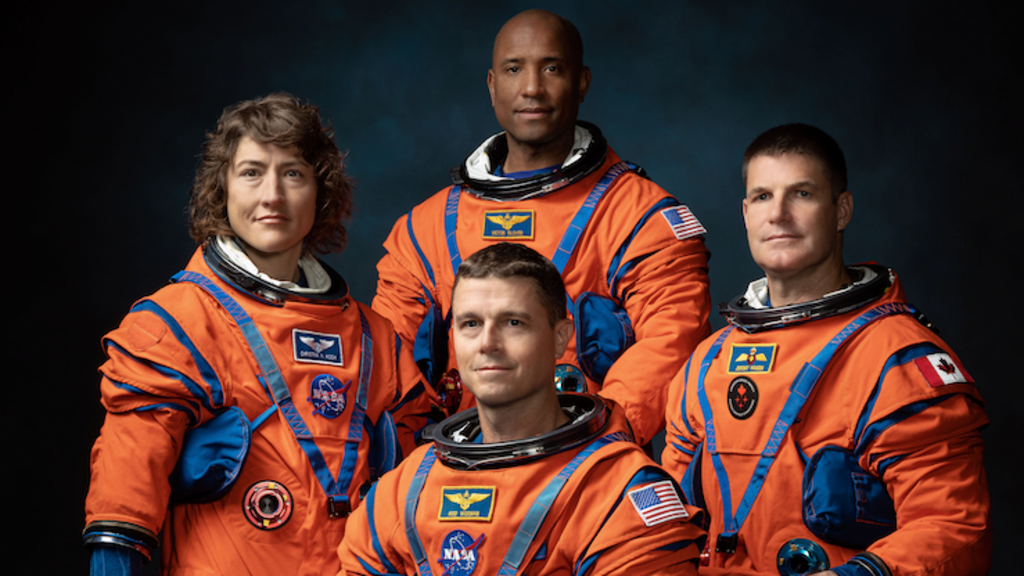
The Artemis II crew comprises NASA’s commander Reid Wiseman, pilot Victor Glover, and mission specialist Christina Koch, along with Jeremy Hansen of the Canadian Space Agency, also serving as a mission specialist.
This mission marks the inaugural crewed flight of the SLS rocket and Orion spacecraft.
Once in a stable orbit, the astronauts will evaluate the performance of the Orion spacecraft, including manually piloting the capsule in Earth orbit to practice maneuvers essential for future lunar landings.
Subsequently, they will journey to a point thousands of kilometers beyond the Moon to assess Orion’s life-support, propulsion, power, and navigation systems.
The crew will also serve as subjects for medical testing, transmitting data and imagery from deep space.
They will operate within a confined cabin in weightlessness. Radiation levels will exceed those on the International Space Station, which orbits in low-Earth orbit, but remain within safe limits.
Upon returning to Earth, the astronauts will experience a turbulent reentry through the atmosphere, culminating in a splashdown in the Pacific Ocean off the US west coast.
This mission serves as a precursor to a lunar landing by astronauts on the Artemis III mission.
NASA anticipates the launch of Artemis III to occur “no earlier than” 2027, although experts suggest that 2028 is a more realistic timeframe.
The final selection of a spacecraft for transporting the crew to the lunar surface is pending, with SpaceX’s Starship lander and a craft developed by Jeff Bezos’s Blue Origin under consideration.
New spacesuits manufactured by US company Axiom are also currently under development.
When Artemis III eventually launches, the astronauts will be heading to the Moon’s south pole.
The long-term objective is to establish a sustained human presence on the Moon.
Artemis IV and V will commence the construction of Gateway, a small space station orbiting the Moon. Subsequent missions will involve further Moon landings, the addition of new modules to Gateway, and the deployment of advanced robotic rovers on the lunar surface. Increased international collaboration will support extended periods of human habitation and research on and around the Moon.
The last crewed Moon mission was Apollo 17, which landed in December 1972 and returned to Earth later that month.
A total of 24 astronauts have journeyed to the Moon, with 12 having walked on its surface, all during the Apollo program.
The United States initially embarked on Moon missions in the 1960s primarily to surpass the Soviet Union, asserting its geopolitical and technological superiority. Once this objective was achieved, political support and public interest waned, leading to a reduction in funding for subsequent lunar expeditions.
Artemis evolved from a renewed aspiration to return humans to the Moon, this time establishing a long-term presence based on advanced technology and collaborative commercial partnerships.
Several other nations harbor ambitions of landing humans on the Moon in the 2030s.
European astronauts are slated to participate in future Artemis missions, and Japan has also secured seats.
China is developing its own spacecraft, with plans for a first landing near the Moon’s south pole by 2030.
Russia continues to express its intent to send cosmonauts to the lunar surface and construct a small base between 2030 and 2035. However, sanctions, financial limitations, and technical challenges render this timeline highly ambitious.
India has also articulated its aspiration to witness its own astronauts walking on the Moon one day.
Following the successful landing of Chandrayaan-3 near the lunar south pole, India’s space agency outlined a goal of sending astronauts to the Moon by approximately 2040, as part of an effort to expand its human spaceflight program beyond low Earth orbit.
Additional reporting by Kevin Church.
It is the first time in Nasa’s over-65 year history that a mission will return early due to a health issue.
Nasa is assessing what to do next following a medical issue on board the International Space Station.
The New Year has a bright start as a supermoon lights up winter skies in the region.
Your photos of the Wolf Moon as it lights up the sky across the South and South East.
BBC Weather Watchers have taken pictures of the Wolf supermoon as it lit up skies across Scotland.
“`