

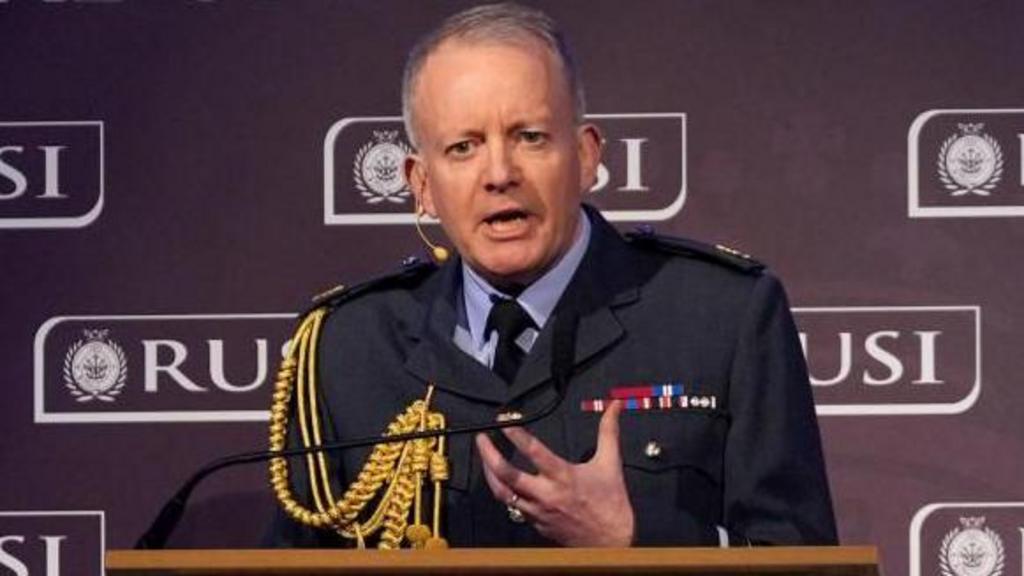
The UK requires “more people being ready to fight for their country” as a deterrent against potential Russian aggression, according to the head of the British military.
Air Chief Marshal Sir Richard Knighton, the Chief of the Defence Staff, emphasized the need for “a whole-of-society response,” including bolstering regular forces, cadet programs, and reserves.
Sir Richard also advocated for increased recruitment of school leavers and graduates into the defense industry.
While acknowledging the remote probability of a direct Russian assault on the UK, Sir Richard told an audience at the Royal United Services Institute that the escalating threat of hybrid attacks necessitated heightened vigilance.
“Sons and daughters. Colleagues. Veterans will all have a role to play. To build. To serve. And if necessary, to fight,” Sir Richard stated.
“And more families will know what sacrifice for our nation means.”
The Chief of Defence Staff referenced a recent incident involving a Russian spy ship suspected of mapping undersea cables near UK waters.
“Every day the UK is subject to an onslaught of cyber-attacks from Russia and we know that Russian agents are seeking to conduct sabotage and have killed on our shores,” he added, highlighting the multifaceted nature of the threat.
He warned that Russia’s military capabilities have become a “hard power [which] is growing quickly.”
Despite the strategic setbacks experienced by Russia in its full-scale invasion of Ukraine, Sir Richard cautioned against complacency: “We should be under no illusions that Russia has a massive, increasingly technically sophisticated, and now highly combat-experienced military.”
Sir Richard, who assumed his role as Chief of the Defence Staff in September, stressed the importance of the UK becoming a “harder target” to deter hybrid threats and prevent conflict.
Building national resilience extends beyond military strength, encompassing the resources of the UK’s universities, energy sector, manufacturing industries, and the National Health Service (NHS).
This also involves expanding industrial capacity “to meet the demands in the UK and of our allies to re-stock and re-arm.”
“Building this industrial capacity also means we need more people who leave schools and universities to join that industry.”
He stated that “we need defence and political leaders to explain the importance of the industry to the nation, and we need schools and parents to encourage children and young adults to take up careers in the industry.”
Addressing a skills gap identified in a recent Royal Academy of Engineering report, Sir Richard announced £50 million in funding for new defense technical excellence colleges, emphasizing the need for collaboration with industry and young people.
In recent weeks, both France and Germany have unveiled plans for voluntary national service initiatives.
Last year, the then-Conservative government proposed its own compulsory scheme, which was subsequently dismissed by Labour as a publicity stunt.
Sir Richard acknowledged that he found himself in an unprecedented position, “looking at the prospect of the largest sustained increase in defence spending since the end of the Cold War.”
The government announced earlier this year that UK defence and security spending would rise to 5% of GDP by 2035 at the latest.