

As sirens blare, Norma Tactacon can only pray.
The 49-year-old domestic worker, employed in the Middle East, is separated by thousands of miles from her family – her husband and three children – back in the Philippines.
Stranded in Qatar, amid the escalating tensions involving the U.S., Israel, and Iran, her sole hope is to return home to her loved ones.
“I get scared and nervous every time I see pictures and videos of missiles in the air,” she told the BBC. “I need to be alive to be there for my family. I’m all that they have.”
As wealthy Gulf states hosting U.S. military bases become potential targets of Iranian strikes, a significant number of expatriates have departed, and tourism has dwindled.
The situation is particularly challenging for the millions of migrant workers whose futures are now uncertain. These individuals, from domestic staff to construction laborers, have long bolstered these economies, enabling them to support their families back home.
Tactacon had aspirations of funding her 23-year-old son’s graduation from police academy and providing her two daughters, aged 22 and 24, with nursing educations, paving the way for lucrative overseas careers.
This ambition has driven her to work as a maid in Qatar, Saudi Arabia, and the United Arab Emirates (UAE) for much of the past two decades.
Her primary motivation for staying is the relatively high salary. Filipino domestic workers in the Middle East earn a minimum wage of $500 (£370) a month, significantly more than similar jobs in the Philippines.
“I hope the world will be peaceful again and things go back to the way they were. I pray that the war will stop,” Tactacon said from Qatar.
However, the ongoing conflict is prompting her to reconsider her decision. She is contemplating returning home and starting a small business with her husband, given the escalating risks.
A stark reminder of the dangers is the death of Mary Ann Veolasquez, a 32-year-old Filipina caregiver in Israel, who was among the conflict’s first casualties.
The Israeli embassy in Manila reported that she was injured while guiding her patient to safety after a ballistic missile struck her apartment in Tel Aviv.
According to the International Labour Organisation (ILO), the region hosts 24 million migrant workers, making it the world’s top destination for overseas labor. Most originate from Asia, including India, Pakistan, Bangladesh, Sri Lanka, the Philippines, and Indonesia. Many of these workers hold low-paying or precarious jobs and have limited access to healthcare, according to the ILO.
Reports indicate that at least 12 South Asian migrant workers have died as a result of the conflict thus far.
Among the war’s mounting fatalities is Dibas Shrestha, a 29-year-old Nepali security guard in Abu Dhabi, who died in an Iranian strike on March 1.
“I tried to convince him to move back to Nepal, but he said he liked his job in Abu Dhabi, and that he had a good life,” his uncle Ramesh told the BBC.
“We have many relatives who’ve moved to the Gulf for work, so we were very worried for all of them,”
When the war started, Shrestha assured his family it was safe. In a post on Facebook, he wrote that watching the news had made him “concerned” but he also felt, “The news sometimes presents exaggerated or misleading information”.
His uncle said Shrestha had been saving up to rebuild his parents’ home after it had been damaged in an earthquake in 2015 that killed hundreds.
“He was their only son,” Ramesh added. “So kind, and very smart.”
More than 120kms away, in Dubai, debris from an intercepted missile killed Ahmad Ali, a 55-year-old water tank supplier from Bangladesh.
His son, Abdul Haque, said he joined his father to work in the UAE but returned to Bangladesh before the war started. His father continued sending money home – $500 to $600 every month, which is a huge sum in the poor South Asia nation.
Ahmad died during Ramadan, and his son was told it happened in the evening, just as people were breaking their fast.
“He really liked the people in Dubai, he said they were welcoming, that it was a great place to live,” Abdul told the BBC.
“I don’t even think he knew the war was going on. He didn’t read the news and didn’t have a smartphone.”
Abdul’s his view of Dubai and the region has changed: “It’s not safe now, nobody wants to lose a father.”
Governments in Asia have been scrambling to bring migrant workers home.
However, the threat of missile strikes has disrupted travel to and from Dubai, Abu Dhabi, and Qatar, forcing those seeking to leave to take longer routes home.
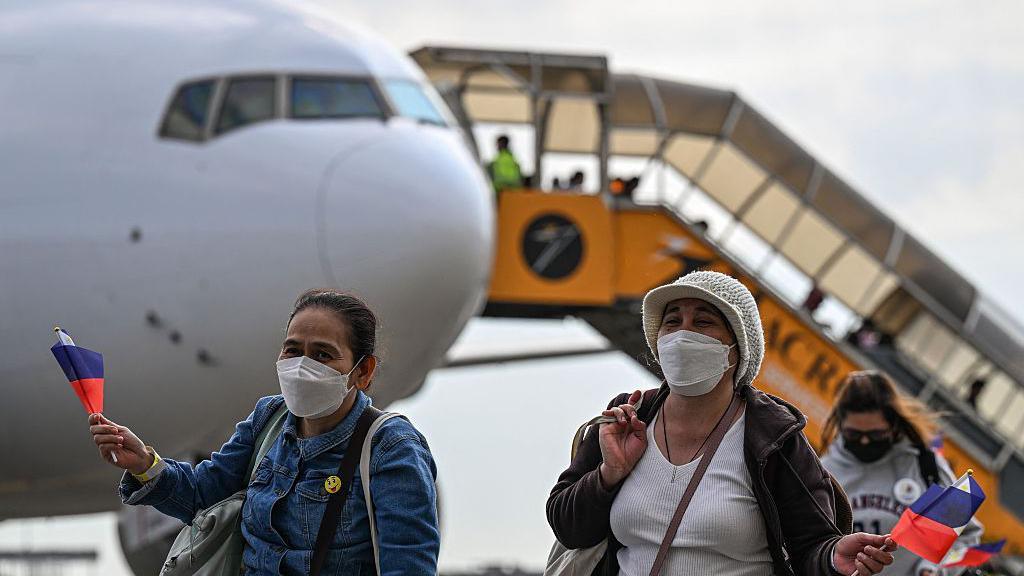
The most recent repatriation effort saw 234 Filipino workers from Kuwait, Qatar, and Bahrain travel up to eight hours by land to Saudi Arabia, where 109 others awaited them on a Philippine Airlines flight.
As of March 23, approximately 2,000 Filipino workers and their dependents had been flown back to Manila, according to the government.
The Middle East hosts roughly half of the over two million Filipinos working overseas, and their remittances contribute 10% of the Philippine economy.
Remittances are equally critical for Bangladesh, where most of its 14 million migrant workers are based in the Middle East.
Nearly 500 Bangladeshi workers have been repatriated since the conflict began, and the government in Dhaka has arranged for at least two more flights home, departing from Bahrain.
For some, leaving is not a viable option.
Su Su from Myanmar found a safe haven in Dubai after fleeing her country, which has been embroiled in a bloody civil war since 2021.
The 31-year-old, who works as an operations specialist for a real estate company, has resided in Dubai for two years.
She notes that her current work-from-home arrangement is reminiscent of COVID-19 lockdowns, except when she hears the sirens, at which point she must stay away from her window.
“I have an emergency bag prepared in case I have to evacuate… This is just a habit I got from Myanmar.”
And yet, she says, “The feeling here is more calm. I believe at the end of the day, we will be fine.”
Additional reporting by BBC Burmese and BBC Indonesian
The average price at the pump has topped $4 in the US for the first time since 2022 as the Iran war continues to push up fuel prices.
The US-Israel Iran war has halted almost all traffic in a key waterway and the price Brent crude has surged.
The BBC’s Gary O’Donoghue spoke to one farmer in Alabama who, despite facing intense financial pressures, continues to support President Trump.
The defence secretary’s comments came after US President Donald Trump told other nations to “go get your own oil”.
An 11-year-old is reported to have been killed in an air strike while manning a checkpoint in Tehran.