

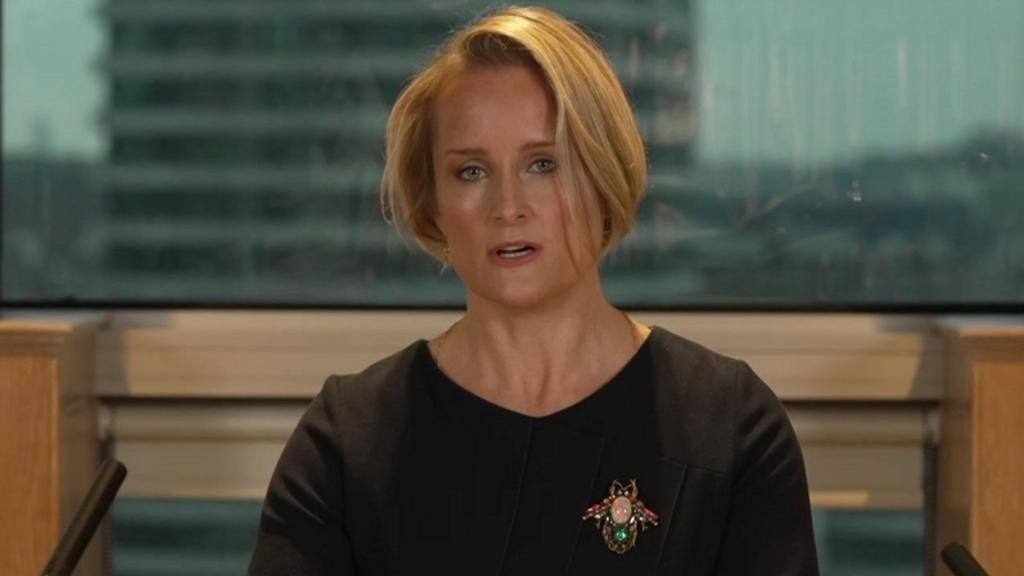
The newly appointed chief of MI6 has stated that “we are now operating in a space between peace and war,” outlining the “interlocking web of security challenges” currently confronting the intelligence agency.
In her inaugural public address since assuming the role, Blaise Metreweli focused on the multifaceted threat posed by Russia, asserting that the nation is “testing us in the grey zone with tactics that are just below the threshold of war.”
She emphasized “the menace of an aggressive, expansionist, and revisionist Russia,” referencing the ongoing conflict in Ukraine and affirming the UK’s commitment to maintaining pressure on Russian President Vladimir Putin in support of Ukraine.
Ms. Metreweli is the first woman to lead Britain’s foreign intelligence service.
She succeeded Sir Richard Moore as the head of the Secret Intelligence Service on October 1.
During her Monday speech, Ms. Metreweli pointed to instances of drone activity over airports and airbases, as well as cyberattacks targeting critical infrastructure, as examples of Russia’s hybrid warfare and grey-zone tactics.
“It’s important to understand their attempts to bully, fearmonger, and manipulate, because it affects us all,” she stated.
Referring to the recent sanctions imposed on Russian entities accused of conducting information warfare, Ms. Metreweli remarked, “The export of chaos is a feature, not a bug, in this Russian approach to international engagement.”
Western sanctions have undoubtedly impacted Russia’s economy, redirecting its exports eastward towards China and India.
However, they have not altered President Putin’s determination to continue the war in Ukraine until his demands for territory and loyalty to Moscow are met.
Furthermore, Ms. Metriweli described “the defining challenge of the 21st century” as “not simply who wields the most powerful technologies, but who guides them with the greatest wisdom.”
“Power itself is becoming more diffuse, more unpredictable, as control over these technologies is shifting from states to corporations, and sometimes to individuals,” she added.
Addressing the threat posed by Russia would require integrating technology and a deep understanding of technology into all MI6 operations, she emphasized, highlighting the importance of acquiring knowledge of new technologies.
Having joined MI6 in 1999, she ascended to the top position after serving in Q Branch. Named after the fictional MI6 division in Ian Fleming’s spy novels, this real-life, highly secretive division within the Secret Intelligence Service is responsible for designing the specialized gadgets and tools that enable agents to communicate with their handlers discreetly and securely.
Ms. Metriweli urged all intelligence officers to master technology, “not just in our labs, but in the field, in our tradecraft…”
“We will become as comfortable with lines of [computer] code as we are with human sources, as fluent in Python as we are in multiple languages.”
The mention of Python, a programming language, might surprise some, given its existence for over three decades. However, her message will resonate with those who have chosen to work in the clandestine world of espionage.
In an era where data is paramount and spies can no longer rely on false identities due to the rapid advancement of biometric scanning at borders and checkpoints, MI6 must demonstrate its continued relevance.
Sign up for our Politics Essential newsletter to stay informed about the inner workings of Westminster and beyond.