

The Home Secretary has declared violence against women and girls a “national emergency,” unveiling plans for specialist rape and sexual offense investigation teams in every police force across England and Wales by 2029.
This initiative forms part of a long-awaited strategy aimed at halving violence against women and girls within the next decade.
The strategy, which includes funding for undercover online units and the rollout of domestic abuse protection orders, is scheduled for release on Thursday after three postponements this year.
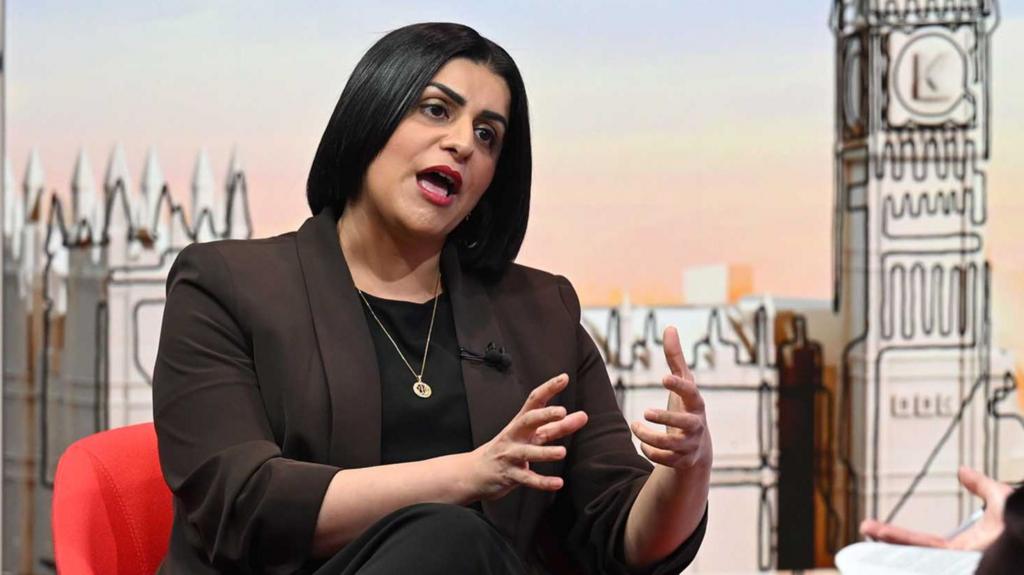
Shabana Mahmood stated that her time in government led her to “the depressing conclusion” that “the criminal justice system fails women.”
Speaking on the Sunday with Laura Kuenssberg program, she noted the inconsistency in police investigation approaches, describing it as “too much of a postcode lottery.”
The government asserts that the new teams will comprise officers with specialized skills in handling rape and sexual offense cases.
It also states that staff will receive appropriate training to understand the perspectives of both abusers and victims.
While over 50% of police forces currently have such teams, the government aims to ensure dedicated officers are in place in every force by 2029.
Metropolitan Police Commissioner Sir Mark Rowley welcomed the initiative, noting that the government would replicate tactics employed by the Met’s existing V100 program.
This program utilizes data to identify and target men who present the highest risk to women.
Sir Mark stated that the Met applies the “same relentless determination we use to combat terrorism to tackle violence against women and girls,” adding, “We built an entirely new system focused on pursuing and prosecuting men who commit violence, and I am pleased the government is now asking all forces to have the same principle.”
Additionally, the rollout of domestic abuse protection orders, trialed over the past year, has been announced for England and Wales.
These orders can prohibit individuals from contacting victims, visiting their homes, or posting harmful content online, and can be applied in cases involving coercive or controlling behavior. Violating an order constitutes a criminal offense.
Mahmood indicated that early evidence from the pilot programs on the effectiveness of these orders was “very, very positive,” with numerous arrests for breaches.
“The really different thing that those orders do is they take the onus away from the woman, the victim herself, to chase her abuser all the way around different bits of the legal system in order to enforce the order and actually puts it back on the police,” she said.
Nearly £2 million will be invested in specialized undercover units of police officers operating online to target individuals harassing women and girls on the internet.
The government is also considering extending Clare’s Law to encompass offenses like stalking, sexual assault, and harassment.
The law was established in memory of Clare Wood, who was murdered in 2009 by her ex-boyfriend with a history of violent behavior.
Currently, it allows individuals to request information from the police regarding their partner’s or ex-partner’s history of domestic abuse.
A report released earlier this month revealed that over a quarter of police forces in England and Wales had not implemented basic policies for investigating sexual offenses.
It highlighted the prevalence of sexually motivated crimes against women in public, criticized the limited data available, and urged immediate action to prevent predators from offending.
The government’s strategy has faced significant delays, initially expected to be announced in the spring.
In last year’s general election manifesto, the Labour party pledged to use “every government tool available to target perpetrators and address the root causes of abuse and violence.”
On Tuesday, the chairs of three Commons select committees expressed their concerns regarding repeated delays in publishing the plans.
The BBC has previously reported that changing attitudes among boys and young men will be central to the proposals.
The strategy is understood to be built around three key objectives: preventing the radicalization of young men, stopping abusers, and supporting victims.
Some domestic abuse survivors have told the BBC that the time for discussion is over and these measures must be implemented swiftly.
Conservative shadow home secretary Chris Philp described the announcement as “too little, too late.”
Speaking to Laura Kuenssberg, he expressed “disappointment” that it had taken the government a year and a half to produce its strategy and that the allocated funding was “a very small amount.”
When asked why the previous Conservative government, of which he was a member, and the current Labour one had struggled to address the issue, he stated that both parties took the matter “seriously” but noted that the criminal justice system was “quite slow and bureaucratic.”
He suggested that changes to evidence disclosure, implemented after a prosecution collapsed in 2017, had “slowed the whole system down.”
The law was passed after Jade Ward was murdered by her ex-partner as their children slept nearby.
Katie Yates wants to warn women to be wary of strangers posing as “nice guys” on dating apps.
A conference to tackle violence against women and girls has set out actions for policy makers.
It will receive £170,000 a year for refuge services and safe accommodation, if councillors approve.
One in every five crimes reported to Gloucestershire Police relates to domestic violence.