

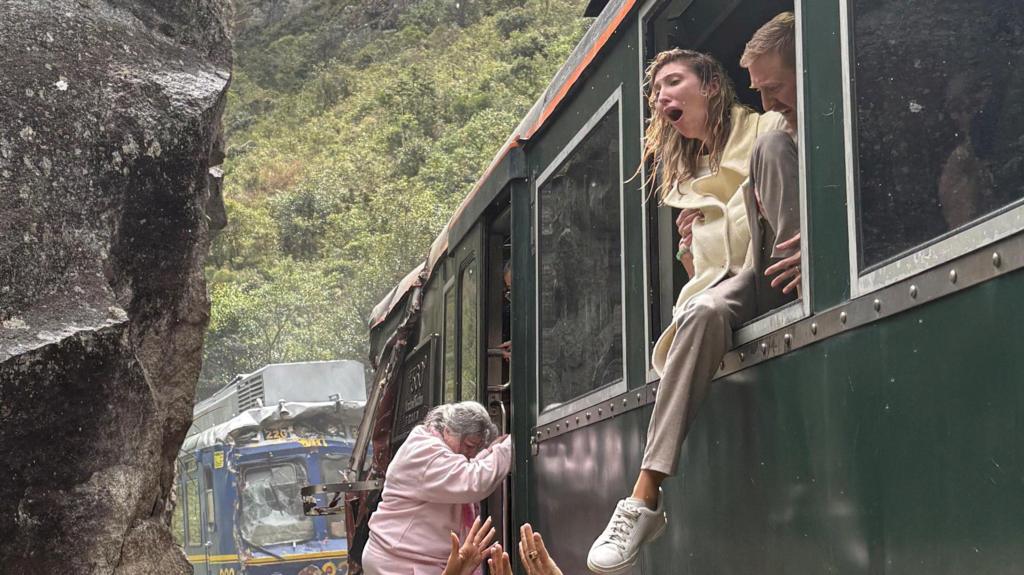
A passenger has described a scene of “chaos” following a head-on collision between two trains in Peru, near the popular tourist destination of Machu Picchu.
Niels Honkoop, 33, recounted to the BBC that he had moved from the middle to the rear of the train before the incident. He noted that many passengers near the front sustained injuries in the crash.
“I witnessed staff running, people crying, and individuals on the floor as chaos erupted,” Honkoop stated. “After disembarking, I observed people bleeding with significant injuries.”
The collision, which occurred at approximately 13:20 local time (18:20 GMT) on Tuesday, resulted in the death of a train driver and injuries to at least 40 others.
Honkoop described the table in front of him breaking in two and shattered glass covering the carriage floor. He also noted that many injured individuals were lying in the aisle, including a woman trapped “between a bench and a table.”
He attempted to provide assistance by moving luggage and distributing painkillers, explaining, “I’d recently had a wisdom tooth removed, so I had a supply of painkillers with me.”
The UK Foreign Office has stated it is “supporting a number of British nationals involved” in the collision, while the US embassy in Peru reported that US citizens sustained injuries.
Honkoop said that a subsequent train arrived with medical personnel after the crash. He and his tour group were transported to a nearby village, where they received food, medical attention, and lodging in a hotel.
The collision took place on the rail line connecting Ollantaytambo Station and Aguas Calientes, the town closest to Machu Picchu. The journey between these stations typically takes about 90 minutes.
The trains involved in the incident were operated by PeruRail and Inca Rail.
“We deeply regret this incident,” PeruRail said in a statement, adding that its personnel had “immediately” provided first aid to the train driver, conductor, and passengers affected.
The cause of the accident remains under investigation.
This incident occurs amidst an ongoing dispute among transportation providers serving the UNESCO World Heritage site, with local communities expressing dissatisfaction over what they perceive as a non-transparent bidding process.
Trains and buses transporting tourists to the ancient site command high ticket prices and can be a lucrative venture for operators due to the site’s limited accessibility.
Machu Picchu, built in the Peruvian Andes during the 15th century, is recognized as one of the New Seven Wonders of the World.
Visitors can access the site via a combination of trains and buses, or by hiking the Inca Trail with a registered tour operator.
In 2011, authorities implemented a daily visitor limit to safeguard and preserve the site; however, concerns regarding over-tourism persist.