

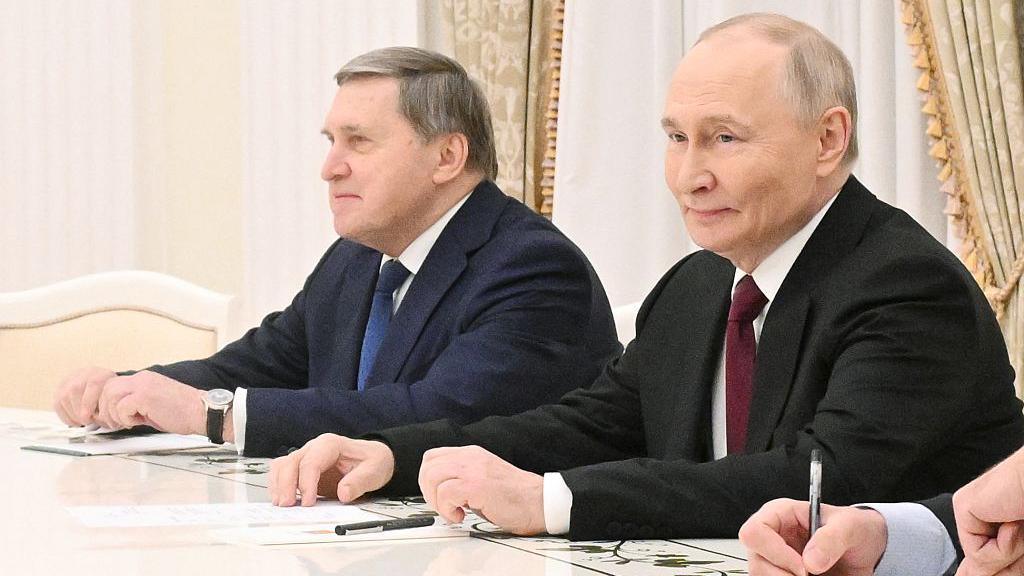
Russian President Vladimir Putin convened with U.S. negotiators at the Kremlin on Tuesday for a reported five hours of discussions centered on resolving the conflict in Ukraine.
Yuri Ushakov, an aide to Putin, characterized the closed-door talks with U.S. envoy Steve Witkoff and Jared Kushner, son-in-law of former President Donald Trump, as “constructive,” while also noting that “a lot of work lies ahead.”
Earlier that day, Putin had dismissed European demands concerning a proposed U.S.-Russia peace accord, asserting that “if Europe wants to fight with us, we are ready to do so.”
The U.S. delegation’s visit to Moscow followed similar consultations with representatives from Kyiv in the preceding weeks. Ukrainian President Zelensky stated he anticipated a briefing from the U.S. team following the meeting.
Zelensky expressed that an opportunity to end the war exists “now more than ever,” but acknowledged that certain aspects of the proposals require further refinement.
“Everything depends on today’s discussions,” Zelensky remarked during a press conference in Dublin, where he was conducting an official visit to Ireland.
Since the circulation of a 28-point peace plan in November – widely perceived as favoring Moscow – Kyiv representatives have engaged in two meetings with U.S. negotiators, including Witkoff, Kushner, and Secretary of State Marco Rubio.
The proposal elicited strong reactions in Ukraine and across Europe due to its apparent inclination towards the demands of Moscow, which initiated its invasion of Ukraine nearly four years prior.
Following discussions with Ukraine over the weekend, the White House indicated that the proposals had undergone “very much refined,” although details of the updated plans remain undisclosed.
Significant disagreements persist between Moscow and Kyiv, particularly concerning Ukrainian sovereignty over territories partially controlled by Russia and the provision of security guarantees.
Zelensky stated on Tuesday that there were “no simple solutions,” reiterating Ukraine’s insistence on participating in peace negotiations and securing clear security guarantees, such as NATO membership – a prospect long opposed by Russia and previously ruled out by Trump.
“We have to stop the war in such a manner that in one year, Russia would not come back,” Zelensky added.
Putin’s stance on his demands appeared firm as recently as last week, while Zelensky has consistently stated he would not cede control of eastern Ukrainian regions.
Concurrently with Tuesday’s talks, Trump conveyed to his cabinet in Washington that the conflict had been challenging to resolve.
“Our people are over in Russia right now to see if we can get it settled,” he said. “What a mess.”
Kyiv’s European allies responded to the 28-point plan with their own document, omitting several of the most contentious elements, such as Washington’s recognition of Donetsk and Luhansk as de facto Russian territories.
Speaking prior to Tuesday’s meeting, Putin told reporters that Europe’s demands were “not acceptable” and accused them of attempting to obstruct peace efforts.
Zelensky met with French President Emmanuel Macron on Monday, with several European leaders participating virtually in the meeting.
Macron stated that there was “no finalised plan to speak of” and that any resolution could only be achieved with the input of Ukraine and Europe.
Meanwhile, fighting persisted on the front lines on Tuesday. Ukraine’s military reported ongoing engagement with Russian troops in the key eastern city of Pokrovsk, contradicting Moscow’s claim of having captured it.
Russia’s Ministry of Defence shared a video on Telegram purportedly showing its troops raising flags in the strategically important city, which they have been attempting to seize for over a year.
Ukraine’s eastern military command asserted that Russia had attempted to “flag-plant” in the city to enable “propagandists” to claim its capture. “They fled in a hurry, and the mopping up of enemy groups continues,” it stated on social media.
Ukraine’s military stated that its forces remained in control of the northern part of the city, with Russian units sustaining heavy losses, while international observers also disputed Russia’s claim to the area.
The military in Kyiv also refuted Russia’s claims of having captured the north-eastern Ukrainian border town of Vovchansk and indicated it had “significantly improved” its position in the northeastern city of Kupyans, which Russia claimed to have conquered a fortnight ago.
Since Russia’s invasion of Ukraine on 24 February 2022, tens of thousands of soldiers have been killed or injured, alongside more than 14,000 civilians, according to UN estimates.
Civilian targets, including kindergartens, hospitals, and residential buildings, have been destroyed or heavily damaged by nightly drone or missile attacks.
The conflict between the two ex-Soviet states dates back to 2014, when Ukraine’s pro-Russian president was overthrown, and Russia responded by annexing Crimea and supporting armed uprisings in eastern Ukraine.
The announcement was made by Taoiseach Micheál Martin at a press conference on Tuesday.
While many Ukrainians believe they have sacrificed too much for their country to lose territory to Russia, others are desperate for the war to end.
The group has been charged under a law which prohibits people from joining foreign armies.
How Russia’s gradual gains in the face of fierce Ukrainian opposition have affected the front line in recent months.
Elizabeth Tsurkov, who was freed in September, tells the BBC that her two years in captivity left her physically and mentally scarred.