

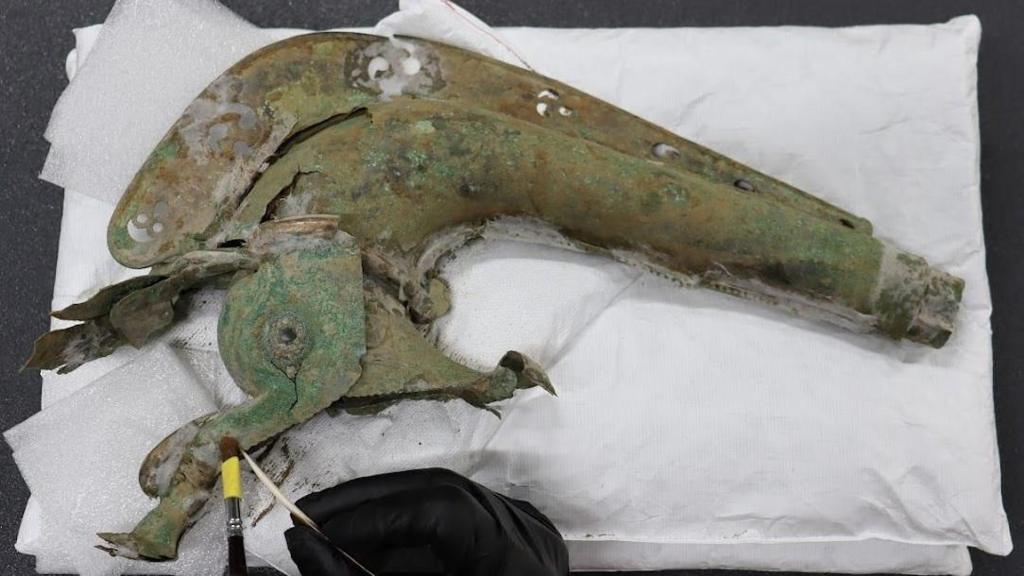
In a remarkable discovery, archaeologists have unearthed two exceptionally rare Iron Age artifacts at a single excavation site.
The team from Pre-Construct Archaeology made the find last year while working on a construction project near Thetford, Norfolk.
The hoard included the most complete battle trumpet, known as a carnyx, ever found in Europe, alongside the first boar’s head flag standard discovered in Britain.
Gary Trimble, senior project officer, stated on BBC Two’s Digging for Britain that carnyces “are extraordinarily rare… a boar standard, that’s even rarer”.
He added, “We have our fair share of hoards in Norfolk, but this is so, so different – it is really, really special.”
Peter Crawley, the dig leader, expressed that he sensed the site’s significance prior to the excavation.
“It felt like one of those special sites that you do get every so often,” he remarked.
The war trumpet was employed by Celtic tribes across Europe to both intimidate adversaries and to galvanize warriors during combat.
This included the Iceni tribe of East Anglia, famously led by Queen Boudica during her revolt against Roman rule in AD60-61.
The Romans were fascinated by carnyces, often depicting them as war trophies.
Jonathan Carr, a conservator, noted that the Thetford carnyx was constructed “from extremely thin sheets of metal which have become extremely brittle after 2,000 years in the ground”.
He further stated that in addition to being one of only three carnyces discovered in Britain, it stands as “the most complete carnyx ever found, with the pipe, mouthpiece and bell all uniquely intact”.
Dr. Fraser Hunter, Iron Age and Roman curator at National Museums Scotland, commented, “I’ve looked at carnyces from around Europe, and the full research and conservation of these incredibly fragile remains will reshape our view of sound and music in the Iron Age.”
The boar’s head standard, fashioned from sheet bronze, would have been raised during battle as a rallying point for troops.
Dr. Hunter elaborated, “They were very fierce animals to face in the hunt, so the symbolism of the boar is a lot about the strength of it – a very appropriate adversary in battle.”
The hoard, dating back to approximately 50BC to AD50, also contained five shield bosses and an iron object of indeterminate origin.
Following its discovery, the entire find was carefully extracted in a soil block and scanned to map the position of the artifacts before conservation efforts commenced.
The discovery has been reported to the coroner, and an inquest will determine whether it qualifies as treasure. A decision regarding its long-term future is pending.
Historic England is collaborating with Pre-Construct Archaeology, Norfolk Museums Service, and the National Museum of Scotland to coordinate the research and conservation of the finds.
Dr. Tim Pestell, senior curator of archaeology for Norfolk Museums Service, stated, “This find is a powerful reminder of Norfolk’s Iron Age past which, through the story of Boudica and the Iceni people, still retains its capacity to fascinate the British public.”
He added, “The Norfolk Carnyx Hoard will provide archaeologists with an unparalleled opportunity to investigate a number of rare objects and ultimately, to tell the story of how these came to be buried in the county 2,000 years ago.”
Claudia Kenyatta CBE and Emma Squire CBE, co-CEOs of Historic England, hailed it as a “remarkable discovery”.
“We look forward to uncovering and sharing the story of the Norfolk community that owned and used these items,” they jointly stated.
The story of the discovery will be featured on BBC Two’s Digging for Britain on 14 January at 21:00 GMT, or on BBC iPlayer.
Follow Norfolk news on BBC Sounds, Facebook, Instagram and X.
The IOPC is still reviewing evidence following the death of Tony Keeble on the A11 at Thetford.
A look at what stories are trending across the West of England.
The CIA officer, who has died, aged 84, sold secrets to the Soviet Union, leading to the deaths of at least 10 Western agents. In 1994, the BBC spoke to one of the spies he betrayed.
Archaeologists have found evidence of 340 Roman graves but say the site could hold more.
Archaeologists peeling back 2,000 years of history hope they will have some “interesting surprises”.