

For Arnob Roy, co-founder of Tejas Networks, a dependable supply chain of computer chips is paramount.
Based in Bangalore, India, his company provides essential equipment that underpins mobile phone networks and broadband connectivity.
“We essentially supply the electronics that facilitate data traffic across telecommunications networks,” he explains.
This necessitates specialized chips tailored for the demands of telecom operations.
“Telecom chips differ significantly from those in consumer electronics or smartphones. They are engineered to manage massive data volumes from hundreds of thousands of simultaneous users.”
“These networks demand unwavering uptime. Reliability, redundancy, and fail-safe mechanisms are critical, requiring a chip architecture designed to support these features,” Roy emphasizes.
Tejas undertakes the design of many of these chips within India, a nation recognized for its proficiency in semiconductor design.
It’s estimated that India is home to 20% of the world’s semiconductor engineers.
“Virtually every major global chip manufacturer maintains its largest or second-largest design center in India, actively developing cutting-edge products,” states Amitesh Kumar Sinha, Joint Secretary of India’s Ministry of Electronics and Information Technology.
However, India faces a deficit in domestic semiconductor manufacturing capabilities.
Consequently, Indian companies such as Tejas Networks design their required chips in India but rely on overseas facilities for their fabrication.
The vulnerability of this arrangement became evident during the COVID-19 pandemic, as chip shortages disrupted supply chains and forced production cutbacks across various industries.
“The pandemic underscored the over-concentration of global semiconductor manufacturing and the inherent risks associated with such concentration,” Roy points out.
This realization has propelled India to foster its own domestic semiconductor industry.
“COVID-19 demonstrated the fragility of global supply chains. Disruptions in one region can cascade and impact electronics manufacturing worldwide,” Sinha observes.
“Therefore, India is actively building its semiconductor ecosystem to mitigate risks and bolster resilience,” he adds.
Sinha is spearheading government initiatives to cultivate the semiconductor industry, focusing on identifying areas within the production process where India can achieve a competitive advantage.
The semiconductor manufacturing process comprises several stages. Design, where India already possesses significant strengths, is the first.
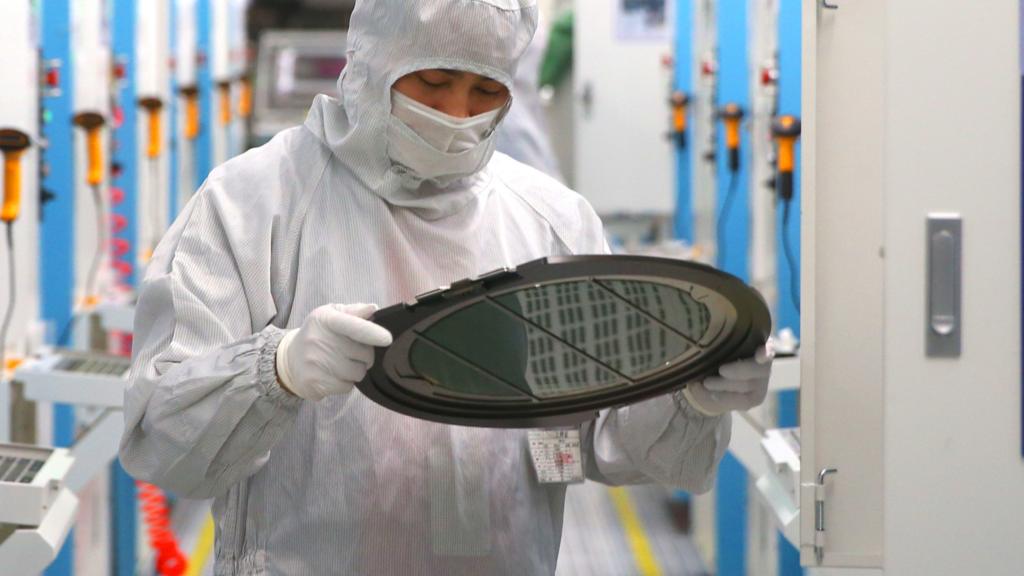
The subsequent stage involves wafer fabrication, where intricate circuits are etched onto thin silicon wafers using sophisticated and expensive equipment within large manufacturing facilities known as semiconductor “fabs.”
This phase, particularly for the most advanced chips, is largely dominated by companies in Taiwan, with China striving to narrow the gap.
The third stage involves dicing the silicon wafers into individual chips, encapsulating them in protective casings, connecting them to electrical contacts, and conducting thorough testing.
This final stage, referred to as Outsourced Semiconductor Assembly and Test (OSAT), is the primary focus of India’s efforts.
“Assembly, testing, and packaging represent a more accessible entry point compared to fabrication, and this is where India is initially focusing its efforts,” explains Ashok Chandak, president of the India Electronics and Semiconductor Association (IESA).
He anticipates that several such plants will “commence mass production” within the current year.
Established in 2023, Kaynes Semicon is the first company to operationalize a semiconductor plant with support from the Indian government.
Kaynes Semicon has invested $260 million in a facility located in the northwestern state of Gujarat to assemble and test computer chips. Production commenced in November of the previous year.
“Packaging entails more than simply placing a chip in a box; it involves a 10 to 12-step manufacturing process,” explains Raghu Panicker, CEO of Kaynes Semicon.
“Consequently, packaging and testing are as critical as the chip manufacturing itself; without this stage, the wafer remains unusable for industry applications.”
The facility will not be producing the most advanced computer chips used in cutting-edge mobile phones or for AI training purposes.
“India’s immediate needs do not center on the most complex data center or AI chips. Our current demand and inherent strengths lie elsewhere,” Panicker clarifies.
Instead, the focus will be on chips used in sectors such as automotive, telecommunications, and defense.
“While these chips may lack glamour, they are economically and strategically more vital for India. Building an industry begins with serving the domestic market. Complexity can follow, but scale must come first,” he adds.
Kaynes Semicon has faced a significant learning curve.
“We had never constructed a semiconductor cleanroom in India before, nor had we installed this type of equipment or trained personnel for such operations,” Panicker states.
“Semiconductor manufacturing demands a level of discipline, documentation, and process control that differs substantially from traditional manufacturing. This cultural shift is as crucial as the technical one.”
Securing adequately trained staff has been a major challenge.
“Training requires time. One cannot condense five years of experience into six months. This represents the most significant bottleneck,” Panicker explains.
Back in Bangalore, at Tejas Networks, Arnob Roy is eager to increase the sourcing of locally produced technology.
“Over the next decade, we anticipate the development of a substantial semiconductor manufacturing base in India, which will directly benefit companies like ours.”
He acknowledges that it is the beginning of a lengthy journey.
“I foresee Indian companies eventually designing and manufacturing complete telecom chipsets, but this will require patient capital and time.”
“The maturation of deep-tech products takes longer, and India is only now beginning to support that type of investment.”
Find out who is in each squad for the Men’s T20 World Cup which begins on 7 February.
Sir Mark Tully’s cremation was held on Monday in Delhi, where he lived even after leaving the BBC.
India take an unassailable 3-0 series lead in the T20 series against New Zealand after Abhishek Sharma hits an unbeaten 68 off 20 balls, including a 14-ball 50.
Fixtures, results and scorecards for the 2026 ICC Men’s T20 World Cup in India and Sri Lanka.
Sir Mark covered some of the defining moments in India’s history in a career that spanned decades.