

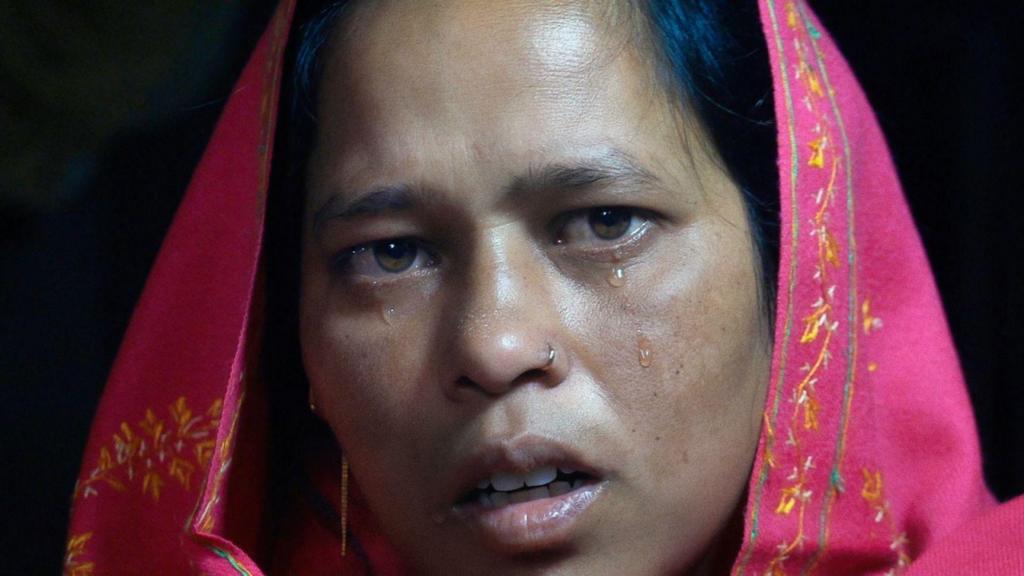
“I was scared that my child’s nationality would change if he was born in Bangladesh,” recounts Sunali Khatun, 25, a heavily pregnant woman who returned to India earlier this month after being deported to the neighboring country in June.
Ms. Khatun, a domestic worker hailing from the eastern Indian state of West Bengal, was detained in Delhi alongside her husband, Danish Sheikh, and their eight-year-old son. The family was subsequently deported to Bangladesh on suspicion of being undocumented immigrants. Upon arrival, Bangladeshi authorities detained the family for unlawful entry.
Her deportation garnered national attention and drew strong criticism from the West Bengal government, which accused the Bharatiya Janata Party-led federal government of deporting her without due cause. Ms. Khatun is among hundreds who have been detained and deported to Bangladesh in recent months under suspicion of illegal immigration.
While Delhi has not released official figures on these deportations, credible sources within the Bangladesh government previously informed the BBC that over 1,200 individuals were “illegally pushed in” during May alone. That same month, the government-run All India Radio reported the repatriation of approximately 700 people from Delhi.
Crackdowns targeting alleged Bangladeshi immigrants are not unprecedented in India. The two nations share deep cultural ties and a porous 4,096km (2,545-mile) border that spans five states. West Bengal, like other states along the frontier, has historically experienced waves of migration driven by the search for work or flight from religious persecution.
However, human rights advocates assert that the recent deportations disproportionately affect Bengali-speaking Muslims—the language common to both West Bengal and Bangladesh—and are conducted without adherence to proper legal procedures.
Ms. Khatun and her family, along with three neighbors—all Bengali-speaking Muslims—were deported after Delhi’s Foreign Regional Registration Office determined they lacked documentation proving their legal entry or residence in India. Her seven-year-old daughter was not deported as she was staying with relatives at the time of the family’s detention.
Standard protocol requires authorities to verify a suspected undocumented migrant’s claim with their home state. Samirul Islam, chairman of the West Bengal Migrant Workers Welfare Board, stated to the BBC that this verification process was not followed in Ms. Khatun’s case.
The BBC has contacted Delhi’s home department, which oversees deportations, for comment.
In December, India’s Supreme Court directed the federal government to permit Ms. Khatun and her son to return on “humanitarian grounds” while her citizenship was under investigation. She currently resides with her parents in West Bengal. Her husband, released on bail, remains in Bangladesh with a relative.
Ms. Khatun expresses mixed emotions about her return to India.
While she is relieved that her child, due in January, will automatically acquire Indian citizenship, she remains deeply concerned about her husband, whom she has not seen for over three months since their separation in Bangladeshi prisons.
She recounts that during video calls, he frequently breaks down, expressing his desire to return home.
“We are not from Bangladesh, we are Indian. Why did they do this to us?” Ms. Khatun asks.
She alleges that approximately one week after being detained by Delhi police, her family and neighbors were transported to the India-Bangladesh border and “pushed” across by Border Security Force (BSF) personnel.
“They left us in a dense forest [in Bangladesh] with lots of rivers and streams,” she claims. She further alleges that when they attempted to re-enter India via a route suggested by locals, BSF guards assaulted members of the group, including her husband, before forcing them back into the forest.
The BBC has reached out to the BSF for a response to Ms. Khatun’s allegations.
With assistance from locals, the group traveled to Dhaka, where they spent days with limited access to food and water before being arrested and imprisoned. Ms. Khatun reports that the prison food was inadequate for a pregnant woman and that her cell lacked toilet facilities.
“I was scared because it was just my son and me. All we did was cry,” she recounts.
The BBC has contacted Bangladesh’s home and prisons departments seeking comment on Sunali’s allegations.
Back in India, her family tirelessly petitioned the courts to prove her citizenship and facilitate her return. Her case is currently under consideration by the Supreme Court.
“My family has been torn apart,” Ms. Khatun laments, sitting in her parents’ single-room dwelling in West Bengal. With two young children and another on the way, she expresses uncertainty about how she will provide for them all.
However, she is resolute about one thing.
“We may struggle to afford three meals a day here, but I will never return to Delhi,” she asserts.
Follow BBC News India on Instagram, YouTube, X and Facebook.
Pakistan’s former PM, who is already serving time in prison, plans to challenge the verdict.
Lucknow recently joined a select list of global cities recognised for their fine food.
Disgraced president Yoon Suk Yeol has become an unlikely poster boy for anti-government sentiment.
The suspect’s spree began at Taipei’s main metro before he moved to another station nearby.
The fresh protests are sparked by the death of one of the leaders of protests that ousted ex-PM Sheikh Hasina.