

“`html
Yoon Ga-eun was not a widely recognized name in South Korea until recently.
Her film, depicting a teenager navigating life as a survivor of sexual violence, has unexpectedly become a significant success.
“It hasn’t really sunk in yet,” the independent filmmaker told BBC Korean in a late November interview at a Seoul studio. “Right now, I feel almost blank – just grateful, and also a bit scared.”
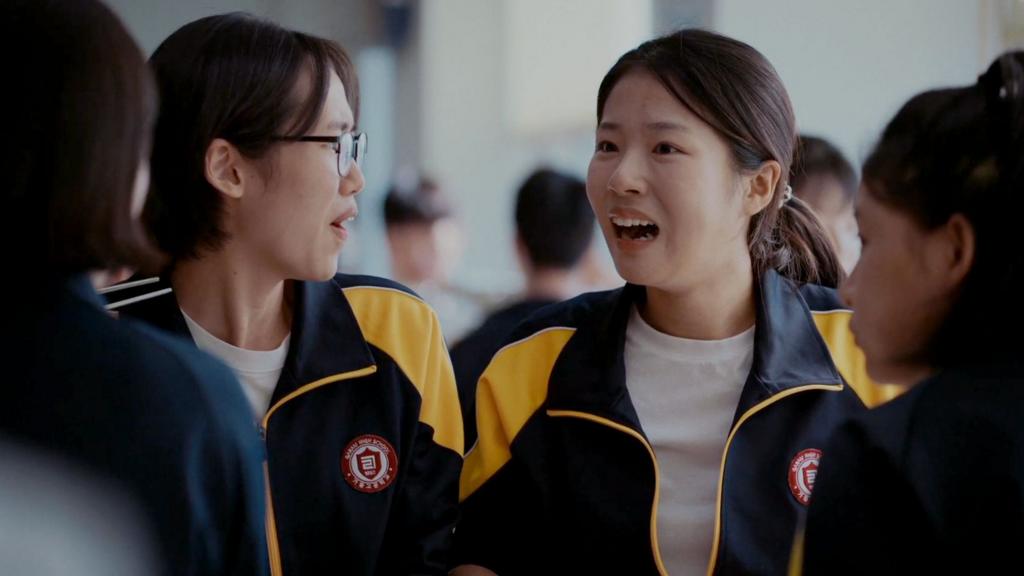
“The World of Love” has been lauded by Korean media as the “movie of the year,” praised for its sensitive and empathetic portrayal of life after trauma. Diverging from a focus on the crime itself, the film centers on the everyday experiences of high-schooler Joo-in, encompassing her academic life, romantic relationships, family dynamics, friendships, and the associated conflicts and joys.
The film has garnered critical acclaim and resonated with audiences, generating over $1.1 million in box office revenue since its October debut. Viewer ratings on Naver, South Korea’s leading search portal, average 9 out of 10.
Bong Jun-ho, director of the globally celebrated film “Parasite” and the first Korean to win an Oscar, described it as “simply a masterpiece,” declaring himself the “head of the Seoul branch of Yoon Ga-eun’s fan club.”
The film’s resonance is particularly significant in a deeply patriarchal society, where women often report facing considerable challenges in having their voices heard. Its unexpected success signals a growing openness to discussing sexual violence and the treatment of survivors.
“The World of Love” might not appear to be a conventional choice for moviegoers.
The Korean title, “Joo-in of the World,” provides limited insight into the plot. While featuring “Parasite” actress Jang Hye-jin and K-drama star Go Min-si, the lead role is played by Seo Su-bin, a relative newcomer to the screen.
Fundamentally, this is a story centered on the life of 17-year-old Joo-in.
By all appearances, Joo-in’s life is thriving. She is well-liked at school, has a loving boyfriend, and lives with a supportive mother and younger brother.
Conflict arises when she refuses to sign a school petition regarding the impending release of a man convicted of assaulting a 10-year-old child who will be returning to their neighborhood. This leads a fellow student to initiate a petition demanding the suspension of his release, which Joo-in alone declines to sign.
Her objection stems from a specific line within the petition: “Sexual violence leaves deep wounds that never heal and completely destroys a person’s life and soul.”
“I can’t agree with this statement,” Joo-in explains to the petition’s author.
This disagreement ultimately leads to the revelation of her secret: she was sexually assaulted by a relative in her youth.
Despite the film’s difficult subject matter, Ms. Yoon intentionally explores the multifaceted aspects of Joo-in’s life. The protagonist’s name, signifying “owner” or “master” in Korean, reflects the autonomy Ms. Yoon envisioned for the character.
Journalists attending the media screening received a handwritten letter from Ms. Yoon requesting that they refrain from explicitly mentioning sexual violence in their coverage of the film.
“The story is more about how we look at her,” Ms. Yoon told the BBC, adding that she resisted labeling her protagonist as a childhood sexual abuse survivor.
“Because Joo-in herself refuses that. It’s one part of her identity and it shakes her, but she insists, ‘That’s not all I am’.”
When deciding to make a film about sexual violence, Ms. Yoon had a clear objective: to avoid predictability.
During her research, she stated she “watched pretty much everything that was out there” on the topic, engaging with survivors and consulting with activists. These conversations shattered the “prejudice” she held, an ignorance that “reduces a person entirely to their wound.”
“We spent so much time talking about completely ordinary concerns,” she said. “Worries about work, family, friendships and romances, about needing to lose weight or gain weight or exercise more. I think those moments dissolved even that last tiny bit of prejudice I still had.”
This approach has resonated with audiences.
Supporters of the film argue that it challenges societal stereotypes surrounding survivors of sexual crimes, encouraging viewers to perceive them differently – as individuals integrated into society who are striving to live their lives like anyone else.
Seo Jinwon, a children’s book editor who saw the film in Seoul, described the cinema as “completely silent” as the film ended.
“No-one rushed to leave. I stayed and watched the end credits. I walked out of the cinema thinking, ‘I want to be a good adult who can stand beside all the children and teenagers who are trying so hard to grow up’.”
A sexual violence survivor, who requested anonymity, said she felt an overwhelming urge to “stretch my arms and cheer” upon leaving the theater.
“Joo-in gave me so much. At the end, it felt like she was smiling at me and saying, ‘I am living well, so let’s keep living well together’.”
According to Cho Eunhee, director of the Korea Sexual Violence Relief Center and consultant for the film, “The World of Love” is furthering the goals that activists have long pursued.
She added that the timing “is incredibly right.”
The 2017–2018 MeToo movement facilitated survivors sharing their stories, fostering greater societal protection and understanding. By 2025, when Ms. Yoon’s film was released, “people were more prepared to empathize with a story like this,” Ms. Cho noted.
She questions whether the film would have “found this level of public understanding” even a few years prior.
While the MeToo movement ignited discussions about harassment and assault in workplaces and public spaces, exposing abuse within families is still widely considered “spitting in one’s own face” – a perception that this film is helping to change by creating more space for dialogue.
“The World of Love” is not without its critics. Some viewers, including survivors, found that the film’s depiction of abuse, families, and trauma minimized fear and lasting damage, and that the portrayal of supportive families was not representative of their realities.
However, critic Min Youngjun argues that these criticisms do not diminish the film’s value. He asserts that “The World of Love” has fostered a constructive environment for discussing sexual violence and its impact on victims.
“The mark of a good film is not how many people liked it versus didn’t like it. What matters is whether it creates a space in which we can talk to each other about what it has put on the table.”
Jessie Buckley won best actress and Adolescence also scooped four awards on the night in California.
Trade, regional security and Beijing’s unofficial ban on Korean pop culture are on the agenda.
The 243kg fish went to a man known as the Tuna King, who said “the year’s first tuna brings good luck”.
Umar Khalid and Sharjeel Imam were arrested under anti-terror laws for their alleged roles in the deadly 2020 Delhi riots.
Coogan stars as football boss Mick McCarthy in the film Saipan, about the fall-out between him and captain Roy Keane.
“`