

The BBC has been granted exclusive access to a collection of artifacts unearthed during the construction of the HS2 rail line, a project that has stirred considerable debate.
The trove of 450,000 objects, safeguarded in a secure warehouse, includes a potential Roman gladiator’s tag, a hand axe estimated to be over 40,000 years old, and a set of 19th-century gold dentures.
Described by the Centre for British Archaeology as “unprecedented” in its scope and variety, the collection promises to offer fresh perspectives on Britain’s history.
In the UK, major construction initiatives are required to undergo archaeological assessments to protect heritage sites, in accordance with planning regulations.
Since 2018, approximately 1,000 archaeologists have participated in 60 excavations along the proposed HS2 route connecting London and Birmingham.
Despite project delays pushing the anticipated opening to after 2033, archaeological fieldwork is reportedly nearing completion.
The warehouse’s location remains confidential for security reasons, situated somewhere in Yorkshire. Inside, rows of pallets hold approximately 7,300 boxes of historical items awaiting further examination.
The ultimate disposition of many artifacts, including whether they will be stored or displayed, and their ownership, is yet to be determined.
Historic England has commended the team for uncovering “new and exciting sites spanning over 10,000 years of our past”.
However, the HS2 project has undeniably reshaped the landscape, impacting fields and communities, and generating significant controversy.
Critics, such as Greg Smith, MP for Mid Buckinghamshire, argue that escalating costs, delays, displaced communities, and environmental damage render the project unjustifiable.
“It should not have cost the taxpayer tens of billions of pounds to build a railway that no-one wants and brings so much destruction,” Smith asserts.
In response, HS2 stated: “Chief Executive Mark Wild has been clear that overall delivery of HS2 has been unacceptable and he’s committed to ending the project’s cycle of cost increases and delays.”
“Our specialist archaeology team and contractors have carefully excavated numerous sites and have shown care and respect throughout this work.”
Historian Graham Evans, chair of the Northamptonshire Battlefields Society, commented: “Whether HS2 is a good or bad thing is debatable, but I tell you what, if they built the railway and they didn’t do the archaeology that would be more tragic.”
The collection includes notable finds such as Roman statue heads and a gold ‘three lions’ pendant dating from the 13th-14th century.
Among the items is a bubble-wrapped empty coffin from 1799, alongside a smaller one wrapped in masking tape, serving as poignant reminders of past lives.
Some of the unearthed objects have previously been made available for public viewing.
We present six artifacts that have not yet been exhibited. Their discovery locations along the HS2 route are indicated on the map below, followed by detailed information about each item.
Experts believe this hand axe, discovered in the Edgcote area of Northamptonshire, dates back over 40,000 years and was crafted by Neanderthals or an earlier human species.
Its sharp edge was likely used for butchering animals.
Hand axes were designed to be held in the palm, rather than attached to a handle.
Dr. Sara Machin, the finds lead for Access +, the consortium of archaeologists overseeing the project, noted: “There is something tactile about it when you hold it. Even now it fits snuggly in my hand.”
This small, inscribed piece of carved bone is believed to be part of a larger inscription, which would have read: “DOMINE VICTOR VINCAS FELIX” or “Lord Victor, may you win and be lucky.”
Discovered in Northamptonshire, Machin suggests it may have belonged to a Roman gladiator, either active or retired, or potentially a spectator, despite the absence of evidence of an arena in the region.
It was found within a large pottery vessel containing cremated human remains, marked with an ‘X’ on the lid.
Dr. John Pearce, Reader in Archaeology at King’s College University, acknowledged the possibility of a gladiator connection but noted that “with more forensic analysis of the burial, a different story may come to light”.
This decorated Anglo-Saxon spindle whorl, thought to be made from a cattle femur and used to add weight while spinning yarn, was unearthed from farmland near Bishopstone, Buckinghamshire.
“It’s a very interesting piece of evidence of textile advancements in the Anglo-Saxon period,” said Willow Major, a post-excavation assistant.
Its polished surface indicates frequent use and sentimental value, she added, noting the presence of a ring and dot motif also found on Iron Age spinning tools.
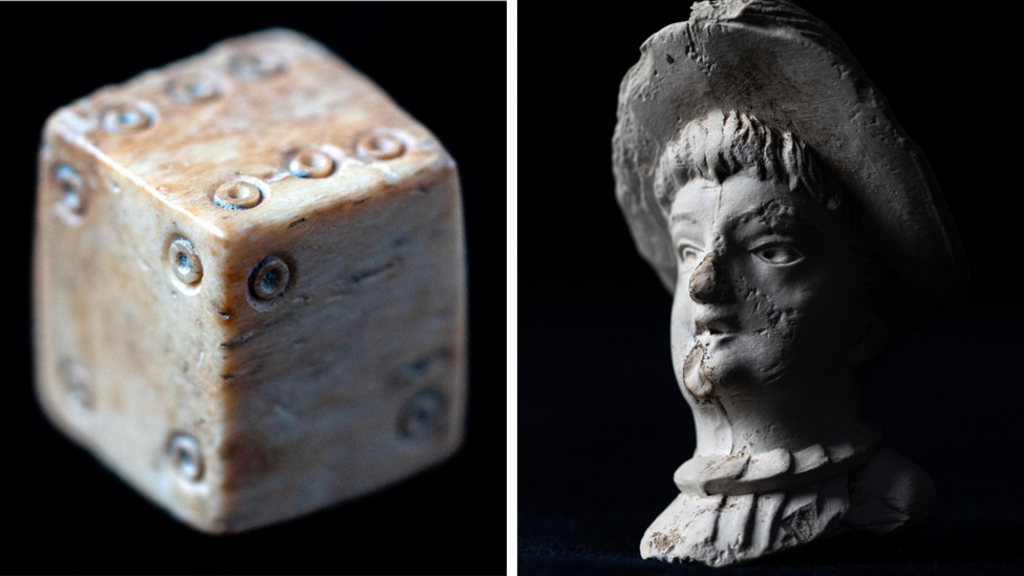
This small, polished die, recovered from a deserted medieval village in Lower Radbourne, Warwickshire, resembles modern dice but features a different numbering system.
Its imperfections, including uneven sides, distinguish it from today’s mass-produced dice.
This complete figurine of a seated pug dog, crafted from plain white-glazed porcelain with black detailing, was discovered in the grave of an unnamed female at St. James’ Gardens in Euston.
It is believed to have been manufactured at the Derby porcelain factory around 1770-1800.
“Every box has a surprise,” Machin remarked as she unwrapped a set of lower gold dentures, believed to be from the 19th century and found at St. Mary’s Old Church in Stoke Mandeville.
The dentures contain six teeth and bear a number stamped on the inside.
“These are objects, but they all relate to people,” Machin stated. “It’s all about the people who lived in these areas going back thousands of years and we can start writing the stories about their lives and what they can tell us.”
Neil Redfern from the Council for British Archaeology emphasized the extraordinary scale of the HS2 project compared to other large developments.
“But it is the length of the scheme and the landscapes and places that HS2 passed through that make the collection of sites and material so interesting. The research potential from this material is remarkable.”
He believes the finds could enhance public understanding of landscape changes, both past and present.
Archaeologists are now entering the second phase of their work, which includes further assessments, cleaning, and conservation efforts.
Plans are underway to exhibit the objects, with artifacts from the Wendover Saxon cemetery, where 122 graves were unearthed, soon to be displayed at a Discover Bucks Museum exhibition.
However, the future of other items remains uncertain.
An HS2 spokesperson explained that, according to English property law, ownership of archaeological and historical objects found during the project will be transferred to either the government or landowners.
“Occasionally landowners may wish to retain title to objects, in which case they will be returned to their care,” the spokesperson noted.
Charlotte Self, archive manager for the project, stated that she and her team are encouraging landowners to donate the artifacts whenever possible, enabling local communities to enjoy them.
“I would love to see the majority of these items deposited with the local museums from near where they were found,” she said.
Get our flagship newsletter with all the headlines you need to start the day. Sign up here.
The Environment Agency says the arrests are a “vital step” into the Kidlington dump investigation.
Detectives are still hunting for four other suspects and have released new CCTV images.
How did a charismatic but impoverished British woman become the leader of the progressive religious sect known as “the Shakers” in 18th-Century America?
The time capsule from Sulgrave Manor marks the 250th anniversary of the Declaration of Independence.
Waymo has laid out plans for a robotaxi service in London with a pilot scheme due to begin in April.