

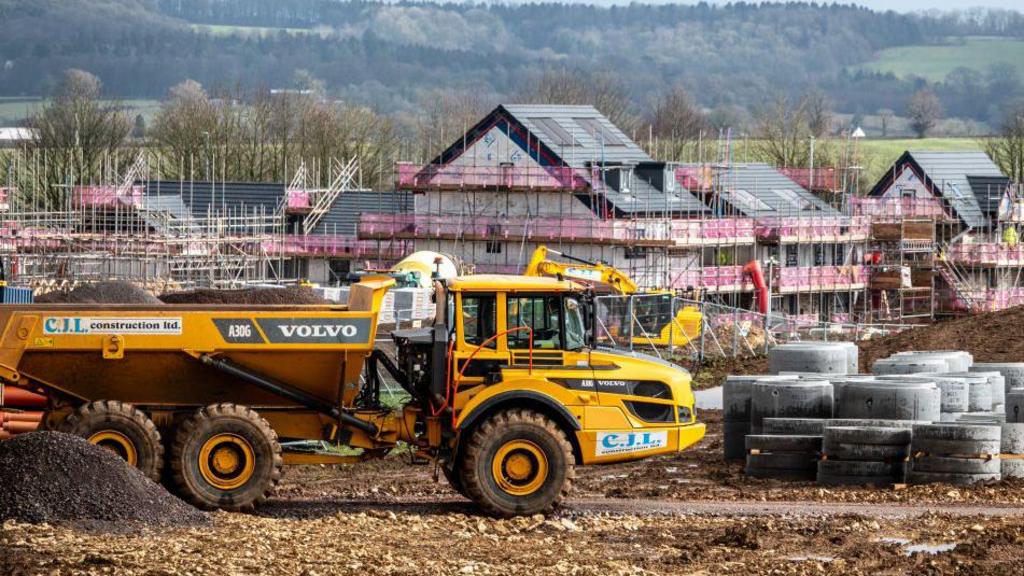
The government announced Tuesday that more housing developments in England will be exempt from regulations requiring builders to enhance local wildlife habitats.
Ministers have been reviewing the Biodiversity Net Gain (BNG) rules, which mandate that developers offset any nature loss resulting from construction projects.
The decision to broaden the scope of exempted developments has drawn criticism from environmental charities, who warn that it could hinder nature recovery efforts.
These changes are part of a broader overhaul of planning regulations, which the government asserts will help it meet its goal of building 1.5 million new homes during this Parliament.
The reforms were unveiled by Minister of State for Housing Matthew Pennycook as part of an effort to “get Britain building again,” encompassing revisions to the National Planning Policy Framework.
“They will not be without their critics. But in the face of a housing crisis that has become a genuine emergency in parts of Britain, we will act where previous governments have failed,” Pennycook stated.
Additional reforms include a “default yes” approach to planning applications near railway stations, potentially including green belt land, and a requirement for new constructions to incorporate nature-friendly elements such as swift bricks to support wildlife.
Biodiversity Net Gain, which requires a 10% increase in biodiversity on development sites, has been in effect for less than two years.
Several environmental organizations have jointly voiced concerns about the government’s decision to weaken the policy’s impact.
Richard Benwell, CEO of Wildlife and Countryside Link, a coalition of conservation groups, cautioned that the revisions risk “hollowing-out one of the most important nature protection policies in a generation.”
“It’s good that exemptions are narrower than originally proposed, but this is still damage limitation, not positive leadership for nature,” he added.
Conversely, critics of the BNG principle have argued that the policy can increase costs and cause delays in the planning process, particularly for smaller developers, potentially rendering some projects unfeasible.
Rico Wojtulewicz of the National Federation of Builders, stated that the policy has made building “harder, more expensive and more complicated.”
The changes to England’s Biodiversity Net Gain rules will exempt developments on sites smaller than 2,000 sq m, with the aim of facilitating home construction on smaller plots. The government estimates that this will apply to approximately 12,500 homes annually.
Alternative proposals during the consultation phase had considered exempting larger sites of up to 10,000 sq m.
Speaking with the BBC, Craig Bennett, chief executive of the Wildlife Trusts, accused the government of attempting to “scapegoat nature for a failing economy.”
“The British people want to see development for the economy and for nature at the same time and yet this government seems intent on pitching them as one against the other,” he told BBC News.
The government also announced plans to consult on expanding exemptions for brownfield sites up to 25,000 sq m in size and will introduce measures to streamline the process for medium-sized developments to deliver off-site nature improvements.
Agriculture and Environment Minister says its detection in Lower Lough Erne is “another significant pressure to our already beleaguered freshwater system”.
Here are the year’s breakthroughs for the climate and nature you might have missed.
Portland Port says that the fault in one of its three tug boats has been fixed.
The leader of a town’s clean team says culture changes and a lack of enforcement are to blame.
Two sites in Peopleton and Evesham are also being investigated, the Environment Agency says.