

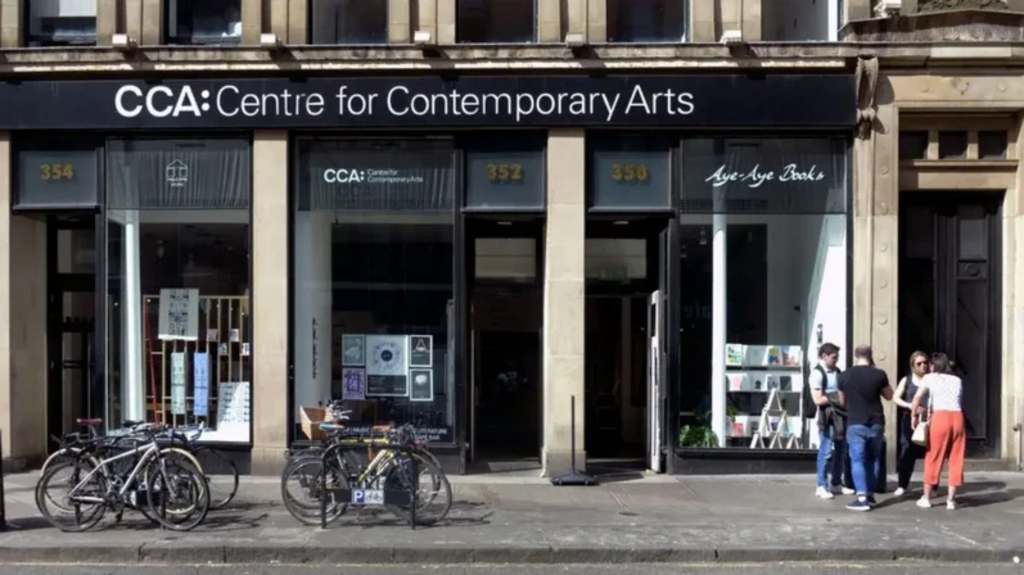
The Centre for Contemporary Arts (CCA) in Glasgow is slated for permanent closure following the surfacing of serious financial concerns.
Consequently, all staff members at the arts venue have been made redundant. The announcement arrives a mere year after securing £3.4m in funding over three years from Creative Scotland, the national arts body.
The Sauchiehall Street venue, established in 1992, has faced a series of disputes in recent years, most recently with pro-Palestine artists advocating for an official boycott of Israel by the center.
A social media account, purportedly managed by a CCA whistleblower, alleged issues regarding payments, unexplained expenses, and other financial irregularities.
Unite Hospitality union confirmed to BBC Scotland News that staff were notified of the job losses via an online video call with only one day’s notice. All forthcoming events at the venue have been cancelled.
Creative Scotland stated that it was unable to provide further payments because the CAA “is unable to demonstrate its ongoing viability and therefore cannot deliver the activity set out in its multi-year funding agreement”.
The organization added that it would explore future options “with the aim of reopening the centre as a cultural resource as soon as realistically possible”.
Last year saw the resignation of several CCA directors, followed by the appointment of Muse Greenwood as chairwoman in December. She resigned just a month later.
Earlier this week, Louise Norris, a solicitor who previously served on the board until last year, was reappointed as a director. She joins the two remaining directors from the previous year, Kirsty Ogg and Paola Pasino.
In a statement, the board indicated its inability to “achieve a sustainable financial position” and announced it was entering liquidation.
Earlier this month, the CCA stated that it was exploring new strategies to bolster ethical policy and fundraising, following protests criticizing the venue’s board for not adopting a stronger stance against Israel.
The Unite Hospitality union released a statement on behalf of staff, expressing devastation over the decision.
“We have worked tirelessly, under sustained pressure, to sustain the organisation in good faith, and we have never wished for the CCA to close,” the statement read.
“Our thoughts are with colleagues, cultural tenants, partners, artists, and communities, locally, nationally, and internationally, who will all feel the loss of this space.
“Throughout a prolonged period of uncertainty, staff have continued to work with restraint and dignity, supporting programmes, tenants, and public activity despite prolonged instability, absent leadership, and repeated governance failures
“Many have done so without clarity, security, or meaningful support.”
The statement added that staff were “deeply concerned” about how the decision was being handled.
“There is currently significant uncertainty around notice, pay, employment protections, and access to HR or pastoral support,” it said.
The CCA building was originally home to the Third Eye Centre, which was established by the Scottish Art Council in the 1970s.
The venue served as an outlet for Glasgow’s counterculture, hosting performers like Billy Connolly, Whoopi Goldberg, and Beat poet Allen Ginsberg.
It closed in 1991, with the CCA subsequently taking its place as a hub for the city’s art scene.
The venue has experienced a tumultuous few years, having initially been forced to close in 2018 after a fire devastated the nearby Glasgow School of Art.
Several businesses renting space within the building did not return after its reopening.
The center’s popular cafe bar, Saramago, permanently closed in 2023 following a protracted and acrimonious dispute over staffing matters, leading the venue to sever its relationship with the bar—a decision resulting in financial repercussions.
The CCA itself temporarily closed in December 2024, citing efforts to secure its long-term future amidst significant financial concerns.
The following month, it announced having secured a “significant uplift in funding” from Creative Scotland, to be distributed over three years.
At the time, the CCA board stated that the influx of funds would allow them to look ahead with renewed vigor.
However, within months, further protests arose concerning the CCA board’s refusal to support the Palestinian Campaign for the Academic and Cultural Boycott of Israel (PACBI).
Art Workers for Palestine Scotland launched a takeover of the site in June of the previous year, resulting in police involvement and the arrest and hospitalization of a 63-year-old woman.
The CCA announced a temporary closure during the dispute, later apologizing for involving the police during the protest, expressing sincere regret for the decision.
During the closure, some businesses based at the CCA were forced to vacate the venue.
Another takeover of the site by Art Workers for Palestine Scotland occurred in January and proceeded peacefully, with the CCA stating its desire to avoid police presence at the protest, which saw the establishment of a “liberated zone” in the building’s courtyard.
The group had previously stated that the CCA must be “a beacon for our city’s solidarity with Palestine, for anticolonialism, and for art to stand on the side of liberation”.
Glasgow’s Third Eye Centre was a fresh and invigorating addition to the Scottish arts scene, showcasing not only local talents like Billy Connolly and John Byrne, but also international voices such as Whoopi Goldberg and Allen Ginsberg.
Thus, it was not a lack of artistic vision that led to its closure in 1991, but a shortage of funds, a balancing act the CCA has struggled to successfully manage.
The Centre for Contemporary Arts had no difficulty attracting artists to its Sauchiehall Street venue, and for a time, it appeared to measure up to the legendary Third Eye Centre in terms of gathering talent.
However, engaging a broader audience in a city with vastly expanded options since the 1970s proved to be a more challenging task.
In the past eight years, the CCA has had to close four times. The center had barely recovered from the first closure, a six-month period after the fire at Glasgow School of Art in 2018, when the global pandemic resulted in another shutdown and a lasting impact on visitor numbers.
While it is easy to blame the protesters for preventing the CCA from staying afloat, it has ultimately failed to overcome the significant challenges it has faced.
Last year, the leadership pledged a restructuring, for which they received additional funding and support. At the start of this year, they announced exploring new avenues to strengthen ethical policy and fundraising.
But it did not happen quickly enough.
And who would want to lead an organization whose internal operations appear to be in conflict?
Closure rumors had been circulating for the past week before the leadership conceded that they “had been unable to achieve a sustainable financial position.”