

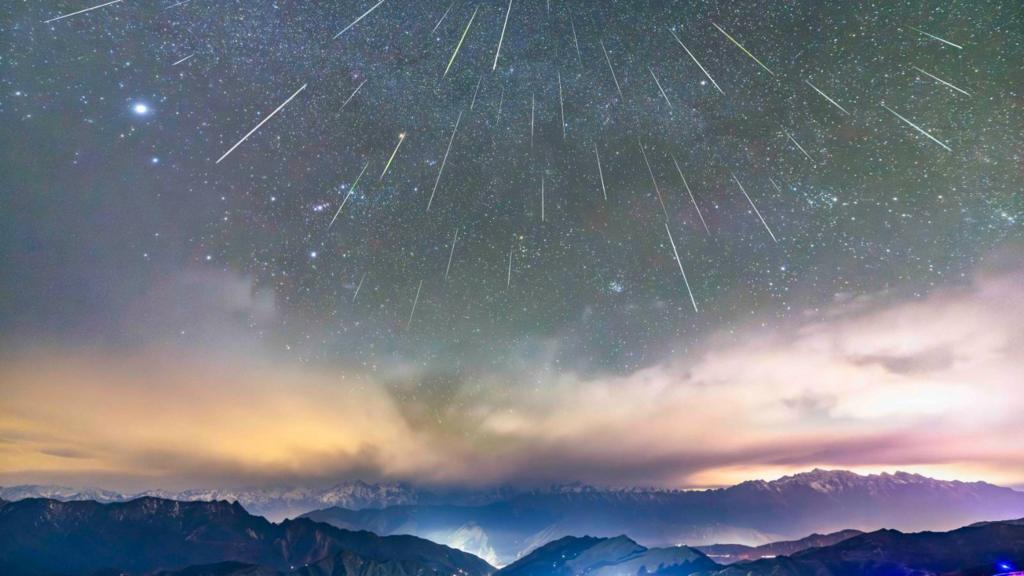
The Geminid meteor shower, renowned as one of the most spectacular celestial events, is expected to peak this weekend, and astronomers suggest that favorable conditions could lead to an especially impressive display, weather permitting.
These meteors are observable worldwide, with viewers in the Northern Hemisphere anticipated to have the most advantageous vantage points.
In the UK, clear skies would mean that the waning crescent Moon will rise after midnight, potentially providing several hours of darkness ideal for meteor observation.
Here’s a look at the science behind the Geminids and guidance on maximizing your viewing opportunity.
Meteor showers occur as the Earth traverses the trails of comets – icy celestial bodies often referred to by NASA as ‘cosmic snowballs’ – or, in rarer instances such as the Geminids, asteroids, which are rocky in composition.
As dust and gases from these objects enter the Earth’s atmosphere, they combust, creating the luminous streaks commonly known as shooting stars.
While most meteors appear white, some may exhibit green, yellow, red, or blue hues, depending on the elements present as they burn up in the Earth’s atmosphere.
Metals like sodium, magnesium, and calcium produce colors similar to those seen in fireworks.
The Geminids shower originates from the remnants of an asteroid named 3200 Phaethon.
Until recently, scientists theorized that the Geminids were a result of dust escaping from 3200 Phaethon. However, two years ago, scientists revealed that Phaethon’s tail is actually composed of glowing sodium gas. This has introduced some uncertainty regarding the formation and timing of the Geminids dust.
The Geminids shower presents one of the year’s most promising opportunities, weather permitting, to witness a meteor shower, owing to the volume and frequency of its ‘shooting stars’.
“In a dark sky devoid of clouds, one could potentially observe approximately 100 meteors per hour, which is quite remarkable,” noted Dr. Robert Massey of the Royal Astronomical Society.
“It is arguably the most prolific meteor shower of the year.”
The presence of bright moonlight can impede the visibility of meteors and other celestial objects. However, weather permitting, we could experience near-ideal viewing conditions as the Geminids reach their peak.
The crescent Moon is currently in its final waning phases, with a majority of its surface in shadow. Moreover, in the UK, it is not expected to rise until the early morning hours, potentially affording us a dark sky for optimal viewing of the spectacle.
Bear in mind that visibility remains heavily contingent upon weather conditions, so consult your local forecast for the clearest possible window.
Seeking a location with minimal light pollution and an unobstructed view of the sky will maximize your chances of witnessing the meteor shower.
The Geminids are a naked-eye event, best observed under dark, open skies, rendering telescopes or binoculars unnecessary.
“There are few natural treats that are entirely free, and this is one of them. So, venture out and enjoy it. It is an opportunity to connect with the sky, to momentarily set aside our earthly concerns,” Dr. Massey suggested.
The meteors appear to emanate from the constellation Gemini, but directing your gaze slightly away from that point often provides a broader field of view.
Dress warmly and bring a blanket or reclining chair for comfort, and allow your eyes to adjust to the darkness.
“Reasonable eyesight is generally sufficient to witness this phenomenon, which I find truly remarkable.”
The Geminids meteor shower is scheduled to peak on Sunday, December 14.
Unfortunately, the weather forecast for the UK is not conducive to ideal viewing conditions. Both Saturday and Sunday are anticipated to be windy and cloudy, with intermittent rainfall throughout the day and night.
On Sunday night, there may be a few drier, clearer spells. Northern Scotland and the Northern Isles, as well as parts of East Anglia and southeast England, are likely to have the best chances of catching a glimpse of the night sky.
Continue to monitor the forecast for potential breaks in the cloud cover. The Met Office’s UK Cloud Cover Map and BBC Weather are useful resources for tracking potential viewing opportunities in your area.
Georgie Thomas says she and her husband were not initially sure what the mass was.
The UK Fireball Alliance is hopeful walkers will stumble across the space rocks which fell in the Highlands in July.
The Perseids are considered the best meteor shower of the year
Amateur astronomers captured the moment it streaked over Victoria on CCTV and dashboard cameras.
Scientists who analysed fragments that crashed into a roof in Georgia, US, say it likely formed 4.56 billion years ago.