

Murals of Novak Djokovic are plastered around Belgrade
The financial demands of professional tennis are undeniable.
The exorbitant costs associated with equipment, coaching, and travel can impede a player’s ability to reach their full potential, particularly for those facing challenging circumstances.
Growing up in a country grappling with the aftermath of war further diminishes the odds of success.
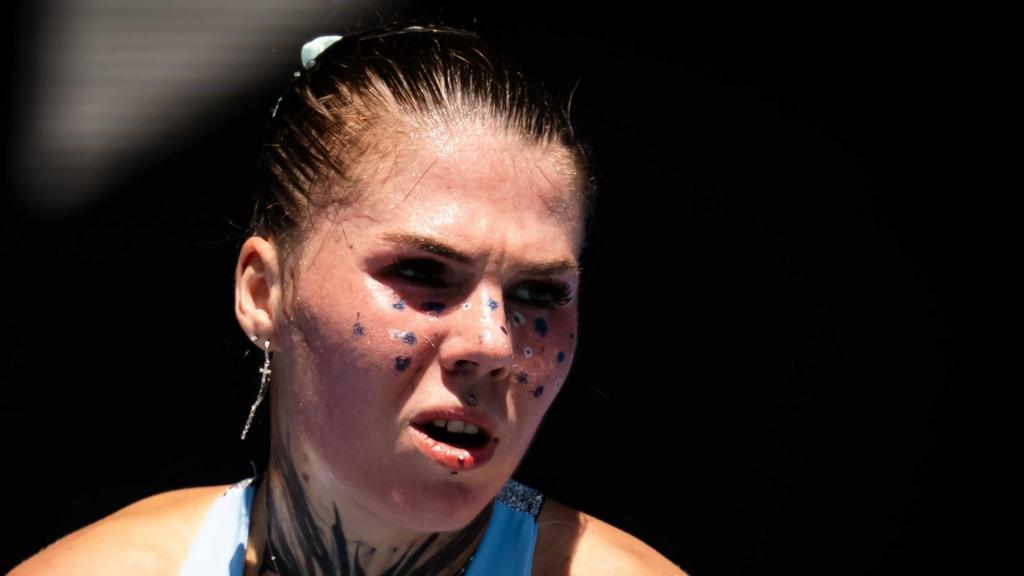
After competing in her inaugural Grand Slam main draw at the Australian Open, Ukraine’s Oleksandra Oliynykova candidly discussed the hurdles she has overcome in her ascent to the top.
The 25-year-old departed Ukraine as a child due to her father’s opposition to the country’s pro-Russian president, Viktor Yanukovych, but has since returned to reside there despite the ongoing large-scale invasion by Russia.
Now ranked among the top 100 players, Oliynykova recalls a time not long ago when she subsisted on sandwiches at tournaments to conserve funds.
Amid the ever-present threat of missile strikes, Oliynykova trained for the season-opening major without electricity or water in her Kyiv apartment.
“A drone struck the building across the street. My apartment literally shook from the explosion,” she recounted.
The A$150,000 (£75,757) earned from her first-round appearance at the Australian Open will provide crucial support to Oliynykova both on and off the court. Facilitating the distribution of resources further down the ranks is a key motivation behind leading players advocating for increased prize money at Grand Slam tournaments.
“Oliynykova’s narrative is extraordinary. It is both inspiring and poignant, and I hope all players take note,” Slovakian former world number five Daniela Hantuchova told BBC Sport.
“Players often discuss prize money. When I won my first 25k tournament, it was the first time our family could afford seafood pizza.”
“It felt like I was indulging in caviar.”
Ukraine’s Oleksandra Oliynykova fled the country in 2011 but has since returned
Damir Dzumhur, a consistent presence in the men’s top 100 for the past decade, was born in Sarajevo as missiles bombarded the capital of Bosnia-Herzegovina in 1992 during the dissolution of Yugoslavia.
Two days after Dzumhur and his mother were discharged from the maternity ward, the hospital was bombed.
When Dzumhur reached an age to begin playing tennis, few courts were accessible, as many had been damaged by bombing.
“My initial experiences on the court were in a small school gymnasium, primarily used for football and basketball, not tennis,” the world number 66 told BBC Sport.
“They simply put up a net in the middle, and that’s where I began to play.”
“I didn’t have the opportunity to play on a proper hard court until I was 12, at a junior tournament in France.”
Being born in a country lacking a strong tennis tradition often translates to limited financial support from the national federation and a dearth of role models to emulate.
Hantuchova believes that players emerging from humble backgrounds cultivate a resilience, discipline, and mental fortitude that is “increasingly rare these days.”
“When I decided I wanted to play tennis, I asked my parents if – one day – I could have a chance of getting a racquet,” said Hantuchova, who describes her Bratislava upbringing as “simple”.
“I understood that I would have to wait until their monthly salary allowed them to afford it.”
Novak Djokovic, widely regarded as one of the greatest players of all time with 24 major titles, has paved the way for Serbian tennis.
As a child, Djokovic was compelled to seek shelter in Belgrade during the NATO bombings of the Serbian capital between March and June 1999.
“My upbringing during several wars in the 90s was a difficult time,” the 38-year-old said in 2020.
“We had to wait in line for bread, milk, water, some basic things in life. That probably has been my foundation, the fact I came from literally nothing.”
From war to Wimbledon: How Belgrade bombings shaped Djokovic
The janitor’s son who became an Australian Open hope
American Frances Tiafoe is another player who forged his career from meager beginnings.
The son of parents who fled the civil war in Sierra Leone in the 1990s, Tiafoe used to sleep on the floor at a prestigious Maryland tennis center where his father worked as a janitor.
The two-time US Open semi-finalist resided there while his mother, Alphina, worked night shifts as a nurse.
The advantage of Tiafoe’s situation was access to high-quality coaching. Similarly, Djokovic expresses eternal gratitude to Jelena Gencic, who ran a tennis camp and nurtured his talent.
Ukraine’s Elina Svitolina had her potential recognized by businessman Yuriy Sapronov, who sponsored her relocation to Kharkiv – 420 miles from her home – to receive professional coaching at the age of 12.
Initially, Sapronov arranged to receive a portion of her future earnings but later waived his percentage in exchange for Svitolina becoming an ambassador for his companies.
“I don’t know how my career would have developed without his support, but I’m very thankful to him,” Svitolina added.
“It’s part of tennis life that you need a lot of investment to get results.”
Djokovic and Svitolina have become symbols of their nations, viewed by many compatriots as representing their voices on the global stage.
They, along with other players, have established charitable foundations to give back to the countries and people who shaped them—a gesture particularly appreciated during times of adversity.
“When the war in Ukraine started, setting up a foundation was a natural instinct to help people who are in need,” world number 20 Marta Kostyuk told BBC Sport.
“The focus was kids affected by war, but I realised I can have more impact and make more difference by popularising tennis as a sport and physical activity in Ukraine.
“I believe sport can bring hope and change lives.”
Live scores, results and order of play
Get tennis news sent straight to your phone