

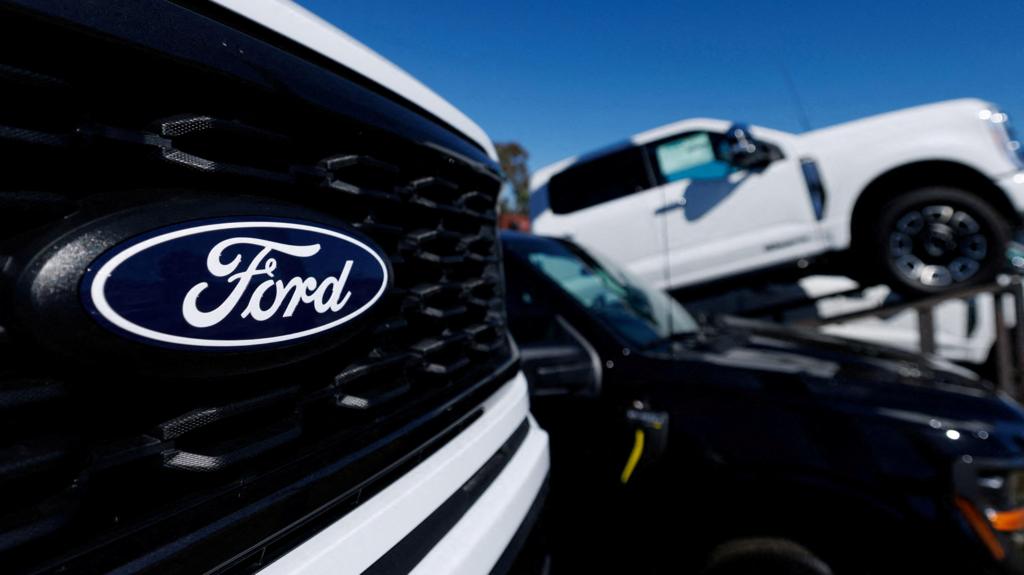
Ford Motor Co. has announced a recalibration of its electric vehicle (EV) strategy, citing diminished demand and recent regulatory shifts under the Trump administration. The automaker revealed Monday it would scale back plans for large-scale EV production.
Instead, the company will prioritize investments in hybrid and gasoline-powered vehicles, alongside smaller and more affordable EV models.
Ford anticipates a $19.5 billion (GBP 14.6 billion) impact on its profits due to this strategic realignment, which coincides with the Trump administration’s easing of fuel economy standards.
The rationale for an aggressive push into EV production, particularly for larger models, has “eroded,” Ford stated, attributing the change to “lower-than-expected demand, high costs and regulatory changes.”
“This is a customer-driven shift to create a stronger, more resilient and more profitable Ford,” declared Jim Farley, Ford’s Chief Executive Officer, in a released statement.
Mr. Farley elaborated, “The operating reality has changed, and we are redeploying capital into higher-return growth opportunities,” highlighting trucks, vans, hybrid vehicles, and the company’s energy storage ventures.
As part of the revised EV strategy, Ford confirmed it will discontinue the production of a purely electric version of its popular F-150 pickup truck. The F-150 Lightning will now be redesigned as a hybrid vehicle, incorporating a gasoline-powered generator.
Ford has also decided to cancel its plans for a new electric van, focusing instead on the manufacturing of gasoline and hybrid models.
This strategic shift from Ford follows a similar announcement from General Motors in October. General Motors projected a $1.6 billion hit as it scales back its EV ambitions, citing weakening demand.
EV adoption in the United States has lagged behind markets such as China, the United Kingdom, and Europe, with analysts pointing to relatively limited government support for the sector.
The Trump administration has recently rolled back incentives and regulations that were expected to bolster electric car adoption.
A previous government subsidy offered up to $7,500 (GBP 5,608) in tax credits for qualifying battery electric, plug-in hybrid, or fuel cell vehicles. However, that tax credit expired in September.
Automakers had anticipated a slowdown in EV momentum following the expiration of the tax credit. At the time, Mr. Farley predicted the EV industry would be “smaller, way smaller than we thought.”
Earlier this month, the Trump administration also announced plans to weaken fuel economy standards, reversing a Biden-era policy that had fueled expectations of an EV boom. The Biden administration’s standards were projected to prevent over 700 million metric tons of carbon dioxide emissions by 2050.
Mr. Farley, along with other automotive industry leaders, applauded the relaxed regulations, hailing the change as a “victory of common sense,” while environmental groups criticized it as a setback for the industry and public health.
He added that the revised fuel economy standards were “aligned with customer demand.”
These changes in the US come as the European Union considers diluting its plan to effectively ban new combustion engine cars from 2035.
Germany has advocated for modifications to the plan on behalf of its car manufacturers, citing concerns about intense competition from Chinese rivals.
The European Commission is expected to announce its decision on the scheme on Tuesday.
Defence Secretary Pete Hegseth also said he would not publicly release “a top-secret, full, unedited video” of the 2 September attack
In the interview, Wiles describes Donald Trump as having an “alcoholic’s personality” and JD Vance as having been a “conspiracy theorist” for a decade.
The move is seen as a further escalation of the Trump administration’s war on drugs in Latin America.
The US president is requesting $5bn (£3.7bn) in damages, according to court documents filed in Florida.
As the US president follows through on his threat to sue the BBC, what are the options for the corporation?