

Governments within the European Union have reached an agreement to indefinitely immobilize Russian assets, valued at up to €210 billion (£185 billion), which have been frozen within the EU since the onset of Russia’s full-scale invasion of Ukraine.
The majority of these assets are held in the Belgian bank Euroclear. European leaders are aiming to finalize a deal at the upcoming EU summit next week, which would leverage these funds to provide a loan to Kyiv, supporting its military and economic needs.
Following nearly four years of Russia’s full-scale war, Ukraine faces a severe financial shortfall, requiring an estimated €135.7 billion (£119 billion; $159 billion) over the next two years.
Europe intends to contribute two-thirds of this amount, but Russian officials have condemned the EU’s actions as theft.
In response to the EU’s loan proposal, the Russian Central Bank announced on Friday that it is initiating legal proceedings against Euroclear in a Moscow court.
The EU froze Russian assets shortly after the full-scale invasion of Ukraine in February 2022, with €185 billion held by Euroclear.
The EU and Ukraine maintain that these funds should be utilized to rebuild the infrastructure destroyed by Russia. Brussels has termed it a “reparations loan” and has devised a plan to bolster Ukraine’s economy with a €90 billion investment.
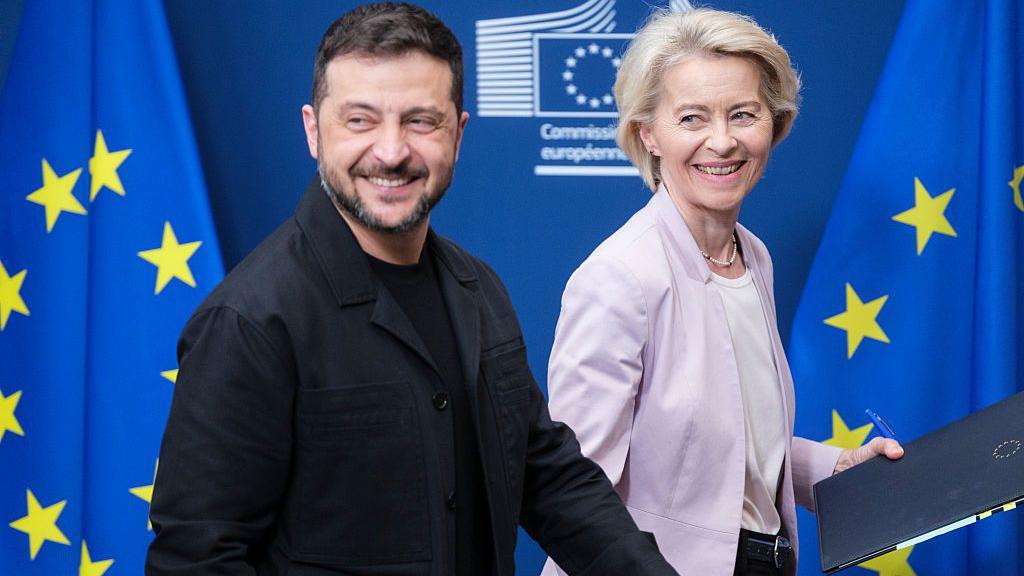
“It is only just that Russia’s frozen assets be used to rebuild what Russia has destroyed – and that money then becomes ours,” stated Ukraine’s President Volodymyr Zelensky.
German Chancellor Friedrich Merz stated that the assets will “enable Ukraine to protect itself effectively against future Russian attacks”.
Russia’s court action was anticipated in Brussels, and European Economic Commissioner Valdis Dombrovskis affirmed on Friday that EU financial institutions are “fully protected” from legal challenges.
However, discontent extends beyond Moscow.
Belgium is concerned about potential financial liabilities should the plan falter, and Euroclear CEO Valérie Urbain warned that its implementation could “destabilize the international financial system.”
Euroclear also has an estimated €16-17 billion immobilized in Russia.
Belgian Prime Minister Bart De Wever has presented the EU with a series of “rational, reasonable, and justified conditions” for accepting the reparations plan, and has not ruled out legal action if it “poses significant risks” for his country.
The EU is working intensively to reach a mutually acceptable solution for Belgium ahead of next Thursday’s summit.
Previously, the EU refrained from directly accessing the assets but, since last year, has channeled the “windfall profits” from them to Ukraine, amounting to €3.7 billion in 2024. Utilizing the interest is considered legally sound as Russia is under sanction, and the proceeds are not Russian sovereign property.
However, international military aid to Ukraine has declined significantly in 2025, and Europe has struggled to compensate for the shortfall caused by the US decision to largely cease funding Ukraine under President Donald Trump.
Currently, there are two EU proposals aimed at providing Ukraine with €90 billion, covering two-thirds of its funding needs.
One proposal involves raising funds on capital markets, backed by the EU budget as a guarantee. While Belgium favors this approach, it necessitates unanimous approval from EU leaders, which is complicated by objections from Hungary and Slovakia regarding military funding for Ukraine.
The alternative is to loan Ukraine funds from the Russian assets, initially held in securities but now largely converted to cash, which are Euroclear property held in the European Central Bank.
The European Commission, the EU’s executive body, acknowledges Belgium’s legitimate concerns and expresses confidence in having addressed them.
The plan involves protecting Belgium with a guarantee covering all €210 billion of Russian assets in the EU.
A Commission source explained that should Euroclear incur losses on its own assets in Russia, they would be offset by assets belonging to Russia’s own clearing house within the EU.
Furthermore, any rulings by a Russian court against Belgium would not be recognized within the EU.
EU ambassadors have reached a significant agreement to indefinitely immobilize Russia’s central bank assets held in Europe.
Previously, unanimous votes were required every six months to renew the freeze, potentially posing repeated risks to Belgium.
The EU ambassadors invoked an emergency clause under Article 122 of the EU Treaties, ensuring the assets remain frozen as long as an “immediate threat to the economic interests of the union” persists, or until Russia fully pays war reparations to Ukraine.
Swedish Finance Minister Elisabeth Svantesson hailed the decision as an “important step in enabling more support for Ukraine and protecting our democracy.”
Belgium insists on its unwavering support for Ukraine but remains concerned about the plan’s legal risks and the potential for bearing the consequences if it goes awry.
The political landscape, typically divided, has rallied behind Prime Minister Bart De Wever, who faces pressure from European counterparts.
“Very important decisions” will be made by the EU in the coming week, he stated during a meeting with UK Prime Minister Sir Keir Starmer in London on Friday. He added that Belgium and the UK would collaborate to “get the certainty that we can support Ukraine to stay a free, democratic and sovereign country.”
While the EU believes it can secure adequate guarantees for the loan, Belgium fears additional risks of exposure to damages or penalties.
“Belgium is a small economy. Belgian GDP is about €565 billion – imagine if it would need to shoulder a €185 billion bill,” says Veerle Colaert, professor of financial law at KU Leuven University.
She also believes the requirement for Euroclear to grant a loan to the EU would violate EU banking regulations.
“Banks need to comply with capital and liquidity requirements and shouldn’t put all their eggs in one basket. Now the EU is telling Euroclear to do just that.”
“Why do we have these bank rules? It’s because we want banks to be stable. And if things go wrong it would fall to Belgium to bail out Euroclear. That’s another reason why it’s so important for Belgium to secure water-tight guarantees for Euroclear.”
There is no time to lose, warn seven EU member states, including those geographically closest to Russia, such as the Baltics, Finland, and Poland. They consider the frozen assets plan “the most financially feasible and politically realistic solution.”
“It’s a matter of destiny for us,” says leading German conservative MP Norbert Röttgen. “If we fail, I don’t know what we’ll do afterwards. That’s why we have to succeed in a week’s time.”
While Russia is adamant that its money should not be touched, there are also concerns among European figures that the US may seek to utilize Russia’s frozen billions differently, potentially as part of its own peace plan.
Zelensky has indicated that Ukraine is collaborating with Europe and the US on a reconstruction fund, but he is also aware that the US has been in discussions with Russia regarding future cooperation.
An early draft of the US peace plan proposed that $100 billion of Russia’s frozen assets be used by the US for reconstruction, with the US retaining 50% of the profits and Europe contributing an additional $100 billion. The remaining assets would then be used in some form of US-Russia joint investment project.
An EU source noted that the anticipated vote on Friday to indefinitely immobilize Russia’s assets would make it more challenging for any party to seize the funds. This implies that the US would need to secure a majority of EU member states’ support for a plan that would impose significant financial costs on them.
Hungary’s Viktor Orban, regarded as Russia’s closest ally in the EU, accused European leaders of “placing themselves above the rules” and substituting the rule of law with the rule of bureaucrats.
The Russian ambassador is summoned over a cyber-attack on air traffic control and attempted electoral interference.
Shoeboxes containing Christmas presents will travel 2,000 miles to Kharkiv.
The overhaul comes as the minister for armed forces warns “the shadow of war is knocking on Europe’s door”.
The UK says it tracked the Krasnodar as it sailed from the North Sea through the Strait of Dover.
Roman Oleksiv,11, was injured in a Russian missile strike on a hospital that also killed his mother