

“`html
The recent release of thousands of pages of documents pertaining to the late sex offender Jeffrey Epstein’s abuse has left some anxiously awaiting the files feeling underwhelmed.
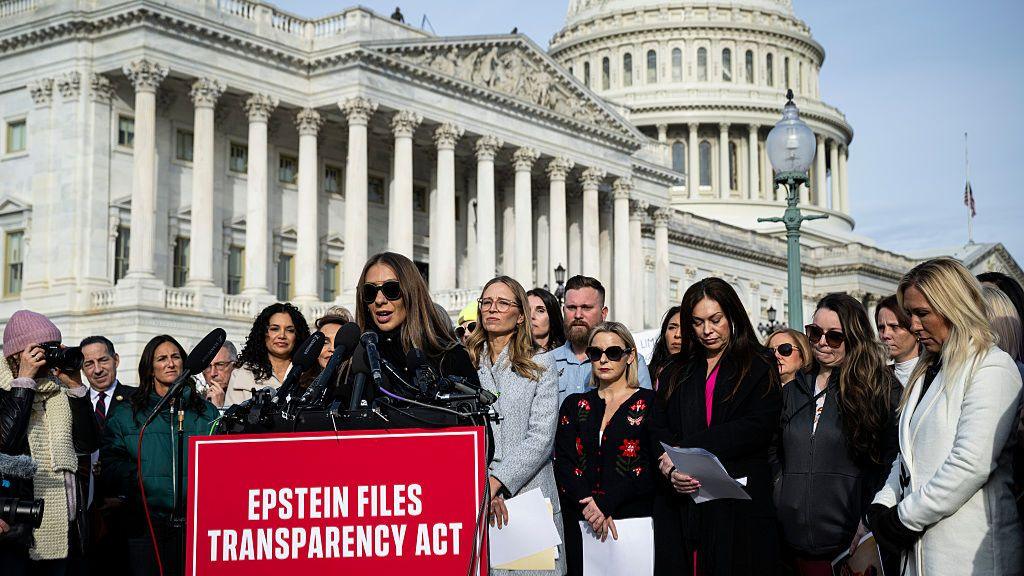
The release of the documents was mandated by an act of Congress that directed the US Justice Department (DOJ) to make materials related to Epstein’s crimes public. However, numerous documents contain extensive redactions, while others have not been released publicly at all.
Lawmakers who advocated for the release of these documents have characterized the effort as incomplete and have described the Justice Department’s efforts as lacking sincerity.
Several legal experts have also cautioned that the extent of the redactions may only serve to fuel ongoing conspiracy theories.
However, Deputy US Attorney Todd Blanche stated on Friday, the day of the release, that the department had identified over 1,200 Epstein victims or their relatives and withheld material that could potentially identify them.
Among the newly released information is a photograph of Epstein’s associate, Ghislane Maxwell, outside Downing Street, a document alleging that Epstein introduced a 14-year-old girl to former US President Donald Trump at Mar-a-Lago, and multiple images of former President Bill Clinton.
Trump has consistently denied any wrongdoing in connection to Epstein and has not been accused of any crimes by Epstein’s victims. Clinton has never been accused of misconduct by survivors of Epstein’s abuse and has denied any knowledge of his sex offending.
Other released photos depict the interiors of Epstein’s residences, his international travels, as well as celebrities, including Andrew Mountbatten-Windsor, Mick Jagger, Michael Jackson, Diana Ross, and Peter Mandelson.
Being named or pictured in the files does not indicate wrongdoing. Many individuals identified in the files, or in previous releases related to Epstein, have denied any misconduct.
However, many of the documents are also heavily redacted.
The Justice Department stated that it would comply with the congressional request to release documents, albeit with certain stipulations.
It redacted personally identifiable information about Epstein’s victims, materials depicting child sexual abuse, materials depicting physical abuse, any records that “would jeopardize an active federal investigation,” or any classified documents that must remain secret to protect “national defense or foreign policy.”
In a post on X, the DOJ stated that it was “not redacting the names of any politicians” and included a quote attributed to Blanche, stating: “The only redactions being applied to the documents are those required by law – full stop.”
“Consistent with the statute and applicable laws, we are not redacting the names of individuals or politicians unless they are a victim.”
John Day, a criminal defense attorney, told the BBC that he was surprised by the extent of the redactions.
“This is just going to feed the fire if you are a conspiracy theorist,” he said. “I don’t think anyone anticipated there would be this many redactions. It certainly raises questions about how faithfully the DOJ is following the law.”
Mr. Day also noted that the Justice Department is required to provide Congress with a log of what was redacted within 15 days of the files’ release.
“Until you know what’s being redacted, you don’t know what’s being withheld,” he said.
In a letter to the judges overseeing the Epstein and Maxwell cases, US Attorney for the Southern District of New York Jay Clayton stated: “Victim privacy interests counsel in favor of redacting the faces of women in photographs with Epstein even where not all the women are known to be victims because it is not practicable for the department to identify every person in a photo.”
Clayton added that “this approach to photographs could be viewed by some as an over-redaction” – but that “the department believes it should, in the compressed time frame, err on the side of redacting to protect victims.”
Survivors of Epstein’s abuses are among those most frustrated by the release.
Marina Lacerda, who was 14 when she was abused by Epstein, told the BBC that she and other survivors have long awaited the files to be released.
“We are a little disappointed that they’re now still lingering on and distracting us with other things,” she said.
“Some of the survivors are still nervous and skeptical about how they are going to release the rest of the files. We are very worried that it will still be redacted in the same way that it was today.”
Epstein survivor Liz Stein told BBC Radio 4’s Today program that she believes the Justice Department is “really brazenly going against the Epstein Files Transparency Act,” which is the law that requires all the documents to be released.
Survivors are genuinely concerned about the possibility of a “slow roll-out of incomplete information without any context,” she noted.
“We just want all of the evidence of these crimes out there.”
Baroness Helena Kennedy, a human rights lawyer and Labour peer in the House of Lords in the UK, stated that she was told the redactions in the documents were to protect the victims.
“Authorities always have a worry” about “exposing people to yet further denigration in the public mind,” she told the BBC’s Today program.
Many Epstein survivors seem “very keen” to have the material exposed, she said, but added that they “might not be so keen if they knew exactly what was in there.”
Democrat Congressman Ro Khanna, who led the charge alongside Republican Congressman Thomas Massie to release the files, stated that the release was “incomplete” and added that he is considering options such as impeachment, contempt, or referral to prosecution.
“Our law requires them to explain redactions,” Khanna said. “There is not a single explanation.”
Massie echoed Khanna’s statement and posted on social media that Attorney General Pam Bondi and other Justice Department officials could be prosecuted by future Justice Departments for not complying with the document requirements.
He stated that the document release “grossly fails to comply with both the spirit and the letter of the law” of the Epstein Files Transparency Act.
Following the release, the White House described the Trump Administration as the most “transparent in history,” adding that it has “done more for the victims than Democrats ever have.”
Blanche was asked in an interview with ABC News whether all documents mentioning Trump in the so-called Epstein files would be released in the coming weeks.
“Assuming it’s consistent with the law, yes,” Blanche said. “So there’s no effort to hold anything back because there’s the name Donald J. Trump or anybody else’s name, Bill Clinton’s name, Reid Hoffman’s name.”
“There’s no effort to hold back or not hold back because of that.”
“We’re not redacting the names of famous men and women that are associated with Epstein,” he added.
The move comes after US President Donald Trump ordered a “blockade” of sanctioned oil tankers entering and leaving Venezuela.
The US says it struck dozens of targets across Syria in response to last week’s deadly Islamic State attack on US forces there.
The trove of new files related to the late sex offender includes previously released footage of police searching his Palm Beach mansion.
The New York congresswoman, a Trump ally, cited a tough gubernatorial primary campaign and her young son as reasons for her decision.
Kemal Mrndzic did not reveal that he had been a guard at a camp where atrocities occurred when seeking US naturalisation, officials say.
“`