

“`html
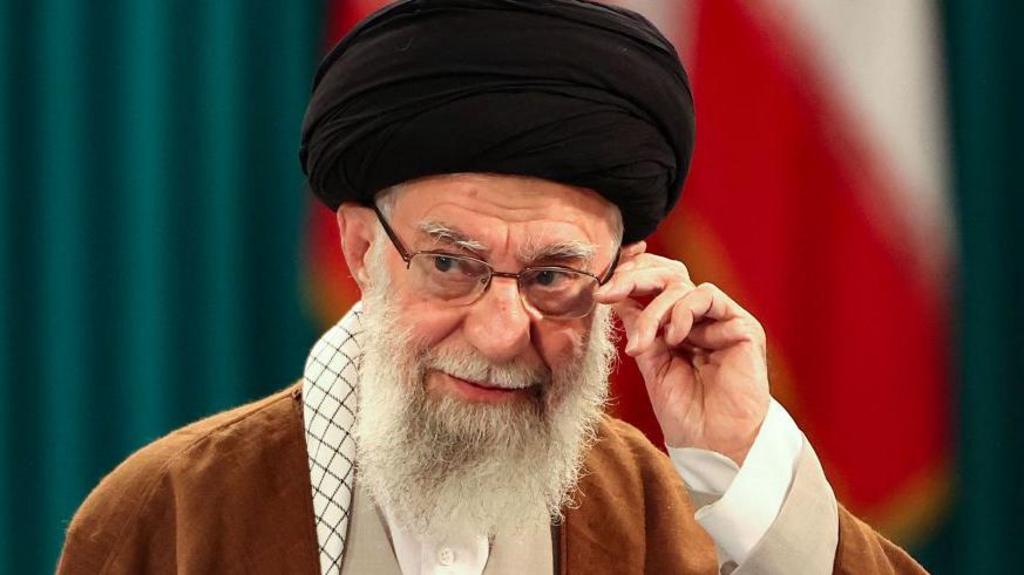
Ayatollah Ali Khamenei has reportedly been killed during the initial hours of joint U.S. and Israeli airstrikes within Iranian territory, according to an announcement from U.S. President Donald Trump.
The passing of the 86-year-old Supreme Leader, who has held the position for three decades – one of the longest tenures globally – was subsequently confirmed on Iranian state television.
Iran has had only two supreme leaders since the 1979 Islamic Revolution.
The office holds immense power; the Supreme Leader serves as the head of state and commander-in-chief of the armed forces, including the elite Revolutionary Guards.
Khamenei’s position is nuanced, situated within a complex network of competing power centers, granting him the authority to veto public policy and select candidates for public office.
Young Iranians have only known life under his leadership.
State television has consistently covered Khamenei’s activities. His image is prominently displayed on billboards and is widely seen in shops.
While Iranian presidents have often taken the international stage, Khamenei has exerted significant influence domestically.
His death, under these circumstances, signals a new and potentially volatile era for Iran and the surrounding region.
Ali Khamenei was born in 1939 in Mashhad, located in northeastern Iran.
He was the second of eight children from a religious family. His father was a mid-ranking cleric within Shia Islam, the predominant religious sect in Iran.
Khamenei later spoke fondly of his “poor but pious” childhood, recalling times when his diet consisted primarily of “bread and raisins.”
His education centered on the Quran, and he qualified as a cleric by age 11. Like many religious leaders of the time, his work had both political and spiritual elements.
A skilled speaker, Khamenei voiced his criticism of the Shah of Iran, who was later overthrown in the Islamic Revolution.
For years, he lived in hiding or was imprisoned. He was arrested six times by the Shah’s secret police, enduring torture and internal exile.
Following the Islamic Revolution, Ayatollah Ruhollah Khomeini, the revolution’s leader, appointed him as the Friday prayer leader of Tehran.
His political sermons were broadcast nationwide each week, solidifying his position within the country’s new leadership.
In the early months after the revolution, militant university students loyal to Khomeini occupied the U.S. embassy, taking dozens of diplomats and staff hostage.
Iran’s revolutionary leaders, including Khamenei, supported the students’ protest against the U.S. decision to grant asylum to the deposed Shah.
The hostage situation lasted 444 days.
It contributed to the downfall of the Carter administration and set Iran on a path of anti-American and anti-Western sentiment that would define the revolution.
The episode also marked the beginning of decades of international isolation for Iran.
Shortly after the crisis, Khamenei survived an assassination attempt.
In June 1981, a dissident group concealed a bomb in a tape recorder, which detonated during one of his lectures.
He sustained serious injuries, requiring months of recovery for his lungs, and permanently lost the use of his right arm.
Later that year, President Mohammad-Ali Rajai was assassinated, and Khamenei entered the subsequent election to succeed him in the largely ceremonial role.
With Khomeini controlling the eligibility of candidates, the outcome was predictable. Khamenei won with 97% of the vote.
His inaugural address signaled his presidential direction, condemning “deviation, liberalism, and American-influenced leftists.”
During his time in office, Khamenei became a wartime leader.
Months earlier, neighboring Iraq had launched an invasion. Saddam Hussein, Iraq’s president, feared that Khomeini’s Islamic revolution would spread and destabilize his own regime.
The resulting conflict was a brutal and protracted war lasting eight years, resulting in hundreds of thousands of casualties on both sides.
Khamenei spent extended periods on the front lines, witnessing the deaths of many commanders and soldiers he knew.
The Iraqi army used chemical weapons against Iranian border villages and bombarded cities, including Tehran, with missiles.
Iran, in turn, relied on human wave attacks, often involving young and devoted soldiers, to break through Iraqi lines, resulting in significant losses.
The war deepened Khamenei’s distrust of the U.S. and the West, which had supported Saddam Hussein’s invasion.
In 1989, the Assembly of Experts, a council of clerics, selected Khamenei as the successor to Khomeini, who had died at 86.
The selection of the new Supreme Leader was made despite concerns about his limited religious scholarship.
“I am an individual with many faults and shortcomings and truly a minor seminarian,” he acknowledged in his first speech.
“However, a responsibility has been placed on my shoulders and I will use all my capabilities and all my faith in the almighty in order to be able to bear this heavy responsibility.”
Lacking the religious authority and personal popularity of Khomeini, the new Supreme Leader proceeded carefully to build his own power base.
Over the next 30 years, Khamenei cultivated networks of loyalists throughout the Iranian government, including parliament, the judiciary, the police, the media, and the clerical elite.
According to Karim Sadjadpour, a fellow at the Carnegie Endowment for International Peace, the Supreme Leader’s power relied on a “tight-knit cartel of hardline clergymen and nouveau riche Revolutionary Guardsmen.”
Khamenei also fostered a personality cult to ensure public devotion, reinforced by political repression and the arbitrary arrest of political opponents.
He rarely traveled abroad and reportedly lived modestly in a compound in central Tehran with his wife, six children, and many grandchildren.
Domestically, he suppressed dissent.
Student protests in 1999 presented a challenge, but they were suppressed.
A decade later, a revolt against a disputed presidential election resulted in demonstrators being pepper-sprayed, beaten, and shot.
In 2019, when rising fuel prices triggered street protests, Khamenei shut down the internet for days to prevent illegal marches. Amnesty International reported that police fatally shot protesters with machine guns.
He eliminated restrictions on women’s education that had been put in place by his predecessor. However, Khamenei did not advocate for gender equality.
Women who campaigned against wearing the hijab were arrested, tortured, and held in solitary confinement. Supporters were also targeted. One human rights lawyer received a 38-year prison sentence and 148 lashes.
And, in 2022, one of the biggest challenges to the Islamic revolution followed the death in police custody of Mahsa Amini, a 22-year-old woman who was accused of failing to wear her hijab properly.
Human rights groups said more than 550 people were killed and 20,000 detained by security forces during the protests following her death.
Internationally, Khamenei has been accused of leading a pariah state. Following the September 11, 2001, attacks on the U.S., President George W. Bush included Iran in his “Axis of Evil,” alongside Iraq and North Korea.
Iran has used Hezbollah, the armed Shia group in Lebanon, as a proxy in a long-running conflict with Israel.
While he promoted “Death to America” rhetoric, his foreign policy was carefully constructed to avoid both accommodation and direct confrontation with Washington.
The primary area of contention was nuclear weapons.
Two decades ago, Khamenei declared them un-Islamic and issued a fatwa prohibiting their development.
However, under his leadership, Israel and the West became convinced that Iran was secretly pursuing a nuclear weapons capability.
Sanctions imposed by world powers in response impoverished a country that had been a major oil exporter, and high unemployment fueled widespread discontent.
Khamenei did not oppose the 2015 nuclear deal, which limited Iran’s nuclear activities in exchange for sanctions relief, but he doubted the U.S. would uphold it in the long run.
In 2018, President Trump withdrew from the nuclear deal and reinstated sanctions to force Iran to negotiate a replacement.
Two years later, Trump ordered the assassination of Qasem Soleimani, a top Revolutionary Guards general close to the Supreme Leader, in Iraq. Khamenei vowed revenge and aligned more closely with Russia and China.
In June 2025, when Israeli forces attacked Iran, targeting its nuclear program, ballistic missile arsenal, and top military commanders, the country launched barrages of missiles towards Israeli cities.
When the Americans joined the war, striking three key Iranian nuclear facilities, Khamenei vowed never to surrender. But, for the first time in years, he looked weak.
In January 2026, Khamenei’s regime faced a wave of street protests that were sparked by the failure of the Iranian economy. It responded with a brutal crackdown, which human rights groups said left at least 6,488 protesters dead and another 53,700 in detention.
In the following weeks, Trump ordered a US military build-up in the region and threatened to strike Iran if it did not agree a new deal on its nuclear programme and give up what he called its “sinister nuclear ambitions”.
But Khamenei refused to abandon uranium enrichment.
“The Americans should know that if they start a war, this time it will be a regional war,” he warned at the end of January 2026.
Khamenei has maintained a firm and often harsh control over Iran.
At times, the Supreme Leader has presented himself as detached from politics, observing the disputes between Iran’s reformists and conservatives. However, Ayatollah Khamenei rarely allowed dissent to escalate or policies he opposed to progress.
Life in Iran is currently governed by the laws he established. The identity of his successor remains uncertain, raising questions about the future direction of the country.
The death of the Supreme Leader will be a major shock to the Islamic Republic, which will strive to demonstrate it has a succession plan in place.
Israel and the U.S. believe Iran’s regime is vulnerable, grappling with an economic crisis and the aftermath of protests.
The UK was not involved in, nor has it endorsed, the strikes on Iran by Israel and the US.
World leaders are reacting to the attacks on several Iranian cities and Tehran’s retaliation.
Tehran responded to the strikes with a wave of missiles and drones aimed at Israel and Gulf countries that host US bases.
“`