

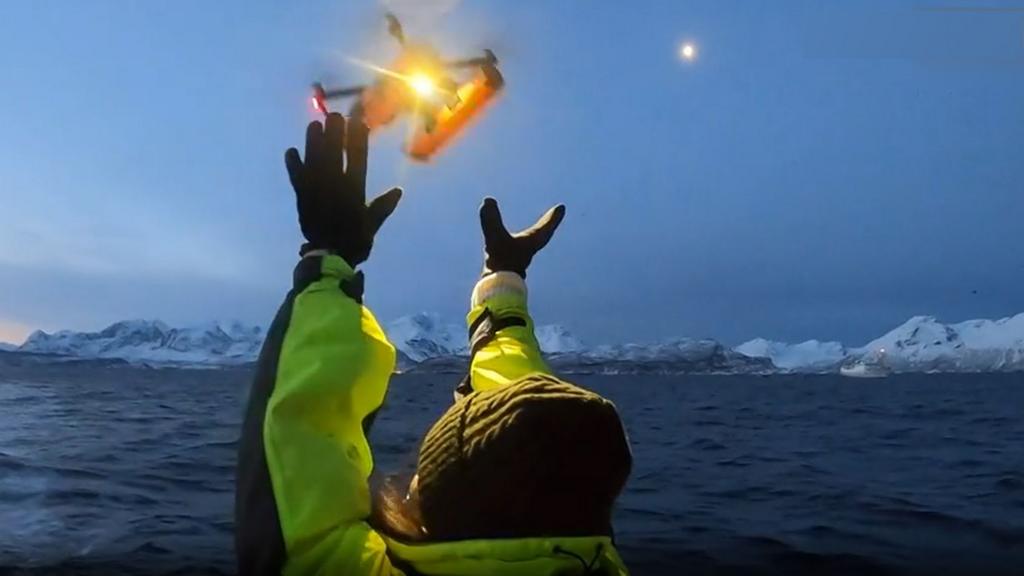
Drone-captured whale breath is providing valuable insights into the health of humpback and other whale species in the wild.
Scientists deployed drones equipped with specialized instruments to fly through the exhaled aerosols, or “blows,” produced when these marine mammals surface to breathe.
The analysis revealed the presence of a highly infectious virus associated with mass strandings of whales and dolphins globally.
According to Prof. Terry Dawson of King’s College London, this method of sampling whale “blow” represents a “game-changer” for assessing whale health and well-being.
“It enables us to monitor pathogens in live whales without causing stress or harm, offering crucial data on diseases within rapidly evolving Arctic ecosystems,” he stated.
Researchers utilized drones carrying sterile petri dishes to collect droplets from the exhaled breath of humpback, fin, and sperm whales, supplementing this data with skin biopsies obtained from boats.
The study confirmed, for the first time, the circulation of cetacean morbillivirus, a potentially lethal virus affecting whales, in regions above the Arctic Circle.
This highly contagious disease spreads rapidly among dolphins, whales, and porpoises, leading to severe illness and mass mortality events.
Its ability to jump between species and traverse oceans poses a significant threat to marine mammal populations.
The researchers anticipate that this innovative approach will facilitate the early detection of threats to marine life, preventing widespread outbreaks.
“Moving forward, our priority is to continue employing these techniques for long-term surveillance, allowing us to understand how various emerging stressors will impact whale health in the years ahead,” noted Helena Costa of Nord University, Norway.
The study, a collaboration between King’s College London, The Royal (Dick) School of Veterinary Studies in the UK, and Nord University in Norway, is published in BMC Veterinary Research.
Sign up for our Future Earth newsletter to keep up with the latest climate and environment stories with the BBC’s Justin Rowlatt. Outside the UK? Sign up to our international newsletter here.
A government-commissioned report into farm profitability says farmers fear what the future might hold.
The amateur jet pilot will be the first NASA administrator in decades to come directly from outside government.
Critics say government changes to a flagship biodiversity policy could stall nature recovery.
Pupils designed and manufactured cars, and launched them down a track using compressed air.
India, which is an emerging AI and cloud infrastructure hub, has witnessed a surge of global tech investment recently.