

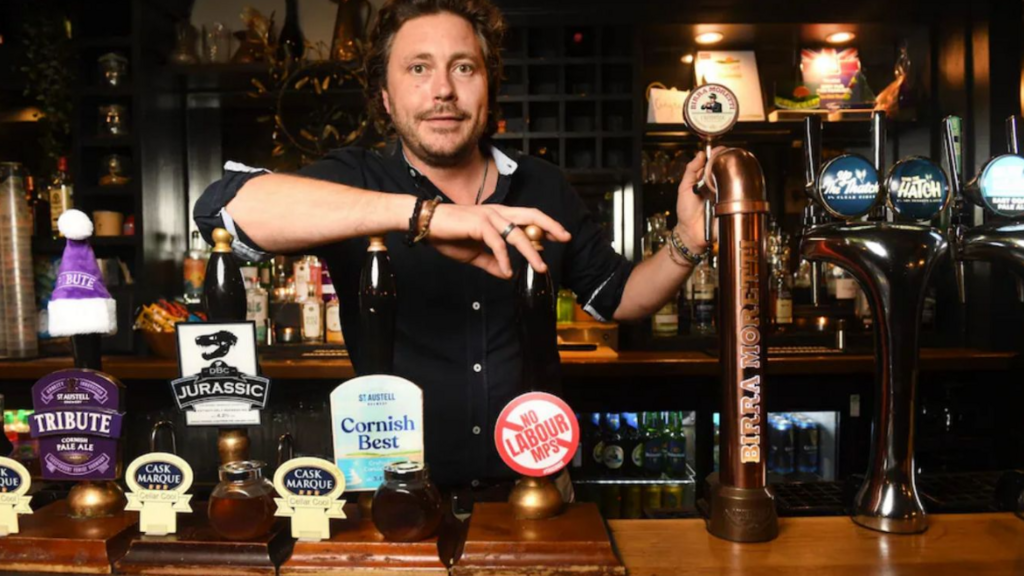
Downing Street has affirmed the government’s support for pubs, amidst a growing campaign where establishments are barring Labour MPs in protest against current tax rates.
The ban on Labour MPs, initiated a week prior, has seen over 250 pubs, restaurants, and hotels across the nation, including the Old Thatch in Dorset, join the movement.
Andy Lennox, landlord of the Old Thatch, described the protest as a last resort, citing repeated unsuccessful appeals for tax cuts for the hospitality sector, which instead faced increased taxation.
However, the prime minister’s spokesperson stated that the chancellor had implemented a £4.3bn support package for pubs, restaurants, and cafes, recognizing the “vital” role of hospitality in the UK economy.
The spokesperson added, “Without this intervention, pubs would have faced a 45% increase in bills next year. We’ve reduced that to just 4%.”
“We’ve also maintained the draft beer duty cut, eased licensing rules for pavement drinks and events, and capped corporation tax.”
“These measures demonstrate our commitment to supporting, not abandoning, the hospitality industry.”
UKHospitality, the industry’s representative body, disputes the government’s figures regarding both the support package and the impact of the intervention.
When asked about the prime minister’s potential exclusion from his local pub during the Christmas season, the spokesperson responded, “The PM will be working diligently up to Christmas. I won’t speculate on his Christmas plans.”
The spokesperson declined to comment further on individual businesses’ policies.
However, Mr. Lennox stated that the campaign to ban the PM and other Labour MPs from pubs was initiated due to the government’s lack of response to the hospitality sector’s needs.
He told the BBC that the industry had launched “extensive, professional campaigning efforts,” including contacting every MP and personally delivering letters to the Chancellor’s office.
“Everyone is frustrated because the Labour government hasn’t listened and has instead increased our taxes.”
“What’s particularly infuriating is their pretense of not having done so. It’s as if the wrong button was pressed, and instead of taxing Amazon and warehouses, they’re taxing us instead.”
“We’ve been imploring our MPs for years because businesses are failing, not due to poor management, but due to excessive taxation.”
Mr. Lennox identified James Fowler, a publican from neighboring Dorset, as the originator of the campaign, having first displayed “No Labour MPs” stickers at the Larderhouse in Bournemouth on Saturday.
Tom Hayes, the Labour MP for Bournemouth East, responded with a video to the “No Labour MPs” sign displayed in one of his local pubs.
The MP stated, “It’s the Christmas season, a time for joy, but the Larderhouse and other businesses displaying “no Labour MPs” stickers are undermining the inclusive culture that local business owners have worked to cultivate.”
“My job has become significantly more challenging because I can’t advocate for businesses with the Chancellor if I’m barred from speaking to business owners.”
Sounding disheartened, he added, “We need to remove politics from the high street, especially during Christmas, when we already have enough political posturing in parliament and division in our country.”
Mr. Lennox acknowledged the risks associated with the ban, stating, “The ban is a risky move for us, and I’m aware of the bridges I’ve burned.”
“Tom Hayes is a good person who has engaged with us and signed letters, so there’s nothing personal against Tom.”
“However, his frustration should be directed at his government, not at the people forced to protest in this manner.”
The UK’s 20% VAT rate for hospitality is among the highest in Europe, with most countries charging approximately half that amount. The Liberal Democrats advocated for a 5% VAT reduction prior to the Budget.
Mr. Lennox asserted that reducing the tax would “resolve all the issues,” adding, “Cutting VAT will stimulate growth and increase tax revenue, allowing the government to recoup the money while also allowing us to generate profit.”
Many businesses are also expressing discontent regarding alterations to business rates, announced in last month’s Budget, which they claim could add tens of thousands to their annual bills.
The government stated that it would calculate business rates for 750,000 High Street retail and hospitality firms using a lower percentage of the rateable value of premises; however, this lower tax rate was perceived as less generous than anticipated.
Concurrently, numerous firms have experienced increases in their rateable value and face the phasing out of a Covid-era 40% discount, beginning in April.
Consequently, despite some transitional relief measures, many will face substantial increases in their business rates bill.
Downing Street stated that the government was capping business rate increases at 15% for most properties and at £800 for the smallest.
The spokesperson added that, from April, there will be new, permanently lower tax rates for retail, hospitality, and leisure, which will be the lowest in more than 30 years for small venues, providing “certainty and stability for the future.”
Sign up for our Politics Essential newsletter to read top political analysis, gain insight from across the UK and stay up to speed with the big moments. It’ll be delivered straight to your inbox every weekday.
The strength of the UK economy helps determine how much tax the government collects to pay for services.
David Skaith says “everything is on the table” in consultation over North Yorkshire visitor levy.
The chancellor tells MPs many of the stories leaked to the media were inaccurate and “very damaging”.
Bank of England deputy governor Clare Lombardelli said inflation would be brought down by measures cutting energy prices and freezing rail fares.
The annual pay for full-time workers on minimum wage will rise to just under £25,000 from April.