

“`html
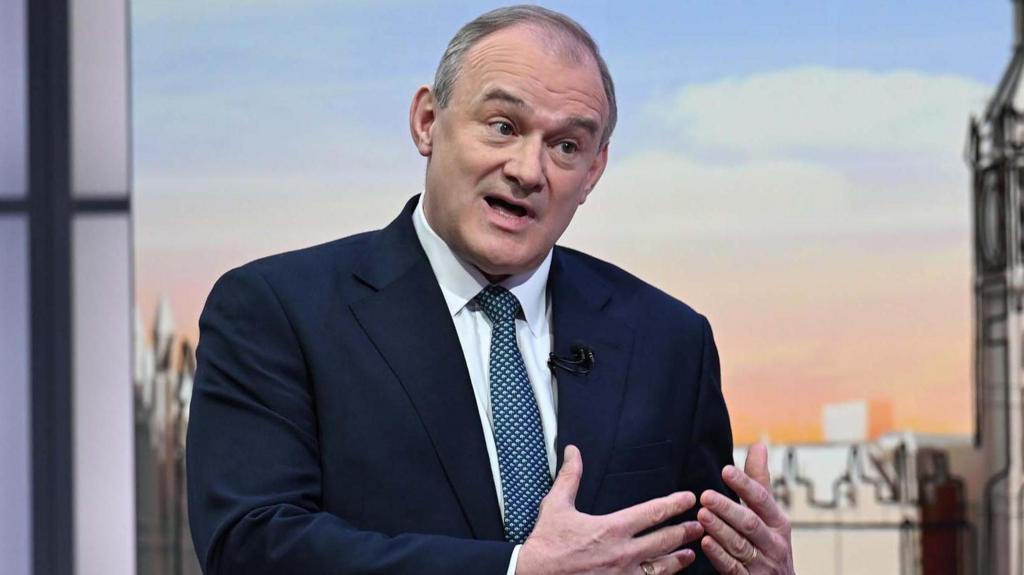
Liberal Democrat leader Sir Ed Davey has advocated for the government to issue war bonds, citing the urgent need for increased UK defense spending.
Under the Liberal Democrats’ proposal, the public would have the opportunity to loan funds to the government through bonds, maturing over a two-to-three year period and yielding interest rates comparable to standard government bonds.
Davey stated that these bonds, which the party estimates could generate up to £20 billion for the military, would provide citizens with a means to “support patriotically our defence”.
A government spokesperson responded that “new debt instruments” are continuously under review, emphasizing the need for them to represent “value for money” and align with broader fiscal objectives.
Calls for heightened defense expenditure have grown louder in recent years, particularly following Russia’s full-scale invasion of Ukraine in 2022 and the election of US President Donald Trump, who has consistently criticized NATO members for insufficient military spending.
Speaking on the BBC’s Sunday with Laura Kuenssberg, Davey argued that the sale of war bonds is necessary given that “we’re in almost a Cold War type scenario,” pointing to the Russian use of drones, submarines and shadow fleets.
He asserted, “This is a serious threat, and we need to move far faster than what the government has been doing.”
“We need to go rapidly.”
The Labour government has committed to increasing overall defense spending from 2.3% to 2.5% of national income by 2027, at an estimated additional cost of £6 billion annually.
It has also pledged to reach 3.5% by 2035, in accordance with a commitment made by NATO members last year.
However, reports in the Times and the Sun suggest that achieving “war ready” status for Britain’s armed forces will necessitate an additional £28 billion beyond current allocations.
The government’s defense investment plan, originally scheduled for publication last autumn, is reportedly delayed due to cost concerns.
Earlier this month, the head of the Armed Forces, Sir Richard Knighton, stated that the UK is “not as ready as we need to be for the kind of full-scale conflict we might face.”
On Sunday, Davey commented: “Everyone can see that since the last election things have changed dramatically. The way that Putin is prosecuting that [Ukraine] war, but as significantly, the attitude of Donald Trump to supporting European defence.”
He voiced apprehension regarding the NATO alliance in light of the US president’s stance.
“I deeply regret to say, because of Donald Trump, there has to be a question about whether we can rely on the United States. With him in the White House they’re no longer a reliable ally. We have to step up and fast,” he told the BBC.
The Liberal Democrats stated that funds raised through bond issuance would be specifically allocated to defense, and that this investment would foster “growth, jobs and higher revenues” for the government, “which would partially offset the cost of additional debt servicing.”
The party further noted that the scheme would require a concurrent overhaul of the Ministry of Defence procurement process, which has faced criticism for inefficiency in the past.
The party asserts that their proposal is modeled after the bond schemes implemented during World War One and World War Two.
Individual citizens could lend the government money, which would be paid back in six to 10 years with interest. By the end of 1945, the scheme had raised £1.754m.
Posters encouraging members of the public to buy bonds – or national savings certificates – used slogans including “lend to defend” and “feed the guns with war bonds”.
Dan Coatsworth, head of markets at investors AJ Bell, said: “War bonds are a proven way of raising money to fund national defence spending, but they can burden a government with long-term debt.
“In theory, the public might demand a better rate of interest than they could get on cash in the bank to take up the bonds.
“While some people might think it is their duty to support the country, there will be others who treat such a bond in the same way as any type of investment.”
Sign up for our Politics Essential newsletter to keep up with the inner workings of Westminster and beyond.
The defence minister claims he wasn’t made fully aware of issues which led to 35 people falling ill.
Former aeronautical engineer David Hill’s investigation into the 1994 Mull of Kintyre crash helped pave the way for families’ campaign for justice.
A neighbouring council [DELETE and local MP] express concern over Cheltenham Borough Council’s delay request.
Most wanting a delay are Labour-led but three are Tory councils and one is a Lib Dem authority.
The army’s cyber unit will benefit from new modern accommodation and specialist training facilities.
“`