

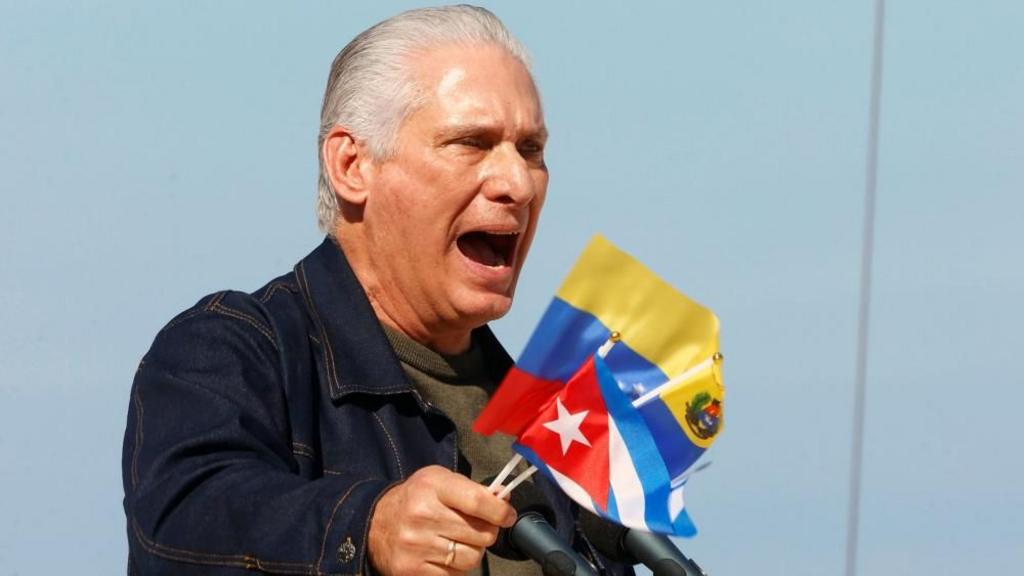
Beyond Venezuela, no nation in the Americas is more deeply affected by the unfolding events in Caracas than Cuba.
The two nations have cultivated a shared political vision centered on state-led socialism since the pivotal meeting between a then-ascendant Venezuelan presidential candidate, Hugo Chávez, and the aging leader of the Cuban Revolution, Fidel Castro, on the Havana airport tarmac in 1999.
For years, their bonds only strengthened, with Venezuelan crude oil flowing steadily to the communist-governed island in exchange for Cuban doctors and medical personnel traveling in the opposite direction.
Following the deaths of Chávez and Castro, Nicolás Maduro, a figure trained and instructed in Cuba, became Chávez’s handpicked successor, chosen in part for his acceptability to the Castro brothers. He represented continuity for both the Cuban and Venezuelan revolutions.
Now, with Maduro forcibly removed from power in Caracas by a US elite Delta Force team, Cuba faces a bleak outlook.
The Cuban government has strongly denounced the operation as illegal and declared two days of national mourning for the 32 Cuban nationals reportedly killed in the US military action.
These deaths have brought renewed attention to a long-suspected reality: the extent of Cuban influence within the Venezuelan presidency and military. Maduro’s security detail was reportedly comprised almost entirely of Cuban bodyguards, and Cuban nationals hold numerous positions within Venezuela’s intelligence services and military.
While Cuba has consistently denied having active military or security agents in Venezuela, freed political prisoners have often alleged being interrogated by individuals with Cuban accents while in custody.
Moreover, despite public declarations of solidarity between the two nations, the extent of Cuban influence behind the scenes in the Venezuelan state is believed to have created divisions between ministers closely aligned with Havana and those who feel the relationship established by Chávez and Castro has become fundamentally unbalanced.
This faction believes Venezuela receives insufficient returns for its oil exports.
Venezuela is estimated to send around 35,000 barrels of oil daily to Cuba, a volume unmatched by the island’s other key energy partners, Russia and Mexico.
The Trump administration’s policy of confiscating sanctioned Venezuelan oil tankers has already begun to exacerbate the fuel and electricity crisis in Cuba, with the potential for rapid deterioration.
At best, the future appears increasingly complex for the Caribbean island without Maduro at the helm in Caracas. Cuba is already grappling with its worst economic crisis since the Cold War.
Rolling blackouts have plagued the island for months, severely impacting ordinary Cubans: weeks without reliable electricity, food spoilage, non-functional fans and air conditioning, mosquito infestations, and accumulating uncollected waste.
Cuba has experienced a widespread outbreak of mosquito-borne illnesses in recent weeks, with significant numbers affected by dengue fever and chikungunya. Cuba’s healthcare system, once a symbol of the revolution’s success, has struggled to manage the crisis.
This challenging situation is the daily reality for most Cubans.
The possibility of Delcy Rodríguez halting the flow of Venezuelan oil to Cuba fills Cubans with apprehension, particularly if she seeks to appease the Trump administration following the US raid and avert further violence.
President Trump asserts that Washington is now in control in Venezuela.
While those comments were partially walked back by Secretary of State Marco Rubio, the Trump administration expects complete compliance from Rodríguez as acting president.
Trump warned of further, potentially harsher consequences if she “doesn’t behave,” as he put it.
This rhetoric, and the US operation itself, has drawn criticism, with some accusing the White House of engaging in a form of US imperialism and interventionism not seen in Latin America since the Cold War.
Critics argue that Maduro’s removal constitutes a kidnapping, and the case against him should be dismissed at his eventual trial in New York.
Trump appears unfazed, suggesting he might repeat the action against the president of Colombia if necessary.
He has dubbed the evolving circumstances in Latin America the “Donroe Doctrine,” a reference to the Monroe Doctrine, a 19th-century foreign policy principle asserting US dominance in the Western Hemisphere.
In essence, this view holds that Latin America is the US’s “backyard,” and Washington has the right to dictate events there. Rubio used the term “backyard” to describe the region while justifying the actions against Venezuela on US news programs.
Rubio, a Cuban American former Florida senator and son of Cuban exiles, is also a key figure in shaping Cuba’s future. The US economic embargo, in place for over six decades, has failed to dislodge the Castro brothers or their political project.
Rubio aspires to be the individual who, directly or indirectly, brings an end to 60 years of communist rule in his parents’ homeland.
He views the strategy of removing Maduro and imposing strict conditions on a more compliant Rodríguez government in Caracas as crucial to achieving that goal in Havana.
Cuba has faced challenges in the past, and the government remains defiant in the face of this latest US intervention in the region.
Cuban President Miguel Díaz-Canel stated that the 32 “brave Cuban combatants” who died in Venezuela would be honored for “taking on the terrorists in imperial uniforms.”
“Cuba is ready to fall,” Trump retorted aboard Air Force One.
Delcy Rodriguez expressed her pain over what she described as the “kidnapping” of Maduro and his wife.
Prime Minister Sir Keir Starmer has thus far refrained from condemning US military action in the Latin American state.
The 25-page charging document details a series of allegations, including accusations that Maduro and his wife ordered kidnappings, beatings, and murders.
The BBC’s Madeline Halpert was present as the former Venezuelan president addressed the judge.
The US action in Venezuela has faced strong criticism from both allies and adversaries.