

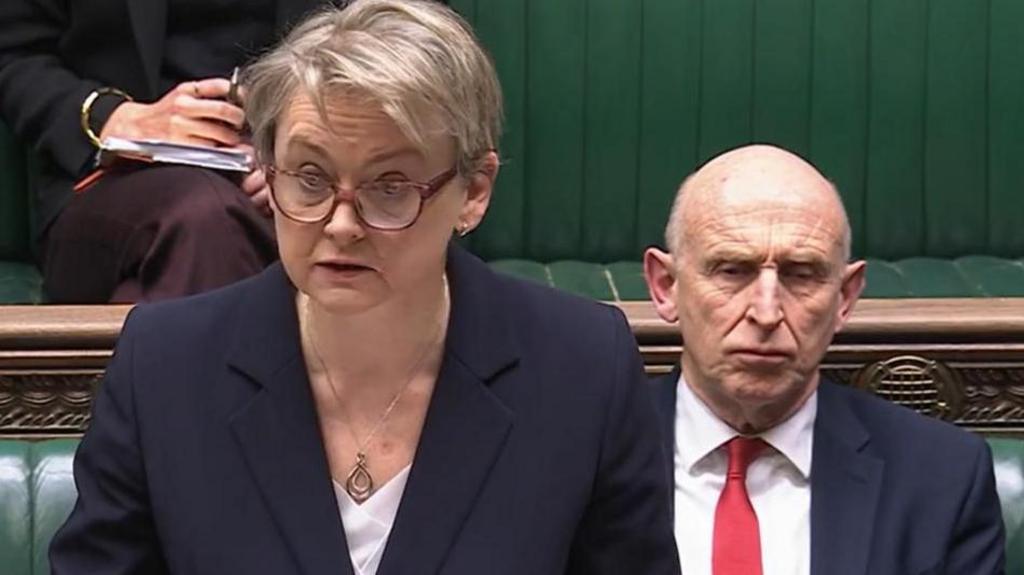
Foreign Secretary Yvette Cooper has reminded US counterpart Marco Rubio of his obligations under international law following US military action in Venezuela, she informed Members of Parliament.
The operation launched by US President Donald Trump, resulting in the capture of President Nicolás Maduro over the weekend, has drawn accusations of the US flouting international law.
Cooper’s statement to the House of Commons went further than Prime Minister Sir Keir Starmer, who has thus far refrained from condemning Trump’s decision, focusing instead on the alleged brutality of Maduro’s regime.
During a heated debate, Conservative leader Kemi Badenoch expressed disappointment at the Prime Minister’s silence on the matter.
The government has faced increasing pressure to denounce Trump’s action, with Emily Thornberry, Labour chair of the Commons Foreign Affairs committee, asserting that the UK should “be clearer that this has been a breach of international law.”
Security analysts have warned that the US intervention destabilizes global politics and could encourage leaders in other nations, including Russian President Vladimir Putin, to disregard international agreements.
Appearing in a New York City courtroom on Monday, Maduro, in leg shackles and accompanied by his wife Cilia Flores, addressed a packed courtroom, stating he had been “kidnapped.”
In the government’s first official statement on the issue to Parliament, Cooper confirmed she had raised the issue of international law in a conversation with the US Secretary of State.
“In my discussions with Secretary Rubio, I raised the importance of complying with international law, and we will continue to urge all partners to do so,” she stated.
“It is, of course, for the US to set out the legal basis for their actions, and the UN Security Council is discussing Venezuela this afternoon. These issues will continue to be matters for international discussion.”
Cooper added that she had also discussed with Rubio the UK’s potential role in supporting a peaceful democratic transition that respects the will of the Venezuelan people.
In response, Badenoch inquired whether the Prime Minister had spoken to Trump, stating: “I ask this because the government talks up its relationship with the US, but we keep finding we’re not in the room when big decisions are made.”
She indicated that the Conservatives understood Trump’s actions and accused the government of distancing itself from its “closest security partner.”
“We must work with them seriously, not snipe from the sidelines,” she asserted.
“We on this side of the House understand why the US has taken this action. As the Foreign Secretary said, UK policy has long been to press for a peaceful transition from authoritarian rule to a democracy. That never happened.
“Instead, Venezuelans have been living under Maduro’s brutal regime for many years. The US has made it clear it is acting in its national interest against drug smuggling and other criminal activity, including potential terrorism.”
The Conservative leader also expressed concern about the precedent set by Trump’s actions in Venezuela, emphasizing the need to protect the “rules-based order.”
However, Labour backbenchers and other opposition parties, including the Liberal Democrats and the SNP, continued to exert pressure on the government to explicitly condemn Trump’s actions.
Dame Emily told the Commons Trump’s actions had created a “profound risk of international norms changing” if the government did not start “calling out” breaches of international law.
“It is for the West surely to stand up and say, call it as it is,” she said.
Cooper replied: “I have raised this issue of international law with Secretary of State Rubio and made clear that we will continue to urge all countries to follow it.”
Liberal Democrat leader Ed Davey stated that the UK government’s refusal to label Donald Trump’s actions a “clear breach of international law” appeared “ridiculous,” adding: “Maduro is a brutal, illegitimate dictator, but that does not give President Trump a free pass for illegal action.”
Cooper demurred, insisting that the focus should be on Venezuela’s “transition to democracy.”
Labour MP for Leeds East Richard Burgon labeled the attack on Venezuela “disgusting,” suggesting that the Prime Minister would react differently if Putin had taken the same military action.
He said: “Isn’t the reality that the Prime Minister is willing to ditch international law and sidestep the United Nations charter in order to appease Donald Trump, and doesn’t this cowardly, craven approach drag this country’s reputation through the dirt?”
Cooper later told MPs: “I really would warn members against making equivalence here around what Putin has done in Ukraine, where thousands of children have been kidnapped, where they have invaded a country led by a democratically elected president.
“We should be careful about recognising what we say and the implications of it.”
Allegations of the illegal deportation of children from Ukraine since Russia’s invasion nearly four years ago led to an international arrest warrant being issued for Putin. Ukraine has said more than 19,000 children were removed to Russia. Moscow maintains the children were evacuated from danger.
Although Cooper was careful not to condemn Trump’s actions in Venezuela, she concluded her statement by emphasizing that Greenland’s future was a matter solely for Greenlanders and Danes.
Trump has once again raised the prospect that the US could annex Greenland, claiming it is necessary for national security reasons.
Greenland’s Prime Minister Jens Frederik Nielsen has dismissed the notion of US control over the island as a “fantasy,” while Denmark’s Prime Minister Mette Frederiksen has urged the US to “stop the threats” concerning the island.
In her statement on Venezuela, Cooper stated: “Greenland is part of the Kingdom of Denmark.
“Our close European partners, our long-standing Nato allies and all our countries work closely together on security issues, and will always do so.
“The future of Greenland is a matter for the Greenlanders and Danes, and no-one else.”
Speaking in the debate, former Conservative Foreign Secretary Sir Jeremy Hunt warned that US attempts to take Greenland could result in the collapse of NATO (the North Atlantic Treaty Organisation) and accused European leaders of appearing “weak and divided.”
“Most people’s view of Maduro’s capture will be ‘good riddance’, and I would have liked the government to be more categorical in supporting US action in removing an illegitimate and evil dictator,” he told the Commons.
“But, if the new US approach extends to the annexation of Greenland, the sovereign territory of a Nato member, it could mean the end of the alliance with disastrous consequences.”
He inquired about the Foreign Office’s efforts to prevent such “a disaster,” and Cooper replied that the government was “very firm” on the issue.
Sign up for our Politics Essential newsletter to read top political analysis, gain insight from across the UK and stay up to speed with the big moments. It’ll be delivered straight to your inbox every weekday.
Delcy Rodriguez said she was pained by what she called the “kidnapping” of Maduro and his wife.
The 25-page charging document details a litany of allegations, including accusations that Maduro and his wife ordered kidnappings, beatings and murders.
The prospects for Cuba – a close ally of Nicolás Maduro’s Venezuela – are now bleak, writes Will Grant.
The BBC’s Madeline Halpert was inside the room as the former Venezuelan president addressed the judge.
The US taking of Venezuela’s leader has faced strong criticism from both America’s friends and foes.