

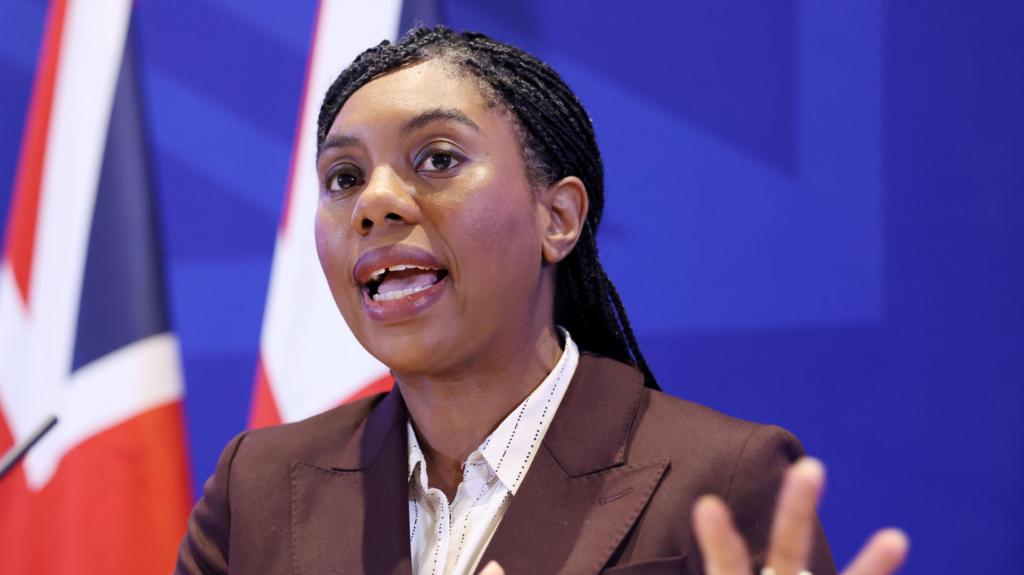
Kemi Badenoch has stated that the Conservative Party will abandon the planned ban on petrol and diesel vehicle sales in the UK should they win the upcoming general election.
In an opinion piece published in the Sunday Telegraph, the Conservative leader described the Zero Emission Vehicle (ZEV) mandate as a “well-meaning but ultimately destructive piece of legislation.”
Current regulations stipulate that from 2030, all new cars must be electric or hybrid vehicles, a measure designed to support the government’s legally binding commitment to achieve “net zero” emissions by 2050.
These comments follow Badenoch’s meeting with Italian Prime Minister Giorgia Meloni, who has been advocating for the EU to weaken its own proposed ban.
“Net zero” refers to achieving a balance between the amount of greenhouse gas produced and the amount removed from the atmosphere.
Recently, six EU member states, including Italy, have urged other members to reconsider the plan to phase out new petrol and diesel cars by 2035, citing concerns about potential damage to industrial competitiveness.
Badenoch suggested the EU was indicating a shift away from a complete ban, adding: “The reality is that the EU’s change of heart on EVs will leave Labour even more isolated. By pressing ahead alone, we are placing our domestic industry at a disadvantage while giving others the opportunity to dominate global supply chains.”
She argued that the only “winners in this economic self-harm are China”.
The Conservative leader clarified that her government would still pursue a “transition to cleaner transport,” but one driven by “affordability, practicality, and technological progress” rather than “unrealistic mandates that weaken domestic manufacturing and empower foreign competitors”.
She posited that scrapping the mandate would provide “space” to revitalize the UK’s automotive industry.
Previously, reports indicated that UK car manufacturers were divided over the 2030 deadline, with some calling for increased support to meet the target.
In the latest Budget, the government announced an additional £1.3 billion investment in the UK’s Electric Car Grant scheme to incentivize drivers to switch to electric vehicles.
Chancellor Rachel Reeves also announced that drivers of battery electric cars, including plug-in hybrids, will be charged 3p per mile for Electric Vehicle Excise Duty starting in April 2028, a move that some argue could diminish the appeal of electric cars.
The ban on the sale of petrol and diesel cars was initially introduced in 2020 by then-Prime Minister Boris Johnson of the Conservative Party; Badenoch, a cabinet member at the time, opposed the plans.
Rishi Sunak later pushed the ban back to 2035, while Labour has pledged to accelerate it in its 2024 election manifesto.
A spokesperson for the Department for Transport stated that the government remains “committed to phasing out all new non-zero emission car and van sales.”
They added, “More drivers than ever are choosing electric.”
The next UK general election must be held by 15 August 2029, but the prime minister has the option to call an election at any point prior to this date.
Rail campaigner Dennis Fancett fears some will be “lost to rail travel” because of LNER’s changes.
Drop-off fees will rise from £7 to £10 at the West Sussex airport from 6 January.
The West Yorkshire station will be closed from 14 December until March 2028, says Network Rail.
Seven bus routes across west London are facing little to no service as bus drivers take action over pay.
David Skaith says “everything is on the table” in consultation over North Yorkshire visitor levy.