

China has set its annual economic growth target at 4.5%-5%, marking the lowest expansion goal since 1991 amid domestic and international headwinds.
This is the first instance of a lowered target since it was adjusted to “around 5%” in 2023. In 2020, no target was established due to pandemic-related uncertainties.
The announcement coincided with China’s “two sessions,” a key political gathering, and included initial details of the 15th Five-Year Plan for the world’s second-largest economy.
Beijing intends to reshape its economic strategy to address challenges such as sluggish consumption, a persistent property crisis, global trade tensions, and energy constraints exacerbated by geopolitical factors.
The event, commencing on Wednesday and typically spanning at least a week, convenes the nation’s leadership for a series of meetings.
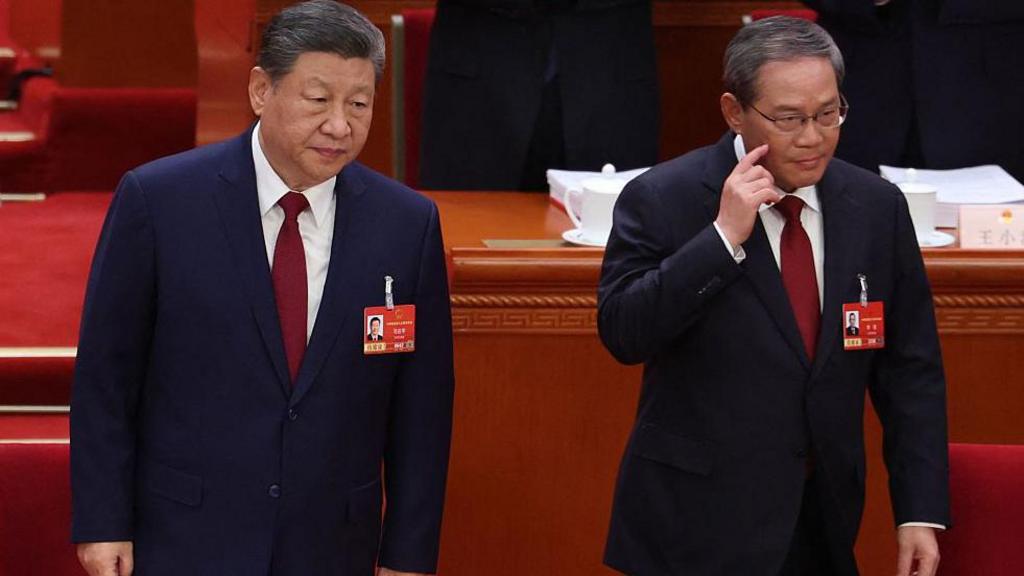
Premier Li Qiang informed delegates that the Five-Year Plan will prioritize investments in innovation, high-tech sectors, scientific research, and initiatives to stimulate household consumption.
His remarks underscore Beijing’s concerns about the economy’s reliance on exports due to weak domestic demand, while also emphasizing its commitment to upgrading the country’s manufacturing capabilities.
Official figures released in January indicated that China achieved its 5% economic growth target for 2025 overall. However, Beijing also acknowledged a slowdown to 4.5% in the final quarter, attributed to subdued domestic spending and a prolonged property downturn.
Over two-thirds of China’s provinces have revised their growth objectives, either reducing the target figure or shifting from aiming for a rate above a specific level to targeting “around” that level.
While China met its growth target last year, Georgetown University policy researcher Ning Leng suggests approaching this with caution, as other data points to a less robust economic picture.
Consumer spending remains subdued, and the ongoing real estate crisis continues to exert downward pressure on growth.
Manufacturing and exports have provided crucial support to China’s economy, leading to a record-breaking trade surplus of $1.19 trillion (£890 billion) last year.
However, China’s increased reliance on exports to compensate for domestic gaps represents a vulnerability that the US may exploit, according to Ning.
US President Donald Trump’s tariffs have intensified pressure on China’s export-oriented economy.
In response, China has invested heavily in diversifying its trade relationships to sustain its manufacturing sector, Ning noted.
Geopolitical tensions mean Beijing has now lost two key sources of cheap oil this year.
It also no longer has access to Venezuelan oil after sanctions.
However, Beijing emphasizes its decreasing reliance on fossil fuels due to its ongoing transition to renewable energy sources.
A trade court has cleared the way for businesses to receive refunds for tariffs that the Supreme Court struck down last month.
Has online privacy become “a luxury not a right” for us all in 2026?
Scott Bessent says that “likely sometime this week” the US will increase its global tariff on imports from the existing 10%.
Experts have warned that if oil and gas prices remains elevated it could make goods and services more expensive.
UK Inflation has dropped back from record highs but remains above the Bank of England’s 2% target.