

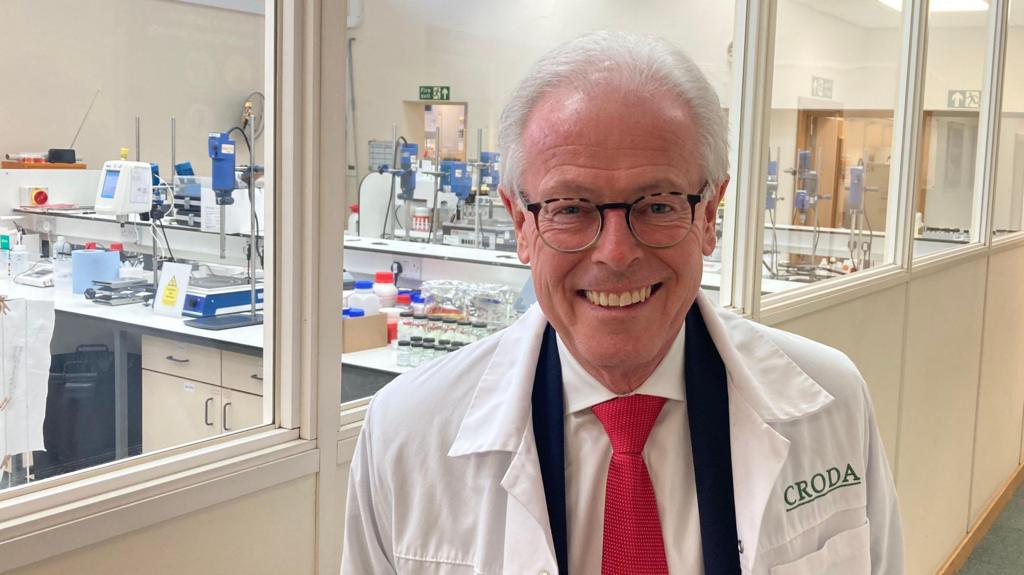
From its modest origins in a repurposed waterworks in rural East Yorkshire, Croda International has ascended to become a FTSE 100 enterprise. As the company commemorates its centennial, employees are reflecting on Croda’s pivotal role in the development of a treatment for a rare, degenerative disease affecting young boys – a narrative famously depicted in a Hollywood film.
In a Hull housing estate, street names serve as a poignant reminder of the story of an American boy afflicted with a severe brain disorder.
In 1984, Lorenzo Odone received a diagnosis of adrenoleukodystrophy (ALD), with medical professionals forecasting a short life span.
Within a year, children with this condition can experience paralysis, blindness, and loss of speech.
However, Lorenzo’s parents resolutely challenged this prognosis, dedicating themselves to finding a treatment that could improve and prolong his life.
Today, Lorenzo’s Way and Suddaby Close in east Hull stand as a testament to their unwavering efforts, which were immortalized in the 1992 film “Lorenzo’s Oil,” starring Nick Nolte and Susan Sarandon.
How did Hull become involved in this remarkable story?
Despite lacking formal scientific training, Lorenzo’s father, Augusto, immersed himself in the study of medicine and biochemistry, eventually devising a potential treatment for ALD using acids derived from olive and rapeseed oils.
The Odones approached Croda, a company with substantial manufacturing facilities in Hull, and chemist Don Suddaby, who was persuaded to distill the innovative formula. The resulting product became known as Lorenzo’s oil.
Mr. Suddaby, who portrayed himself in the film, passed away a year after its release.
Keith Layden, who was employed at Croda at the time and now serves as a non-executive director, recalls the events.
“We were approached by Augusto Odone, the father of Lorenzo, after whom the product is named,” he recounts.
“He presented us with an idea, a hypothesis, that required chemical expertise.”
“Fortunately, the request landed on the desk of Keith Coupland, the technical director at the site. In typical Croda fashion—entrepreneurial, creative, and innovative—Keith agreed to give it a try, finding the proposition intriguing.”
Mr. Coupland then contacted Mr. Suddaby, who, despite nearing retirement, accepted the challenge.
“That collaboration led to the creation of Lorenzo’s oil,” Mr. Layden adds. “What began as a simple ‘let’s give it a try’ scenario eventually took us from Hull to Hollywood.”
Croda was established in 1925 by George Crowe and Henry Dawe, who initially produced lanolin, a waxy substance derived from sheep’s wool.
Their first facility was a disused waterworks in Rawcliffe Bridge, near Goole.
The company soon expanded into other product lines and relocated its headquarters to Cowick Hall, a stately home in East Cowick.
Today, the historic house is complemented by modern laboratories and office buildings, all set within expansive green parkland.
The modern-day business produces ingredients for skincare, pharmaceutical, homecare and agricultural products.
At the foot of the grand staircase, Sandra Breene, president of consumer care, suggests many people will not “go a day without using a product that has some Croda ingredients in”.
At the time when Croda began developing Lorenzo’s oil, it supplied products for various industries, but did not have a healthcare or pharmaceutical division.
“It wasn’t an area that we worked in before,” Mr. Layden says.
“We started thinking about how our materials could be used in those sorts of areas.”
“The release of the film generated considerable excitement within Croda, leading to the establishment of a healthcare division in 1997. Over the past three decades, this division has become a significant part of our business.”
“We’ve had significant successes that have benefited hundreds of millions of people, most notably during the Covid pandemic, where we played an integral role in the production and manufacture of the first mRNA-based vaccine.”
Ms. Breene, an alumna of the University of Hull, expressed her disappointment upon learning of the institution’s decision to close its chemistry department.
“We need to ensure that our universities continue to provide us with that pipeline of young people to come into the industry,” she added.
Lorenzo Odone passed away in 2008, having lived two decades longer than initially predicted.
From the outset, questions were raised regarding the effectiveness of Lorenzo’s oil for patients already afflicted with the disease.
Scientific studies indicated that it did not appear to benefit those who were already ill, but it did seem to help prevent illness in those whose genes made them vulnerable to developing symptoms.
Alex TLC, a British leukodystrophy charity, states that the available evidence suggests that Lorenzo’s oil is not a proven preventative but may be beneficial for boys with asymptomatic ALD.
The treatment continues to be produced today.
“Fortunately, it’s a very rare disease,” Mr. Layden says. “Consequently, it was never going to be a commercially attractive proposition for Croda, but we pursued it because we believed it was the right thing to do.”
“As a FTSE 100 company, there’s a lot of focus on the financial metrics.”
“But as employees, you need more than that. You need more of a purpose.”
Listen to highlights from Hull and East Yorkshire on BBC Sounds, watch the latest episode of Look North or tell us about a story you think we should be covering here.
Download the BBC News app from the App Store for iPhone and iPad or Google Play for Android devices
How to identify whether you have cold, flu or Covid and how to look after yourself.
Hannah Dickerson, 30, says functional neurological disorder has drastically changed her life.
Those with long-term conditions share their tips for staying well as part of the NHS campaign.
Probe into historical abuse at former units in Sussex could lead to more alleged victims coming forward.
In a new BBC documentary, six fearless women take on a huge challenge drawing on their sisterhood, resilience and unbreakable bonds.