

From plunging into the icy waters of Coney Island in January, quipping about “freezing… your rent,” to engaging with food truck vendors on how city permits contribute to “Halalflation,” Zohran Mamdani’s campaign trail was anything but conventional. He even walked the length of Manhattan to connect with New Yorkers, asserting they “deserve a mayor that they can see, they can hear, they can even yell at.”
These savvy social media strategies were instrumental in propelling Mamdani and his progressive policies to a surprising victory in New York City’s mayoral primary and subsequent November election.
The 34-year-old democratic socialist successfully engaged New Yorkers, particularly younger voters immersed in “doom-scrolling,” by cultivating an image of authenticity and optimism through social media, as noted by experts speaking to the BBC.
Now, having been sworn in as mayor on January 1st, Mamdani faces the challenge of maintaining momentum and keeping his core supporters engaged throughout his term.
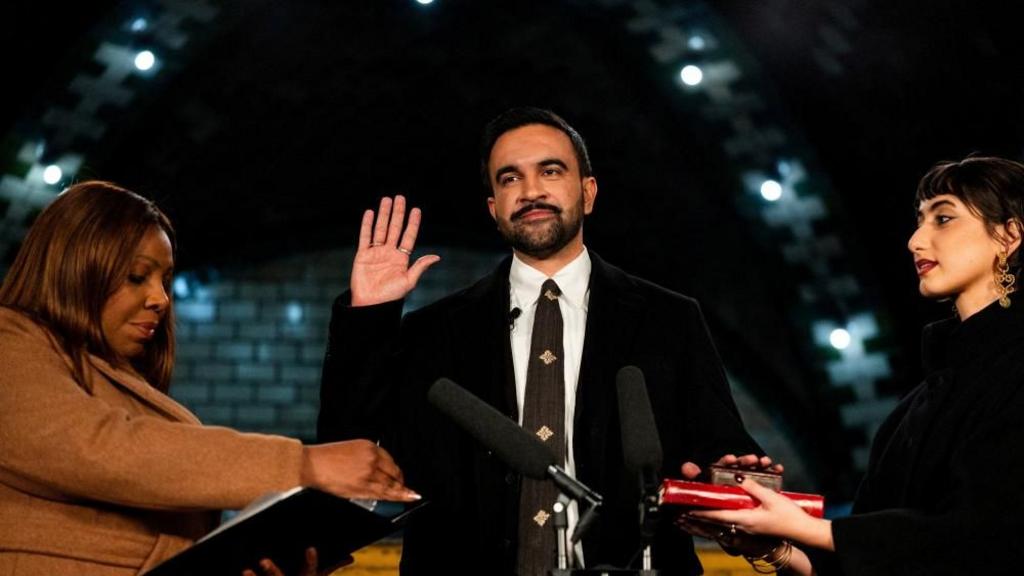
After making history as the first New York mayor to be sworn in with his hand on the Quran, Mamdani addressed the crowd gathered in freezing weather at his inauguration, vowing to represent every resident of the city.
“I do not stand alone. I stand alongside you,” he declared, adding, “I promise you this: If you are a New Yorker, I am your mayor.”
According to an Associated Press voter poll, approximately three-quarters of New York City voters under 30 cast their ballots for Mamdani.
Jane Hall, a communications professor at American University, specializing in politics and media, told the BBC following Mamdani’s win that his adept social media strategy resonated with younger voters who were seeking a political candidate distinct from the more established, older guard.
Hall emphasized that age isn’t the sole determinant of connecting with young voters. “But I think you have to be seen as being authentic and speaking to what people care about in a way that is hip and makes people want to be on the bandwagon,” she stated.
Jack Bratich, a journalism professor at Rutgers University specializing in political culture and social media, noted Mamdani’s ability to blend lightheartedness with serious discourse.
Jennifer Stromer-Galley, a professor of communications, political science, and rhetorical studies at Syracuse University, highlighted the contrast between Mamdani’s approach and the often negative tone adopted by President Donald Trump on social media.
Despite an unexpectedly friendly first meeting in November, where the two politicians reportedly found common ground on issues such as the affordability crisis facing New York City, they clashed during the mayoral campaign.
Trump labeled Mamdani an extremist “lunatic,” threatened to cut federal funding to the city if Mamdani were elected, and vowed to have him arrested if he interfered with immigration enforcement.
On election night, Mamdani responded defiantly in his victory speech, telling the president that “to get to any of us, you will have to get through all of us.”
While this statement was met with enthusiastic cheers from his supporters, experts suggest that the realities of governance may necessitate a more pragmatic approach to dealing with the Trump administration. The cordial November meeting may signal Mamdani’s willingness to engage in such a way.
His working relationship with the White House, and the nature of his rapport with the president, could be crucial in realizing his agenda.
Ioana Literat, a Columbia University communications professor studying youth online political socialization, notes that while promising “fast, sweeping change” in campaign videos is relatively straightforward, the challenge intensifies when “governing under a hostile administration.”
“If his [social media] content doesn’t reckon honestly with those constraints, the same young people who made him go viral can just as quickly turn that energy into disillusionment or backlash,” she warned.
Jonathan Nagler, co-director of NYU’s Center for Social Media and Politics, told the BBC that to succeed in office, Mamdani must keep his supporters engaged with the often less glamorous aspects of day-to-day governing.
“It’s easy to mobilise people to oppose Trump. They already disagree with Trump on so many things, if we’re talking about New York City voters,” Nagler said.
“What’s much harder to do is to go on social media and say: “Hey, the New York City Council is in my way. I need you to get riled up about convincing the New York City Council to do something.”
Nagler also suggested that educating some of these voters about the inner workings of city government could be a hurdle.
“Like all election campaigns, the transition to governance via media is tricky,” Rutgers Prof. Bratich stated.
One strategy to sustain his campaign’s momentum could involve transforming his dedicated social media following into active grassroots organizers. After all, social media “was the front door into a huge field operation and youth volunteer corps” for the mayor-elect, Bratich observed.
Throughout his campaign, Mamdani consistently directed followers to protests, canvassing events, registration drives, and other forms of active participation, ultimately generating over 100,000 volunteers.
“But if his administration stumbles and the feeds keep promising more than he can deliver, it could harden a sense among young voters that ‘even the internet’s mayor couldn’t change anything,'” Literat cautioned.
“That broader reputational risk is part of what makes his governing-era social media so consequential,” she added.
Mamdani’s transition team did not respond to the BBC’s request for comment.
However, there are indicators suggesting that the grassroots enthusiasm surrounding Mamdani will persist.
In November, his allies announced the formation of a new advocacy group aimed at leveraging his extensive volunteer base to raise funds for his agenda. The nonprofit, Our Time for an Affordable NYC, was founded by Mamdani volunteers and members of the Democratic Socialists of New York.
While legally independent of Mamdani and his transition team, Our Time asserts its focus on advancing the mayor-elect’s affordability agenda through “door-knocking, phone-banking, communicating, and organising at the neighbourhood, city, and state level.”
Mamdani’s swearing-in ceremony took place on Thursday inside the original City Hall subway station, now abandoned for regular transit.
“This is truly the honour and the privilege of a lifetime,” he said. “I cannot wait to see everyone tomorrow as we begin our term.”
The 6.5 magnitude trembler shook buildings and set off the country’s earthquake alert system.
The US president says “we will come to their rescue” after days of demonstrations and clashes.
Colorado officials said that it would be the first time in more than 25 years that a mountain lion killed a person in the state, if confirmed.
The plan to impose steep tariffs on 13 producers could have seen major price rises for US consumers.
In an interview about his health, the US president says: “I don’t want thick blood pouring through my heart”.