

“`html
Bulgaria, recognized as the European Union’s economically weakest member, is poised to become the 21st member of the eurozone, surpassing nations such as Poland, the Czech Republic, and Hungary, which might have seemed more obvious candidates.
For a segment of Bulgarians, particularly those in urban areas who are young and entrepreneurial, this transition represents an optimistic and potentially advantageous step, marking the culmination of Bulgaria’s integration into the European mainstream, following its accession to Nato and the EU, and its inclusion in the Schengen Area.
Conversely, among the older, more rural, and traditionally-minded portions of the population, the replacement of the Bulgarian lev with the euro has sparked apprehension and discontent.
The lev, meaning “lion,” has served as Bulgaria’s currency since 1881. However, it has been pegged to other European currencies since 1997, initially to the Deutschmark and subsequently to the euro.
Public opinion polls indicate that Bulgaria’s 6.5 million citizens are almost evenly split on the adoption of the new currency, a transition further complicated by ongoing political instability.
Prime Minister Rosen Zhelyazkov’s coalition government faced a setback on December 11, losing a confidence vote in the wake of widespread protests against the proposed 2026 budget. Bulgaria has experienced seven elections in the past four years, with the likelihood of an eighth early next year.
“I am against the euro and disapprove of the manner in which it has been imposed,” stated Todor, 50, a small business owner in Gabrovo, a town situated at the foot of the Balkan Mountains, in an interview with the BBC.
“If a referendum were to be held, I estimate that 70% of the population would vote against it.”
A referendum on euro adoption was proposed by President Rumen Radev but was ultimately rejected by the outgoing government.
Todor reported that his business, which produces colored plastics for the domestic market, has suffered a downturn due to high inflation and a decrease in sales, which he attributes to fears surrounding the euro.
In contrast, Ognian Enev, 60, who owns a tea shop in central Sofia, expressed more enthusiasm. “Overall, it’s a positive development. It’s merely a technical adjustment and does not concern me,” he conveyed to the BBC.
He further noted that individuals who have purchased apartments or vehicles have already become accustomed to prices displayed in euros. Additionally, the 1.2 million Bulgarians residing abroad have been remitting funds in euros for many years.
Like many retailers, Ognian has stocked the new currency, including coins and small denomination notes, in anticipation of the transition.
Throughout January, transactions can be conducted in both lev and euros, with change expected to be given in euros. From February 1st, payments in lev will no longer be accepted.
He anticipates that joining the single currency will stimulate trade, as many of his flavored and fruit teas are sourced from eurozone sellers, while more premium teas are imported directly from China and Japan.
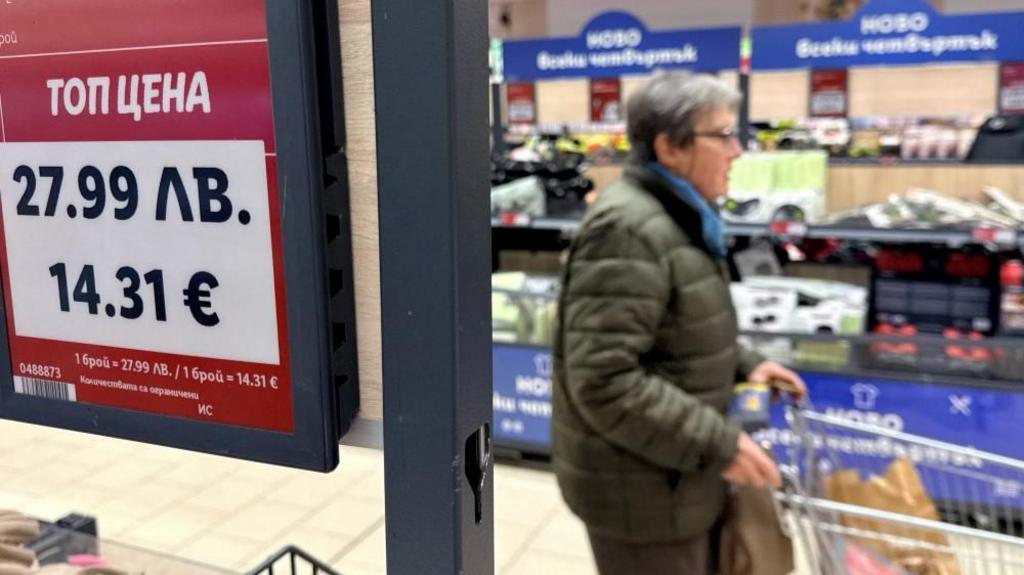
Since August 2025, all businesses in Bulgaria have been legally mandated to display prices in both currencies.
Notably, €1 is approximately equivalent to two lev (1.95583 to be precise). To address public concerns about potential price increases due to rounding, regulatory bodies have been established to safeguard consumers. Furthermore, some prices have been reduced, with the cost of public transportation in Sofia expected to decrease slightly.
The design on the reverse side of the new euro coins was carefully selected to assuage fears that Bulgaria is relinquishing its sovereignty. St. Ivan of Rila is featured on the €1 coin, while Paisius of Hilendar, an 18th-century monk and advocate of national revival, is depicted on the €2 coin.
The smaller denomination euro cents showcase an image of the Madara Rider, a symbol of early Bulgarian statehood, based on an 8th-century rock relief.
The potential impact of the new currency on Bulgaria as a whole is a matter of universal concern.
Lessons from other countries provide two possible scenarios: the successful “Baltic model” implemented by Estonia, Latvia, and Lithuania, which combined the euro with administrative reforms, investment incentives, and anti-corruption measures, and the “Italian model,” characterized by years of economic stagnation.
“I fear that we will resemble Italy more closely,” Ognian Enev predicted.
EU leaders said the loan would be repayable only when Russia paid reparations for the war.
EU leaders agreed to loan Ukraine €90bn to stay financially afloat for the next two years.
The EU is deciding whether to loan tens of billions of euros of Russian money to fund Ukraine’s military and economic needs.
Several years after it was scrapped, the UK is now set to rejoin the Erasmus scheme in 2027.
The UK left in December 2020 as part of the post-Brexit trade deal with the EU negotiated by Boris Johnson.
“`