

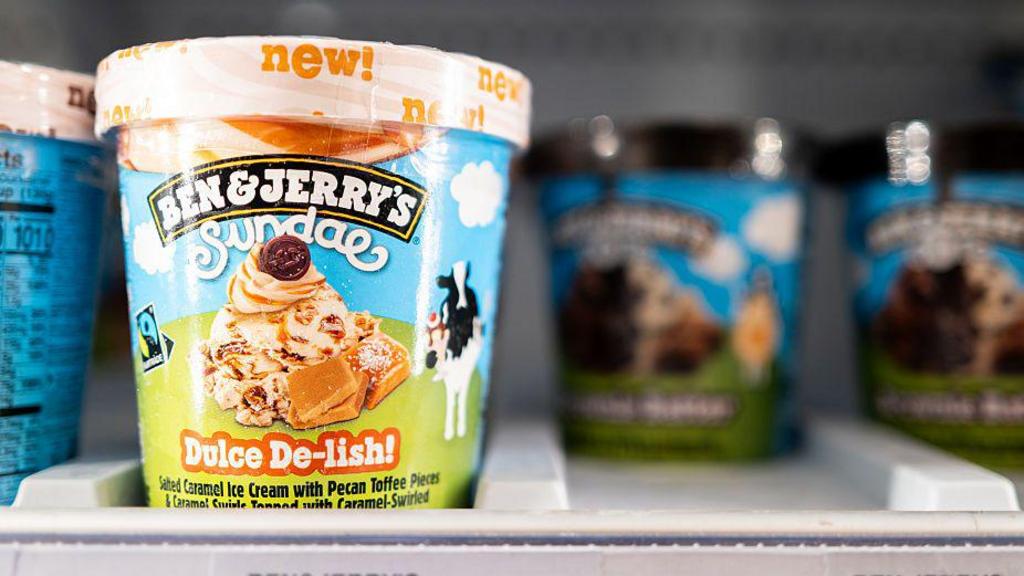
The former chairperson of Ben & Jerry’s has alleged that the company now owning the brand threatened a public smear campaign against her.
Anuradha Mittal, who served as chair of Ben & Jerry’s independent board for seven years, told the BBC that Magnum threatened to release “defamatory statements” about her unless she resigned from her position.
This stems from an escalating dispute between the Vermont-based ice cream maker, known for its activism, and its parent company regarding the board’s independence and its capacity to pursue its social initiatives.
Magnum stated that, following an investigation conducted by external advisors, it believed Mittal “no longer met the criteria to serve” on the board.
In a statement released Monday, Magnum outlined modifications to the board’s operational structure, including a nine-year term limit for its members.
In addition to Mittal, who reported receiving a letter informing her of her removal, two other board members will be required to step down.
The statement also noted that an audit of the Ben & Jerry’s Foundation, a charitable organization, “identified a series of material deficiencies in financial controls, governance, and other compliance policies, including conflicts of interest.”
Speaking to the BBC’s World Business Report, Mittal stated that friction between Ben & Jerry’s board and its owner had intensified over the brand’s independence, social mission, and integrity.
“For several years now, we have been resisting their overreach, including their efforts to muzzle us from speaking out for human rights, for peace,” she said.
The brand, also recognized for its creatively named flavors, was owned by Unilever until earlier this month, when the multinational consumer goods company spun off its ice cream division to create Magnum Ice Cream Company.
Ben & Jerry’s was acquired by Unilever in 2000 through an agreement that allowed it to maintain an independent board and the authority to make decisions regarding its social mission.
This arrangement frequently caused tension during Unilever’s ownership.
In 2021, Ben & Jerry’s refused to sell its products in areas occupied by Israel, leading to the sale of its Israeli operations by Unilever to a local licensee. In October, Ben Cohen stated that the company was prevented from launching an ice cream expressing “solidarity with Palestine.”
Magnum has now inherited this dispute, culminating in the recent standoff and Mittal’s removal.
“This October, Unilever-Magnum executives threatened me with defamatory statements in their forthcoming prospectus if I did not resign,” Mittal stated.
“At the same time, they offered me a prominent role in a multimillion dollar Unilever-funded non-profit if I gave in,” she added.
She stated that she declined the “inappropriate” offer.
Magnum is currently the world’s largest ice cream manufacturer, with brands including Cornetto, Wall’s, and Carte D’Or.
Mittal, the founder of the Oakland Institute, a California-based think tank focused on human rights and development, characterized Magnum’s approach as a “public smear campaign” and asserted that the allegations were baseless.
Jerry Greenfield, one of the company’s original founders, departed in September, citing concerns that its social mission was being stifled. The other founder, Ben Cohen, has also criticized Magnum, stating that it was “not fit” to own the company.
In a statement, a spokesperson for Magnum said the steps it had taken were aimed at strengthening corporate governance and to “reaffirm the responsibilities of the Board of Ben & Jerry’s”.
“These actions aim to preserve and enhance the brand’s historical social mission and safeguard its essential integrity,” a spokesperson said.
When Ben & Jerry’s was established in 1978, it gained recognition for selling flavors such as Cherry Garcia, named after the guitarist from the rock band Grateful Dead, Bohemian Raspberry, a play on the Queen track, and the now discontinued Vermonty Python.
Magnum stated in its announcement: “We remain unequivocally committed to Ben & Jerry’s three-part mission – product, economic and social – and its progressive, non-partisan values.”
“Ben & Jerry’s continues to advocate for a range of causes and be a bold voice for social justice, as a glance at its social media channels demonstrates.”
Some people loathed the bitter taste of Brussels sprouts as children. But the humble vegetable has been the subject of a decades-long breeding programme to banish the bitterness.
Why jars of kimchi and bottles of gochujang are turning Korean food into a UK staple.
An Egyptian snack, Icelandic pool culture, Cuban music and Albanian lahuta music also get recognition.
Nestle has used more vegetable oil in it recipes, meaning the treats no longer qualify as chocolate under UK law
The produce will be planted in 2026 with any surplus used for cooking workshops.