

Rumors of a significant prisoner release from Belarus had circulated in recent days.
However, the names and exact number of those to be freed remained undisclosed until their safe departure was confirmed.
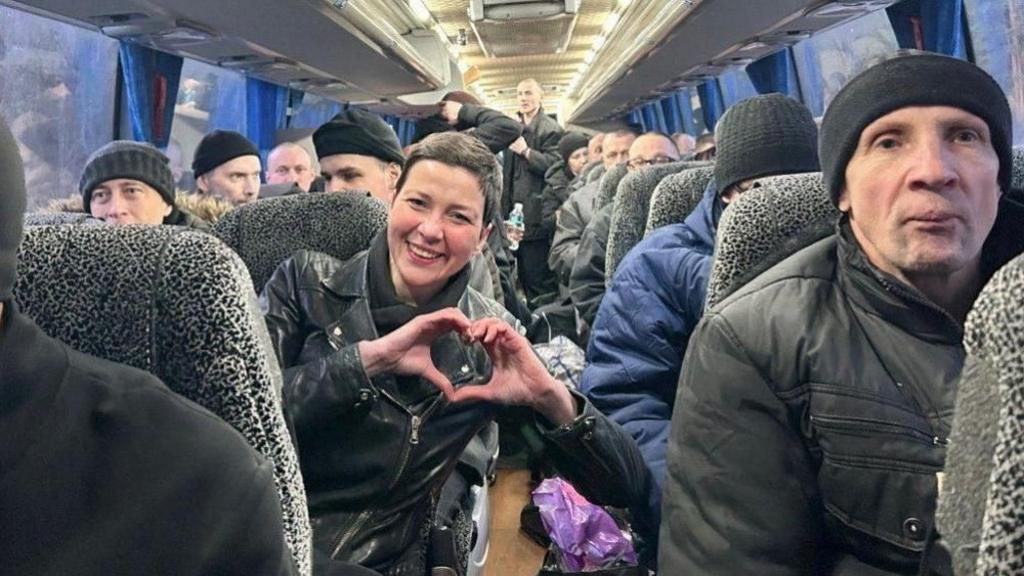
Ultimately, 123 political prisoners were released, including prominent Belarusian opposition figures, human rights advocates, and journalists.
Maria Kolesnikova, the protest leader known for her signature red lipstick, was among those released.
A video quickly spread across social media showing her joyfully embracing fellow former prisoners, celebrating their reunion. Subsequently, another video surfaced showing her on a bus leaving Belarus, expressing gratitude to those who facilitated their release.
“It’s an incredible feeling of happiness to see those who are dear to me, to hug them and realize we are all free,” Kolesnikova, known as Masha, conveyed to the camera, her lips already adorned with red lipstick.
She described the first sunset of her freedom as exceptionally beautiful.
“But I also think of those who are not yet free and I await the moment when we can all embrace, when all are free.”
Viktor Babaryka, a banker who attempted to run for president in 2020 but was imprisoned prior to the election, was also released.
Nobel Peace Prize laureate Ales Bialiatski has also been released from a 10-year sentence.
Each had been imprisoned for opposing the authoritarian rule of Alexander Lukashenko, whose security forces violently suppressed the widespread protests of 2020, which posed the greatest challenge to his authority to date.
The prisoners’ release is the culmination of intricate negotiations led by the U.S., marked by a two-day visit to Minsk this week by Donald Trump’s special envoy, John Coale.
For Lukashenko, this engagement is a victory, signaling a return to dialogue with the U.S. after years of political isolation in the West.
Furthermore, U.S. sanctions on potash, a crucial export for Belarus, were lifted as a tangible benefit. However, EU penalties and stricter policies remain in effect.
The U.S.’s motivations remain somewhat unclear. Given Belarus’s close alliance with Russia, particularly in the conflict in Ukraine, this move coincides with renewed U.S. engagement with Moscow in pursuit of a peace agreement.
It was expected that the released prisoners would arrive in Vilnius, Lithuania, where supporters gathered outside the U.S. embassy in anticipation.
Some attendees were draped in the red and white opposition flag of Belarus.
Tatsiana Khomich, Maria Kolesnikova’s sister, expressed elation, stating, “I’ve just spoken to Masha,” after a video call.
Kolesnikova, a professional flautist before the disputed 2020 elections, spent much of her sentence in solitary confinement, deprived of communication with her family.
“She’s fine, she’s good. I just want to hug her. I still can’t quite believe it,” her sister remarked.
A commotion ensued as a police car, lights flashing, approached the U.S. embassy gates, followed by a small convoy.
It was revealed that only seven foreign nationals and Ales Bialiatski were brought to Lithuania.
The remaining prisoners, including Kolesnikova, were transported to Ukraine, moving from incarceration to a war zone.
Remaining in Belarus was reportedly not an option.
The diversion to Ukraine was attributed to Lukashenko’s intervention, with one of opposition leader Svetlana Tikhanovskaya’s team interpreting it as a final power play delaying long-awaited family reunions.
However, the price for this moment remains a concern. Tikhanovskaya, a close ally of Kolesnikova, consistently advocates for increased Western pressure on Lukashenko.
This raises questions about whether the U.S. has conceded too much.
“This is a process of negotiation. Of course, it would be good for us if nothing is given to Lukashenko, because all those people are hostages of his regime. They are innocent.
“But this is how negotiation goes,” she replied, before noting that sanctions can always be reapplied if necessary.
“President Trump now uses carrots. He also can use sticks.”
A nearby protester expressed concern that Lukashenko would imprison more individuals, dismissing the release as a sign of genuine compassion.
After a brief period inside the U.S. embassy, Ales Bialiatski emerged to cheers from the crowd.
Visibly gaunt and wearing his prison jacket, he acknowledged the overwhelming emotions after four years in prison.
“I was driven across Belarus in a blindfold, from east to west, so I still can’t get my head round it. This is so emotional,” he shared, describing being woken at 04:00 and told by his prison guard to pack.
When asked about his immediate desires, he responded, “I want to see my wife!”
She’s on her way, I was told.
Bialiatski’s organization, Viasna, which monitors political detentions in Belarus, emphasized that many lesser-known individuals remain imprisoned.
“It is very important for everyone to continue to work for those political prisoners who are still in Belarusian prisons, to strive for the complete release of all of them.”
Lifting the red and white flag, he addressed Belarusians, delivering a message of optimism and activism: “Never give up!”
Julia Fenner was given a long jail term after being detained while entering Belarus in March 2024.
After his unexpected release, Sergei Tikhanovsky broke down describing his five years in solitary confinement
Sergei Tikhanovsky had planned to challenge Alexander Lukashenko in the 2020 election, but was detained before the vote.
Some receive threatening messages or phone-calls, others say their relatives are visited by authorities back home.
After an election win which has been widely criticised as illegitimate, Alexander Lukashenko faced questions from the BBC’s Russia editor Steve Rosenberg.