

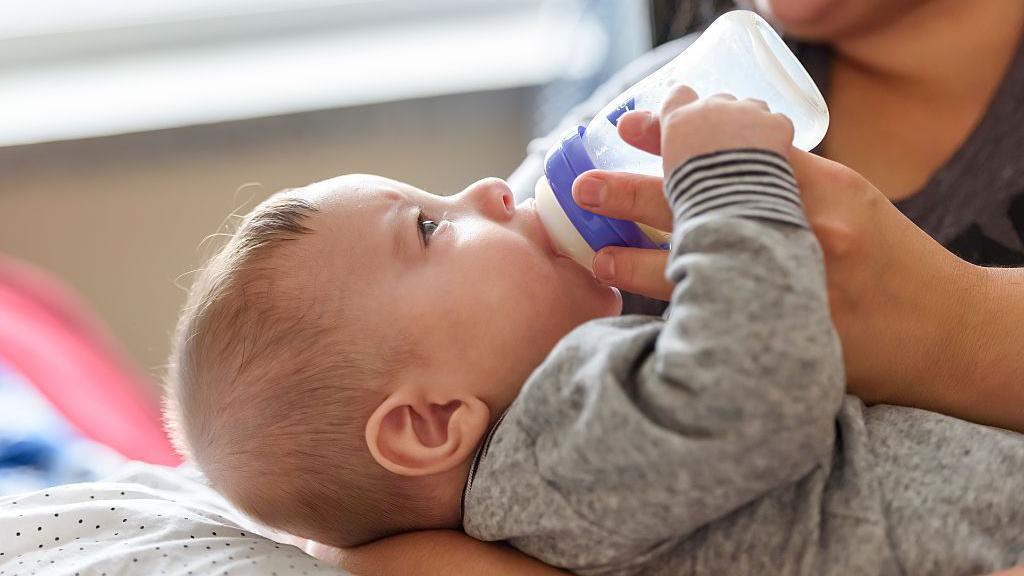
In a move to alleviate the financial burden on parents, the government has announced a plan to allow the purchase of infant formula in supermarkets using loyalty points and vouchers.
The cost of infant formula has seen a substantial increase in recent years, with the price of a standard tin now ranging between £12 and £15.
Alongside enabling parents to access discounts on infant formula, the government has committed to implementing proposals from the competition regulator to ensure consumers are not unduly influenced into buying more expensive brands.
The policy change aims to empower families to confidently choose more affordable options, which, according to government and consumer watchdogs, could save families who cannot or choose not to breastfeed up to £500 annually.
Concerns have been raised by charities that lower-income families were resorting to diluting formula or struggling to afford other essential items due to its high cost.
The new measures will provide parents with clearer guidance on the nutritional standards that all formula sold in the UK must meet, and encourage retailers to ensure they are adhered to.
Some retailers had previously pointed out that regulations prohibiting the direct or indirect advertising of infant formula made it impossible to offer discounts, and it was unclear whether loyalty schemes could be used for purchases.
The current regulatory framework treats baby formula similarly to tobacco and lottery tickets, banning promotions such as loyalty points or discounts.
This approach is intended to encourage breastfeeding, which the NHS promotes as healthier for children. However, the Competition and Markets Authority (CMA) noted in its interim report in February that this also hindered price competition among companies, inadvertently leading to higher costs for consumers.
The CMA report also highlighted significant price disparities between brands, estimating that families could save approximately £540 annually by opting for a less expensive formula.
The infant formula market is dominated by three companies: Danone, Kendal, and Nestle, which together account for approximately 90% of sales.
The CMA investigated the sector earlier this year, advocating for greater clarity for parents regarding the adherence of all products to nutritional standards. This would help prevent families from feeling pressured to purchase higher-cost brands out of concern for their baby’s well-being.
Announcing the changes during Prime Minister’s Questions on Wednesday, Sir Keir Starmer stated that parents had for too long “been pushed into spending more on infant formula than needed”.
“We will take action to give parents and carers the confidence to access infant formula at more affordable prices… with clearer guidance for retailers and by helping new parents use loyalty points and vouchers,” he said.
Sir Lindsay Hoyle, the Speaker, subsequently cautioned him for making a policy announcement at PMQs.
Health Secretary Wes Streeting commented that it was “not right” that manufacturers had been able to package their products in ways that took advantage of new parents who are concerned about what is best for their baby.
“These new measures mean parents will have confidence in the formula they are buying, no matter the price, and can now make the most of supermarket loyalty schemes too,” he said.
Shereen Fisher, director of the Baby Friendly Initiative at UNICEF, welcomed the move, emphasizing that infant formula was “a basic necessity”.
“For too long, families have faced inflated prices for this essential product. The CMA has shown that many formulas are vastly overpriced, with many families struggling as a result,” she noted.
“Today’s announcement signals the first step to tackle these issues, improve affordability and strengthen infant feeding support.”
The announcement was also applauded by infant feeding charity Feed.
Its chief executive, Clare Murphy, stated: “We are delighted to see clarification that there is no law preventing the use of vouchers and loyalty points in the purchase of infant formula, a ludicrous restriction that simply stigmatises and punishes families’ feeding decisions.”
Andrea Martinez-Inchausti, assistant director of food at the British Retail Consortium (BRC), described the government’s proposed next steps as sensible.
“We look forward to working through the detail with them to implement the necessary changes.”
Other recommendations from the CMA, which the government has agreed to adopt in principle, include ensuring all infant formula is displayed together, separate from other formula milks, and to clarify what counts as advertising.
The government stated that further action was required on other recommendations, including the prohibition of non-verifiable messages on infant and follow-on formula labels, and extending the restriction on advertising for follow-on formula.
A CMA spokesperson said the watchdog was ready to support governments and agencies across the UK in either implementing its recommendations or advising on measures that remained under consideration.
The authorities in all four devolved nations have agreed to the government’s response.
People were spending without telling their partners on beauty products, gambling, and cryptocurrencies.
As temperatures fall across much of the UK, the best ways to keep people and pets warm and dry.
As temperatures fall across much of the UK, how should you heat your home and keep yourself safe?
Professor Tim Draycott’s work improved the lives of countless babies.
The food bank’s plea for donations comes as figures showed rising demand across the West Midlands.