

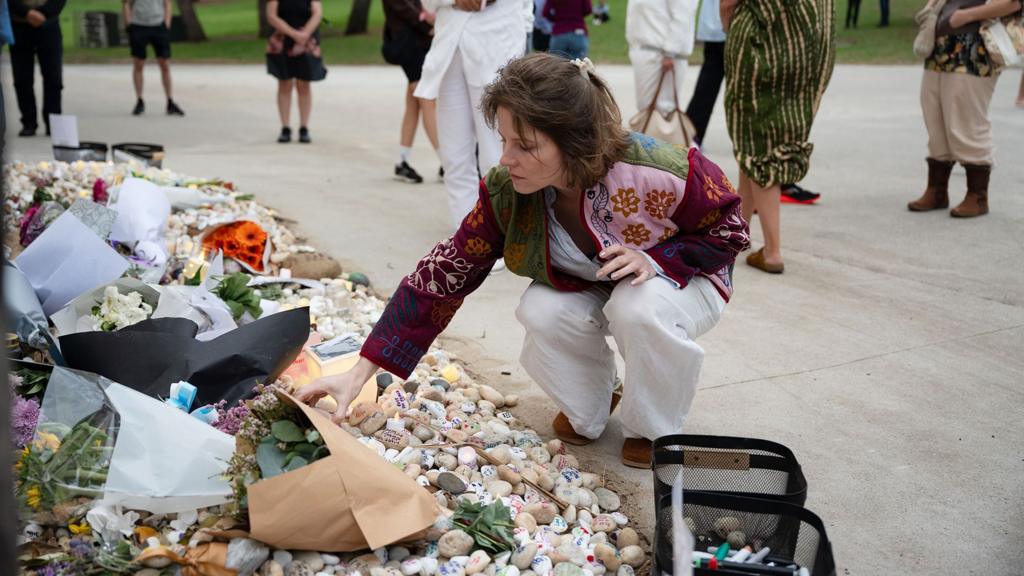
Thursday was designated as a day for Australians to commemorate the victims of the Bondi shootings that occurred last month.
The families of those who perished in the antisemitic attacks intended for it to be an opportunity to honor the deceased and promote compassion.
However, the day was overshadowed by a political dispute that led to the dissolution of the opposition coalition.
“One would have anticipated that they could have postponed this for 24 hours,” remarked veteran political analyst Malcolm Farr to the BBC.
“At the very least, the timing is unfortunate and indicative of a degree of self-indulgence.”
The conflict, which revolved around reforms initiated by the tragedy, threatens to undermine the standing of two leaders and jeopardize their parties’ electoral prospects, culminating in what many Australians perceive as a disappointing month in politics.
The recriminations commenced almost immediately after two gunmen opened fire at a Hanukkah celebration at Bondi Beach, resulting in the deaths of 15 individuals, including a 10-year-old child.
“The speed with which they [politicians] politicized it was astounding,” observed Kass Hill, 52, a Bondi resident. “The blame game is not conducive to solutions.”
While families were preparing to lay their loved ones to rest, a procession of politicians, including the opposition leader, visited the site to assign blame. Populist figures arrived to denounce immigration, while prominent business figures made appearances to pose with floral tributes.
Prime Minister Anthony Albanese, who faced accusations from many Jewish Australians of neglecting their concerns prior to the attack, spent the ensuing weeks rejecting calls from within the community for a national inquiry into antisemitism.
He was met with public heckling on multiple occasions, arriving at a memorial to a chorus of boos and cries of “You’re not welcome.” One individual exclaimed, “You might as well go to a jihadist nation where you can fit in.” Above the crowd, a large screen displayed the words “a night of unity.”
Albanese, criticized for being overly defensive and unresponsive, has in turn accused his parliamentary adversaries of “playing politics” with the tragedy.
The Bondi attack on December 14 marked Australia’s deadliest mass shooting since the Port Arthur massacre in 1996, which claimed 35 lives; however, the responses to the two tragedies have differed significantly.
In the aftermath of the Port Arthur shooting, then-Prime Minister John Howard visited the site in Tasmania to lay wreaths alongside opposition leaders, who subsequently united to assist him in enacting firearms legislation that positioned Australia as a global leader in gun control.
“Australian society and politics are markedly different from what they were 30 years ago, and we are now a far more polarized society,” stated John Warhurst, an emeritus professor of political science at the Australian National University.
According to Mark Kenny, a political columnist and host of the Democracy Sausage podcast, a number of factors have contributed to the divisive nature of this attack compared to Port Arthur, including the already contentious debate surrounding Israel, Gaza, and antisemitism in Australia.
“When this event entered the equation, I believe it was immediately politicized,” he told the BBC.
Since the October 7, 2023, attack on Israel by Hamas and the subsequent protests in Australia against Israel’s war in Gaza, Albanese has consistently faced accusations of failing to adequately address antisemitism. The Executive Council of Australian Jewry reports that antisemitic incidents have risen from an average of 342 prior to the October 7 attacks in 2023 to 1,654 last year.
Similarly, he has been accused of not doing enough to condemn Israel’s actions in Gaza, which UN experts have described as genocide, an allegation that Israel denies.
Hours after the Bondi shooting, the antisemitism commissioner appointed by Albanese linked it to the pro-Palestinian protests that have been regularly held in Sydney and which Jewish leaders have lobbied against.
“It began on 9 October 2023 at the Sydney Opera House,” Jillian Segal stated. “Now death has reached Bondi Beach.”
Investigators have stated there is no link between the alleged gunmen and the pro-Palestinian movement, instead alleging the pair were inspired by the jihadist group Islamic State, with the younger of the father-son duo on intelligence agencies’ radars for a period in 2019.
As was the case after Port Arthur, gun reform was the first item on the legislative agenda following the Bondi attack.
“We know that one of these terrorists held a firearm licence and had six guns, in spite of living in the middle of Sydney’s suburbs… There’s no reason why someone in that situation needed that many guns,” Albanese said as he announced a suite of changes in the following days.
Unlike Port Arthur, when the measures were broadly popular, Albanese’s focus on gun laws was immediately attacked by the Liberal opposition and parts of the Jewish community as a distraction from what they view as the real cause of the attack – antisemitism. Even Howard, the architect of the 1996 reforms, came out to suggest they were an “attempted diversion”.
“That kind of ‘either or ism’ is a feature about politics these days probably everywhere in the West. Everything becomes supercharged and divisive,” says Kenny.
“There’s just this fundamental lack of trust that’s almost like we’re in the grip of a toxic cynicism that means that motives of political leaders… the first instinct is to question them, to regard them as disingenuous.”
The recent decision by a festival in Adelaide to disinvite a Palestinian-Australian author – leading ultimately to the collapse of the entire writers’ week portion of the event – due to “sensitivities” after Bondi and her “past statements” is also a sign of how tense the current circumstances are, adds Kenny.
In the days following the attack, there were strong calls for immediate action on antisemitism, and Albanese swiftly announced a crackdown on hate speech, supported by the antisemitism commissioner.
However, some critics argued that the measures would infringe upon free speech, including the right to criticize Israel, and on protest, while others contended that they did not go far enough in protecting other minorities.
“[It’s] a can of worms,” says Warhurst, noting that there has never been “an easy agreement on finding where that balance lies” between free speech and hate speech.
“Now is the worst time, I think, to be trying to resolve those sorts of issues because you are doing it fairly quickly and you’re doing it in a heated environment.”
While the hate speech laws were supported by the Jewish community, many felt that they were insufficient. Several of the victims’ families urged Albanese to convene a royal commission, Australia’s most powerful form of independent inquiry.
For weeks, Albanese maintained that the measures already announced were adequate and that a royal commission would be an inappropriate tool for investigating the events. He argued that it could provide a platform for antisemites.
Albanese pointed out that royal commissions had not been launched into previous tragedies like Port Arthur, comments which were widely dismissed. Promised reviews of intelligence agencies and law enforcement similarly did nothing to dissuade those calling for the inquiry.
Their pleas were echoed by a coordinated letter-writing campaign that was featured on the front pages of right-wing newspapers. ”I don’t think it’s controversial to say that the News Limited and other parts of the media were certainly stirring the pot,” says Warhurst.
Albanese’s arguments against a royal commission were “really hard to make in these circumstances”, says Kenny, and it backfired on him when he was ultimately forced to reverse course on the issue.
Analysts have also suggested his reluctance may have been down to fears it could become complex, controversial and divisive. It could invite discussion of the war in Gaza, while potentially excluding examination of Islamophobia – which exploded after Bondi, with The Islamophobia Register Australia recording a 740% rise in incidents by early January – when many Labor MPs have large Muslim electorates.
There was likely also a “reluctance to cave to the opposition”, Farr believes: opposition leader Sussan Ley had vociferously demanded the royal commission, asking what Albanese was “hiding”, and revelled in his backflip.
It is fair to say that, before December’s attack, Ley had been struggling to land a punch on the government and assert authority over her own party. In the weeks before the shooting, some pundits were even predicting her imminent ousting.
“The Bondi attacks offered her an opportunity to prosecute a very strong case against the government,” says Kenny.
But any momentum she gained over the royal commission collapsed this week when she failed to rally her Coalition behind the very hate speech laws she had so loudly demanded Albanese quickly implement.
By Thursday – the national day of mourning for the Bondi attacks – things had fallen apart.
The National Party announced they were leaving the coalition, having refused to vote for the legislation despite a shadow cabinet agreement. They, despite earlier calls for haste, said they had not been given enough time to examine the proposals which they said could threaten free speech.
On his way out the door, Nationals leader David Littleproud suggested the only way his party would consider returning to the fold was if Ley was dumped, leaving her already shaky leadership hanging by a thread.
“I’m quite sure there are people… who are polishing their shoes and tightening the knot on their ties to step forward should that vacancy occur or be forced,” says Farr.
However, Littleproud’s bold ultimatum could be an overstep which costs him his own job, with mutterings that Liberals wouldn’t accept him as a leader in any future coalition either.
But then, it seems all of Australia’s politicians may be on shakier ground.
The posturing of the main parties over the past month has left a bitter taste in the mouths of many Australians. In a poll released earlier this week, Albanese’s net approval rating had plunged to minus 11 from his previous score of zero in November, while Ley’s approval rating – never high – barely budged at minus 28.
The repeated calls for unity by politicians who simultaneously fail to heed their own statements will not have gone unnoticed, and Thursday’s display of political infighting is unlikely to improve the fortunes of any party, says Farr.
“It will reinforce the view of so many Australians who already are cynical about what politicians, no matter their party, actually represent and will reinforce the belief that politicians, MPs, just stand for themselves rather than the national good.”