

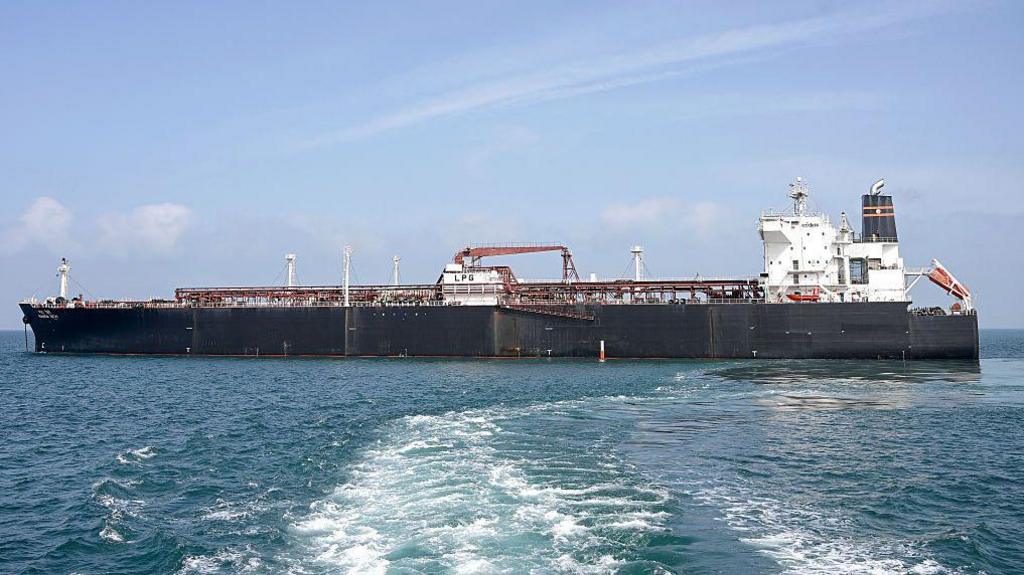
On Monday, former U.S. President Donald Trump asserted that he could “take out” Iran “in one night” should it fail to agree to reopen the Strait of Hormuz by 8:00 PM Washington D.C. time on Tuesday (00:00 GMT Wednesday).
Prior to this latest threat, however, several nations had already secured agreements with Tehran for the safe passage of their vessels through the vital shipping lane.
Asian countries, most recently the Philippines, have been particularly proactive in reaching such agreements, given their economies’ significant reliance on energy resources from the Gulf region.
The Strait has become a global focal point after Tehran responded to alleged U.S. and Israeli airstrikes by threatening to target ships traversing the waterway.
Oil prices have risen sharply due to the disruption of shipping in the narrow strait, which typically facilitates approximately one-fifth of the world’s energy shipments.
Last week, Mr. Trump stated that the U.S. does not require oil from the Gulf, and he has repeatedly called on countries dependent on the region’s energy to deploy warships to the strait and assume responsibility for ensuring the resumption of shipments.
In recent weeks, several Asian nations, including Pakistan, India, and the Philippines, have entered into agreements with Tehran to allow certain vessels to pass safely through the strait. China has also acknowledged that its vessels have utilized the channel.
Questions persist regarding the extent of these assurances and the potential longevity of these agreements with Iran.
“It remains unclear whether these guarantees apply solely to specific ships or to all vessels flagged under a particular country,” noted Dimitris Maniatis of shipping consultancy Marisks.
However, Roc Shi from the University of Technology Sydney observes that countries reliant on Gulf energy are now recognizing the necessity of engaging with Iran to resume shipments.
The Philippines is the most recent nation to secure such an agreement with Iran.
Iranian officials have assured “safe, unhindered, and expeditious passage” for Philippines-flagged ships through the waterway, according to Theresa Lazaro, the South East Asian country’s foreign affairs secretary.
She stated that the agreement, reached following “a very productive phone conversation” with Tehran on Thursday, is “vital” in ensuring the supply of energy and fertilizers.
The Philippines imports 98% of its oil from the Middle East and was the first country to declare a national energy emergency after domestic petrol prices more than doubled following the onset of the conflict.
Roger Fouquet from the National University of Singapore’s Energy Studies Institute notes continued uncertainty regarding Tehran’s claim that the strait remains open to all countries except the U.S. and its allies.
He suggests that the Philippines, often considered a U.S. ally, presents an interesting case, potentially indicating Iran’s willingness to “compartmentalize.”
“Iran appears to be distinguishing between a country’s alliance and its active participation in the conflict,” Mr. Fouquet stated.
Other nations have also engaged in discussions with Iran.
On March 28, Pakistan announced that Iran had agreed to permit 20 of its ships to pass through the Strait of Hormuz.
“This is a welcome and constructive gesture by Iran and deserves appreciation,” stated Pakistani Foreign Minister Ishaq Dar. “Dialogue, diplomacy, and such confidence-building measures are the only way forward.”
Iran has publicly welcomed the passage of India-flagged ships through the strait.
“Our Indian friends are in safe hands, no worries,” the Iranian Embassy in India posted on X last week.
This statement was in response to a post by Iranian Embassy offices in South Africa asserting that “only Iran and Oman” would determine the future of the Strait of Hormuz.
India’s Foreign Minister Subrahmanyam Jaishankar told the Financial Times in March that the passage of its tankers was a result of diplomatic efforts.
China, the largest purchaser of Iranian oil, confirmed last week that some of its ships had transited the strait, although it did not reference Iran or provide specific details regarding the vessels involved.
“Following coordination with relevant parties, three Chinese vessels recently transited the Strait of Hormuz. We express our gratitude to the relevant parties for the assistance provided,” a foreign ministry spokeswoman told reporters.
Vessel-tracking data indicate that, despite the conflict, millions of barrels of U.S.-sanctioned Iranian oil have been delivered to China in recent weeks.
Beijing maintains cordial diplomatic relations with Tehran and has joined Pakistan in endeavors to mediate a ceasefire between the U.S. and Iran.
The precise conditions under which certain ships have negotiated safe passage, including whether tolls were paid, remain unclear.
Over the weekend, a Japanese vessel transporting liquefied natural gas passed through the Strait of Hormuz, shipping firm Mitsui OSK Lines confirmed to the BBC.
“The safety of the vessel and all crew members has been confirmed,” the company stated, without commenting on potential tolls or the means by which safe passage was secured.
In March, Malaysia also reported that some of its tankers had been cleared by Tehran to transit the strait, with Prime Minister Anwar Ibrahim expressing gratitude to Iran’s president for facilitating the passage of these vessels.
Anthony Loke, Malaysia’s transport minister, attributed this to “good diplomatic relationship with the Iranian government,” according to local media reports.
It is uncertain whether other Malaysian-flagged vessels will receive similar assurances.
Roughly two-thirds of Malaysia’s oil imports originate from the Gulf region.
The implications of these agreements for other countries remain uncertain. For example, whether other countries might switch their flags to those of countries being allowed to pass through.
Maniatis noted that many tankers currently fly the flags of countries like Panama and the Marshall Islands, which have not secured assurances of safe passage.
Energy economist Shi acknowledged that while these agreements represent a “diplomatic breakthrough,” they do not constitute a comprehensive resolution to the underlying issues.
The long-term viability of these assurances and the potential impact of ongoing military operations in the region remain uncertain, he stated.
India’s currency, stocks and growth projections take a beating as the country faces a triple energy shock due to Iran war.
Almost nothing was known about the Royal Hill casino until the Thai military took control of it in December.
The US president wants Tehran to reopen the Strait of Hormuz, a critical global energy route, before his Tuesday deadline.
The operation to extract him from the ground in hostile territory was hugely complex and involved multiple US government agencies.
Ordinary Iranians respond to the US president’s threat to destroy Iran’s power plants and bridges unless it opens the Strait of Hormuz.