

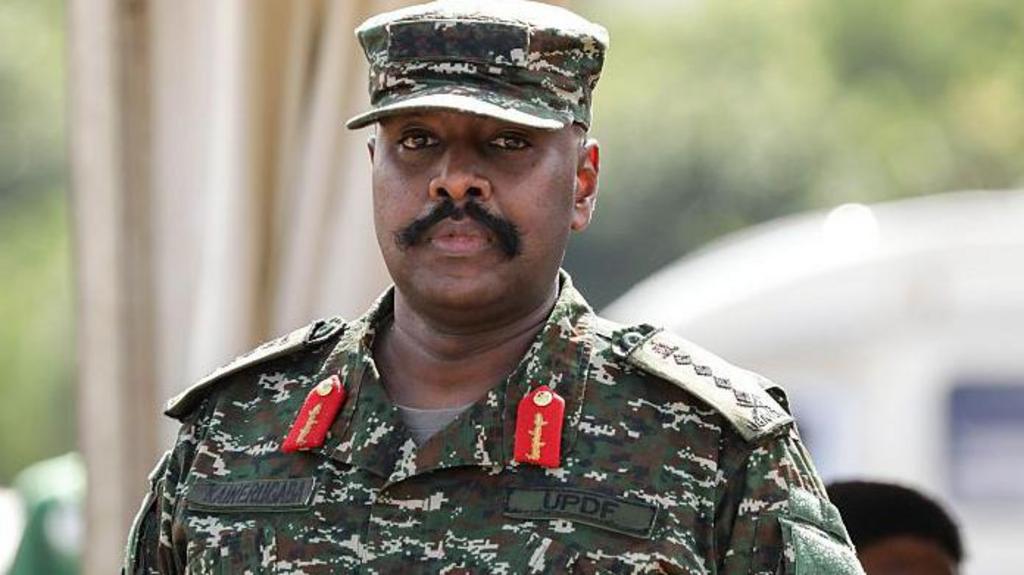
Gen. Muhoozi Kainerugaba, a vocal figure on X and a prominent figure in Uganda’s military, is viewed by critics as a key member of what they describe as an “unholy trinity” dominating the East African nation.
Kainerugaba, son of long-serving President Yoweri Museveni, has stirred controversy with his posts on X regarding the suppression of opposition during the recent, hotly contested presidential election.
In since-deleted posts, he also issued threats against opposition candidate Bobi Wine, including a disturbing reference to removing his testicles.
With President Museveni, 81, securing a seventh term in office, analysts suggest this is likely his last, with a succession plan potentially in place to elevate his 51-year-old son.
This “unholy alliance” – a satirical take on the Christian Holy Trinity – reportedly comprises President Museveni, Gen. Kainerugaba, and the president’s brother, Salim Saleh, a powerful advisor.
Nicodemus Minde, a Kenya-based analyst at the Institute for Security Studies, shared with the BBC that he encountered this description during a recent research trip to Uganda.
“The Father being Museveni, then the Son being Muhoozi, then the Unholy Spirit could be the uncle, Salim Saleh,” he explained.
Minde characterized Saleh as a “power behind the scenes,” highlighting his influence in “money, business, and access.”
Opposition voices accuse the Museveni family of operating under the belief that they possess a divine right to rule Uganda, a notion reinforced by Museveni’s extended 40-year tenure, solidified by a recent election win with over 70% of the vote.
Notably, Anita Among, speaker of the previous parliament, invoked the Holy Trinity analogy last year, urging voters to support Museveni.
“We believe in God the Father – and God the Father is President Museveni. God the Son is MK [Muhoozi Kainerugaba], and now you [the voters] are the Holy Spirit. Therefore, vote for them,” she stated, drawing considerable criticism.
Wine, securing just 24% of the vote, denounced the results as “fake,” citing widespread “ballot-stuffing” as the reason for Museveni’s victory.
This accusation drew the ire of Kainerugaba, who threatened Wine, demanding he “surrender himself to the police” within “exactly 48 hours.”
“If he doesn’t we will treat him as an outlaw/rebel and handle him accordingly,” he wrote.
These tweets, along with the one threatening Wine’s testicles, have since been deleted.
Wine, who went into hiding after a raid on his residence following the election, subsequently challenged the general on X, including a screenshot of some of the deleted tweets – to which Kainerugaba responded with: “Boo hoo hoo Mr. 24%.”
Another tweet stating Wine was wanted “dead or alive” remains on his feed, despite a government minister stating the opposition leader is free to conduct his activities.
The army chief later accused the U.S. of assisting Wine’s escape and announced the suspension of all military cooperation between the two nations.
On Friday, he issued an apology, stating he had received “wrong information.”
Subsequently, he announced “I intend to reduce my interactions” on the social media platform. Last year, he declared he would leave X, only to return after a few days.
Kainerugaba has a track record of controversial posts, many later deleted, earning him the moniker “tweeting general.”
He has also used religious rhetoric to promote his political ambitions.
“I fear no one on this planet because my bloodline is from Jesus Christ,” he posted earlier this month. This tweet was also deleted.
A long-time friend of the general, speaking anonymously, describes him as “incredibly loyal,” comparing his posting style to that of former U.S. President Donald Trump.
“He might be Trumpian, but that’s him expressing himself,” the friend told the BBC.
He stated “it is wrong to try to understand him from the tweets that he posts,” adding that Kainerugaba is “a man of complex character.”
Minde describes the general’s posts as often “wild,” but contends that many comments become more understandable when viewed within the context of Uganda’s succession politics – particularly Kainerugaba’s efforts to position himself as his father’s successor.
“He probably wants to endear himself to his father,” Minde told the BBC, adding that some posts are deliberate “provocations.”
He argues that Kainerugaba’s statements do little to gain public favor.
Kainerugaba’s friend, however, told the BBC that the general would be an “incredible successor” to his father.
He emphasized that Uganda is a post-conflict country where security is paramount.
“This is our number-one priority, to make sure that you are peaceful and stable and [Kainerugaba] is very experienced in that sphere. He’s been doing this all his life,” he added.
However, some of his posts could strain international relations if taken literally.
In 2022, he threatened to invade neighboring Kenya, provoking a backlash from Kenyans who criticized his “reckless” comments.
He responded by urging them to “relax,” but as the situation escalated, Museveni was compelled to phone his Kenyan counterpart, William Ruto, to apologize for his son’s “mistake.”
Kainerugaba has previously dismissed some of his remarks as “musings” and “abstractions” that should not be taken seriously.
Uganda-based security analyst Freddie David Egesa observes that the military chief “enjoys having that kind of vibe.”
“He sometimes likes joking around it,” Egesa stated.
Kainerugaba’s friend portrays the general as “a kind, generous, intensely smart person who spends all his time thinking about the peace and security of this country.”
He adds that the general executes his responsibilities to the best of his abilities.
“And that’s why he serves in the role that he serves.”
Critics contend that Kainerugaba has tolerated little opposition, acting decisively against anyone perceived as a threat to his father’s administration.
By the general’s own admission on X, at least 30 people were killed and 2,000 others detained by security officers following the recent elections.
Prior to the polls, opposition rallies were disrupted, with security forces occasionally opening fire. The United Nations stated that the election was held in an “environment marked by widespread repression and intimidation against the political opposition.”
Kainerugaba played a role in the four-day internet blackout that lasted until after the elections, according to Reuters news agency, quoting Andrew Mwenda, a Ugandan political commentator and close ally of the general.
The internet remained partially restricted afterward, but on Monday, Kainerugaba posted that access to all social media platforms was being restored.
“We are releasing all social media today,” he wrote.
On the same day, he took to X to deny that his soldiers had beaten up Bobi Wine’s wife, Barbara Kyagulanyi.
She had alleged from her hospital bed on Saturday that military officers had assaulted her overnight as they searched for her husband.
According to Minde, Kainerugaba’s actions appear driven by loyalty or a desire to protect Museveni’s administration. The general’s first name, Muhoozi, means avenger.
“I named him Muhoozi, which means vengeance, such that when someone wrongs me, he avenges,” Museveni once explained.
Kainerugaba, born in 1974, grew up in exile in Tanzania, Kenya, and Sweden before his father seized power in 1986 after overthrowing the regime of Milton Obote.
He joined the military in 1999, enrolled at the UK’s elite Sandhurst military academy, and graduated the following year. He is married with several children.
He rose rapidly through the military ranks shortly after joining, reaching the rank of lieutenant-general ten years later. He was promoted to a full general in 2022.
He played a critical role in the formation of the Special Forces Command (SFC), an elite military unit responsible for his father’s security.
The SFC has been accused of involvement in abductions and torture of opposition members. It has denied the allegations, but some officers have been convicted of abusing their power.
The most prominent case was that of a 32-year-old SFC soldier court-martialled and sentenced to death in 2024 for shooting dead three people and injuring two others, including a one-year-old child.
And after a bodyguard of Wine, Edward Sebuufu went missing last May, Kainerugaba revealed on X that he was in detention “in my basement,” sparking a social media storm after publishing a photo of him appearing half-naked and with his beard shaved off.
As with Wine, he threatened to castrate Sebuufu.
Wine has alleged that members of the SFC, as well as the military, were behind a raid on his home the day after the election.
The unit is viewed as a shadow army that has helped Museveni, along with his growing family dynasty, to consolidate power.
The latest addition to the political dynasty is Kainerugaba’s son, Ruhamya, who has joined the army – seen as the first step to acquiring power in Uganda.
In the years to come, the composition of the trinity could shift, with Kainerugaba as the Father, Ruhamya as the Son, and another family patriarch succeeding Saleh as the Spirit.
Go to BBCAfrica.com for more news from the African continent.
Follow us on Twitter @BBCAfrica, on Facebook at BBC Africa or on Instagram at bbcafrica
Prosecutors say Mamadou Hawa Gassama described Alassane Ouattara as a “tyrant” and “an enemy of Mali”.
Niger’s defence ministry said four military personnel were injured and 20 attackers killed in the incident.
South Africa accuses the Israeli envoy of insulting President Ramaphosa. Israel says the expulsion is “baseless”.
The multiparty system had been “promoting division among citizens”, the country’s interior minister said.
Almost 30 years after he died, the Nigerian will posthumously receive a Lifetime Achievement Award.